

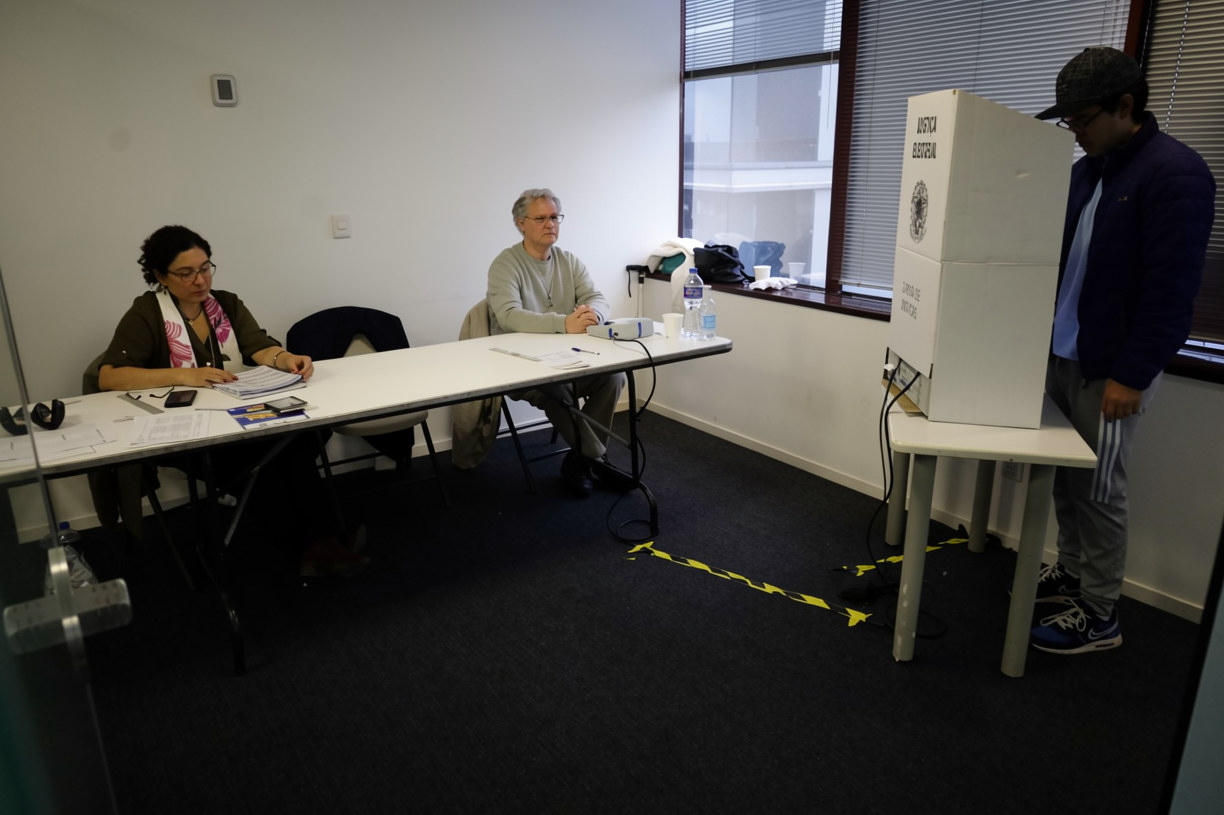
A people that freely chooses its leaders gives itself the means to build its future. A people that is long deprived of its right to vote sees its sovereignty compromised and its institutions shaken.
Democracy is not just a political speech. It is lived through citizen participation, regular elections, alternation, and respect for the popular will. When elections are free, transparent, inclusive, and regular, they establish the legitimacy of governors, institutional continuity, and political stability.
Three examples deserve our attention.
The United States: Continuity Through the Ballot
On November 5, 2024, Americans elected their president and renewed part of Congress. Beyond personalities and partisan differences, what matters is the ability of institutions to organize the vote, count the ballots, and ensure the transfer of power according to established rules. This regularity gives citizens the opportunity to sanction or reward their leaders.
While elections are certainly not enough to guarantee development, an effective administration, an independent judiciary, and responsible management of resources are also required. But without regular mechanisms of political accountability, building a stable state becomes much more difficult.
The Dominican Republic: A Lesson in Proximity
On the island we share, Dominicans went to the polls on May 19, 2024, to elect their president, senators, and deputies. It would be excessive to attribute their development solely to elections: investments, infrastructure, education, and tourism also contribute. Nevertheless, electoral regularity fosters a predictable political environment for both citizens and economic actors.
A question arises: why does a neighboring country manage to renew its leaders regularly while Haiti struggles to restore the normal functioning of its elected institutions?
This question should not provoke blind admiration or an inferiority complex. It should compel us to examine our own shortcomings.
Brazil: The Strength of Popular Sovereignty
This Sunday, October 25, 2026, Luiz Inácio Lula da Silva won the second round of the presidential election against Flávio Bolsonaro.
According to the Superior Electoral Court, he received 51.79% of the votes cast (64,256,232 votes) compared to 48.21% (59,826,041 votes) for his opponent. He will begin a fourth term on January 5, 2027.
Beyond the victory of one man or one camp, this election reminds us that in a democracy, power is no one's private property. It belongs to the people, who renew their trust or choose alternation according to constitutional rules. Competition can be intense and campaigns contentious, but institutions must allow the citizens' choice to be expressed and to have its effects.
While Brazilians open a new chapter, a painful question arises for us: why does our people continue to face such a long interruption of the electoral process?
Haiti: A Democracy Deprived of Electoral Meetings
The last Haitian presidential election took place on November 20, 2016. Since then, parliamentary mandates have expired, President Jovenel Moïse was assassinated on July 7, 2021, and the country is sinking into a deep political and security crisis. The mechanisms of democratic control have been significantly weakened.
It must be acknowledged that widespread insecurity, the grip of armed groups over certain territories, logistical difficulties, and political disagreements are real obstacles. We cannot reduce this crisis to a collective will to reject democracy. But these difficulties cannot justify an indefinite suspension of popular sovereignty. They must compel authorities, political actors, and the active forces of the nation to seek concrete solutions: restore security, make polling places accessible, strengthen trust in electoral institutions, and guarantee the participation of all.
The Haitian people must not remain indefinitely spectators of their own destiny.
The Cost of the Absence of Elections
Without elections, the legitimacy of institutions weakens, leaders are less accountable to citizens, and uncertainty discourages businesses and investors. Added to this are, in Haiti, organized crime, corruption, forced displacements, the degradation of public services, and the despair of youth seeking security and dignity elsewhere.
It would be inaccurate to claim that the absence of elections solely explains these ills: armed violence, inequalities, weak justice, and poor governance have their own root causes. But restoring elected, accountable, and functional institutions remains a key element of any sustainable recovery.
And democracy is not limited to organizing votes. It requires respect for results, independence of the judiciary, freedom of expression, transparency in public management, and the opportunity for everyone to hold their leaders accountable.
Haitian Youth: Let’s Demand Results
Elections must not serve the ambitions of a few or allow a political class to share power. They must serve the people, the common good, and national development.
To you, the youth of Haiti, essential force of the future, I call upon you: do not resign yourself to political exclusion or the trivialization of anarchy. Demand credible elections, but also require from candidates serious programs, a national vision, verifiable integrity, and a concrete commitment to security, education, employment, social justice, and the modernization of the state.
Let us not confuse democracy with mere electoral competition: an election without transparency, without security, and without respect for results is not enough. Let us not confuse stability with imposed silence, nor public order with the absence of freedom. Let us refuse resignation, but also the cult of personalities and short-sighted calculations. Let us promote a new political culture based on competence, integrity, and a sense of the common good.
Conclusion: A Choice of National Responsibility
Haiti does not live in a vacuum. The American, Dominican, and Brazilian experiences remind us that regular elections allow for the renewal of power, the organization of alternation, and the preservation of state continuity. We must learn from these lessons without copying them blindly and build a democracy adapted to our reality, based on solid institutions, credible justice, and effective citizen participation.
Between democracy and anarchy, the question is what kind of society we want to leave to future generations. Do we want a country where power rests on force, uncertainty, and private interests, or a Republic where citizens choose their leaders, control their actions, and defend the common good?
Youth of Haiti, let us choose democracy, demand transparency, and work together for the reconstruction of our Republic. Because sustainable progress requires legitimate institutions, stability demands accountability, and democracy begins with respect for the will of the people.
Haiti first. Democracy as a path, law as a compass, and the common good as a destination.
