

Obtaining a diploma from experience is the most visible outcome of the validation of acquired experience (VAE). But the system can also educate, change the way a person views their journey, and force institutions to rethink their practices. Provided these functions do not contradict each other.<\/strong><\/i><\/p> Why would a professional who has been practicing their job for years want to have officially recognized what they already know how to do? Behind a diploma request are various expectations: obtaining a qualification corresponding to the responsibilities exercised, resuming studies without starting over, establishing legitimacy, accessing a promotion that has previously been blocked due to lack of a title. The diploma is sought after for itself, but also for what it is supposed to enable.<\/p> In my thesis dedicated to Haitian higher education (Boursiquot, 2014), respondents primarily associated the VAE with the possibility of "avoiding starting from scratch" and the opportunity to "evolve", followed by time savings. These results describe expectations, not measured effects: they articulate what stakeholders hoped for from a still-developing system.<\/p> Five functions, not just one<\/strong><\/p> The certifying function remains central. Bourdieu (1979) demonstrated this: the educational title separates "statutorily recognized and guaranteed competence" from "simple cultural capital, constantly required to prove itself". The VAE precisely works on this boundary.<\/p> But the approach is also formative: to compile their file, the candidate must analyze their activity, explain their choices, and identify their limits. It is identity-forming: by reflecting on their journey, they discover competencies they considered ordinary and can, at the end of the process, speak about themselves based on what they can do rather than the positions they have held (Ansart, Sanséau, and Lefort, 2010). It is professional when a certification makes a profile more comprehensible for an employer: in France, Gehin and Palheta (2012) observe that, in integrating young individuals who left without a diploma, the educational title counts more than the qualification because it serves as a "signal" to employers. Finally, it is organizational when a university or a company must review its assessment or skill management practices.<\/p> These five functions are neither mandatory steps nor guaranteed results. A process may fulfill some without producing the others.<\/p> Unforeseen effects<\/strong><\/p> In Portugal, Carmen Cavaco (2013) studied adults certified through this pathway. The conclusion is clear: their new qualification hardly changed their professional situation, and according to a national evaluation she cites, 66% of certified adults reported that their company did not recognize it. Nevertheless, these same adults reported effects that public policies had not anticipated: self-confidence, self-esteem, and new learnings. The expected professional integration and mobility did not materialize; the formative effects, however, were indeed present.<\/p> This lesson applies to Haiti: it is crucial to distinguish what stakeholders seek, what they experience during the process, and what actually changes in their journey.<\/p> What benefits one may hinder another<\/strong><\/p> The VAE connects candidates, advisors, universities, and employers whose interests do not always align. Pascal Lafont (2009) sees it as a "multipolar transaction," where each party acts according to their culture, values, and interests.<\/p> My doctoral research provides a concrete example. The dean of a faculty of education affiliated with a private university explained it candidly: "Instead of taking 45 courses, the student will only have to take 30 because 15 of those courses will have been validated. They will not have to pay the same amount as a new bachelor." What represents a gain of time and money for the candidate becomes, for the institution, a loss of revenue. Resistance can also remain discreet: only opening a part of the diplomas to the VAE, or forming juries that rarely grant full validation.<\/p> A question of social justice<\/strong><\/p> Many Haitian professionals have learned their trade through practice, without having the opportunity to follow the training that leads to it. A private university official summarized it: "The individual is valuable, the individual can communicate, the individual has experience, but they will remain outside the higher education system because they lack the required diploma."<\/p> The VAE can open a pathway for them. However, it does not guarantee equity. Ide Blériot and Marie-Clotilde Pirot (2007) reminded us that possessing a skill and knowing how to prove it in writing, in French, are not the same things. They added that "if a VAE, whatever its form, costs less than training, it is nonetheless costly." Thus, we must ask ourselves to whom this opportunity is truly accessible.<\/p> The VAE is not merely a "second chance." It only makes sense within a policy that raises certification levels and makes recognition accessible, credible, and usable: it is under this condition that it can contribute to a reality of social justice (Boursiquot, 2023).<\/p> From law to real effects<\/strong><\/p> The Haitian law on the recognition and validation of acquired knowledge and professional experience (RVAEP), published in the Moniteur on February 25, 2019, provides a legal framework for the system. Article 12 sets the limits: the license, master’s, and doctorate are not accessible through this pathway. However, a text alone does not create accessible procedures, trained juries, and certifications recognized by employers. It also does not guarantee that its limits will be respected: in August 2025, the State University of Haiti denounced the awarding of doctorates through validation of acquired skills in private universities.<\/p> To evaluate the VAE, the number of diplomas awarded is not sufficient. We must also ask what individuals can do with this recognition, how institutions engage with it, and what transformations become possible when experience gained outside of traditional paths is finally taken seriously.<\/p> This text is an abridged version of an article published on boursiquotherve.com, which contains complete references.<\/i><\/p> Hervé Boursiquot holds a doctorate in educational sciences, author of Diplômes, compétences et validation des acquis de l’expérience en Haïti (L’Harmattan, 2023) and of Communauté de pratique d’enseignant-e-s : défi du relèvement de la qualité de l’éducation en Haïti (L’Harmattan, 2024).<\/i><\/p>
Why is the VAE much more than just a way to obtain a diploma?
Obtaining a diploma from experience is the most visible outcome of the validation of acquired experience (VAE).
Par Hervé Boursiquot
06 Nov 2026 — Lecture : 4 min.
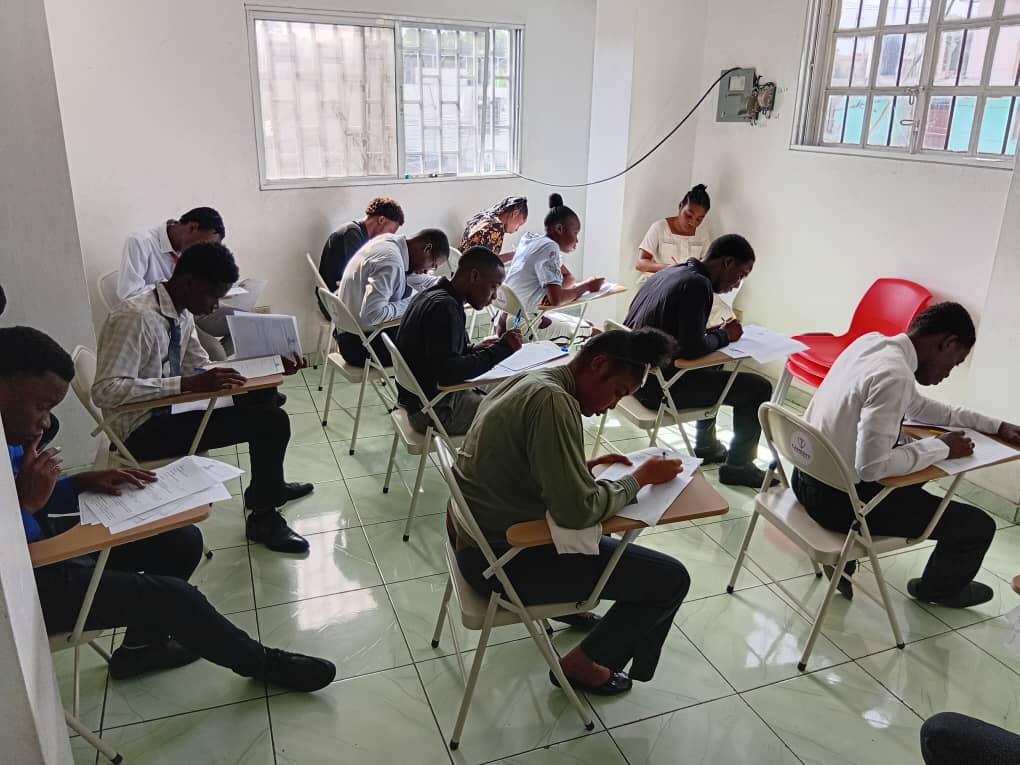
Des postulants lors d'une évaluation
Photo : Louise Rabel
