

Can official recognition of skills acquired without following the usual path associated with a diploma be achieved? The validation of acquired experience (VAE) hinges on this possibility. It does not reward seniority and does not automatically convert experience into a diploma: it confronts achievements with the requirements of a certification.<\/strong><\/i><\/p> The diploma occupies a central place in our societies. It certifies knowledge and skills, plays a role in recruitment and promotion, and contributes to the social recognition of individuals. But its value exceeds the proof of a level of education: it is also associated with representations of success, merit, and professional legitimacy.<\/p> This position raises a fundamental question: must the skills recognized by educational institutions necessarily have been acquired in the training they provide? Can learnings constructed through professional activities, associative responsibilities, or social activities meet the requirements of a diploma? The VAE offers an institutional answer to this question. It distinguishes the situations in which a person learns from the procedures through which an institution officially recognizes what they have learned.<\/p> Experience is the starting point of the VAE, but it should not be confused with learning. One can perform an activity for a long time without developing all the associated skills; conversely, particularly demanding situations can lead to significant learning in a short time. Therefore, the richness of an experience is not solely measured by its duration, but by the situations encountered, the problems solved, and the reflection they allowed.<\/p> Competence is not reduced to the possession of resources: it depends on the ability to mobilize and combine them meaningfully in a given situation (Le Boterf, 2008). The diploma attests that a person has met certification requirements; competence manifests itself in activity situations. The VAE is situated between the two. It does not evaluate the value of a career: it examines whether the knowledge gained from experience corresponds to the requirements of a specific certification.<\/p> The European guidelines from Cedefop (2023) distinguish four operations: identifying the acquired knowledge, documenting it, evaluating it against defined criteria, and then certifying it when a competent authority formally recognizes mastery. This framework states what must be accomplished. It does not specify how a candidate achieves it.<\/p> This is what I studied in my master’s thesis dedicated to supporting VAE at the University of Toulouse II – Le Mirail (Boursiquot, 2011). The choice of diploma, understanding the framework, preparing the dossier, and preparing for the evaluation are not mere formalities. These are moments where the candidate learns to connect their experience with the institution's requirements. Support here appears as a transversal function, not just another step.<\/p> The work of explicating is one of the main difficulties of VAE. Many professionals act effectively without being able to spontaneously describe what underlies their action. Reflecting on a real activity to describe the decisions made, the resources mobilized, and the results requires a process that explicitation interviews have contributed to shaping (Vermersch, 1994). It is, in essence, a “taking a step back”: stepping back from one’s experience to analyze it and account for it (Cherqui-Houot, Nkeng, and Triby, 2007).<\/p> The difficulty is greater when a candidate seeks a university diploma without having attended higher education themselves. They may master complex professional situations while being unaware of academic writing codes and jury expectations. This lack of knowledge should not be mistaken for a lack of competence. The facilitator helps clarify expectations and structure the analysis, but does not replace the candidate in demonstrating their accomplishments, nor the jury tasked with evaluating them.<\/p> A persistent representation needs to be dispelled: VAE would be an easy pathway, a sort of “fan school” where everyone would leave with a degree, or just a second chance pathway. For the candidate, it can actually prove more challenging than sitting on school benches. The student follows a program designed for them, guided by teachers, and punctuated by progressive evaluations. The VAE candidate must, often in parallel with their professional activity, analyze their experience, translate it into the language of a framework, and demonstrate before a jury that their accomplishments meet the diploma's requirements.<\/p> The framework and the jury are the guarantors of this requirement. Without explicit criteria, evaluation would depend on individual assessments; without rigorous judgment, the diploma would lose its value. In my thesis, I already emphasized that the hope attached to VAE should not be confused with a second chance strategy (Boursiquot, 2014). Recognizing experience does not mean lessening certification, but rather demanding proof through another path.<\/p> The VAE also confronts socially constructed conceptions of the diploma and competence, which the theory of social representations allows for analysis (Moscovici, 1961; Jodelet, 1989; Abric, 1994). A candidate who has held responsibilities for years may believe their journey alone justifies a diploma, risking underestimating the process's requirements. Conversely, another may doubt that their achievements are legitimate enough to be presented to a university.<\/p> Academics and jury members also have their representations. Some fear a devaluation of diplomas; others see in VAE an opportunity to renew evaluation practices. These positions reflect different conceptions of the university's missions and the legitimacy of certification. This was the hypothesis guiding my thesis: institutional certification practices are shaped by the representations that actors associate with diplomas and competence.<\/p> Too lenient recognition would undermine the trust that society places in diplomas. However, a system that replicates the expectations of the academic path would make it impossible to recognize learning from experience. The credibility of VAE rests on this balance: maintaining the certification requirements while adapting the way to demonstrate mastery.<\/p> In my book dedicated to VAE in Haiti, I emphasize that a recognition system cannot be an automatic solution to the challenges of higher education: it all depends on the conditions of its design, the actors' representations, and the institutional transformations that accompany it (Boursiquot, 2023). VAE is neither a diploma distribution mechanism nor a threat to the university. It reminds us that training institutions do not monopolize skill production, even if they retain the responsibility to certify them.<\/p> This text is an abbreviated version of an article published on boursiquotherve.com, which contains full references.<\/i><\/p> Hervé Boursiquot holds a doctorate in education sciences, and is the author of Diplomas, skills, and validation of acquired experience in Haiti (L’Harmattan, 2023) and Community of practice for teachers: a challenge for improving the quality of education in Haiti (L’Harmattan, 2024).<\/i><\/p>Recognizing what has been learned in other ways<\/strong><\/h2>
Experience is not yet a skill<\/strong><\/h2>
A four-step process<\/strong><\/h2>
Supporting without doing it for them<\/strong><\/h2>
Neither a “fan school” nor a second chance<\/strong><\/h2>
Competing representations of the diploma<\/strong><\/h2>
Recognizing without weakening the diploma<\/strong><\/h2>
Validation of acquired experience: what exactly are we talking about?
Can official recognition of skills acquired without following the usual path associated with a diploma be achieved? The validation of acquired experience (VAE) hinges on this possibility.
Par Hervé Boursiquot, Ph.D.
27 Oct 2026 — Lecture : 5 min.
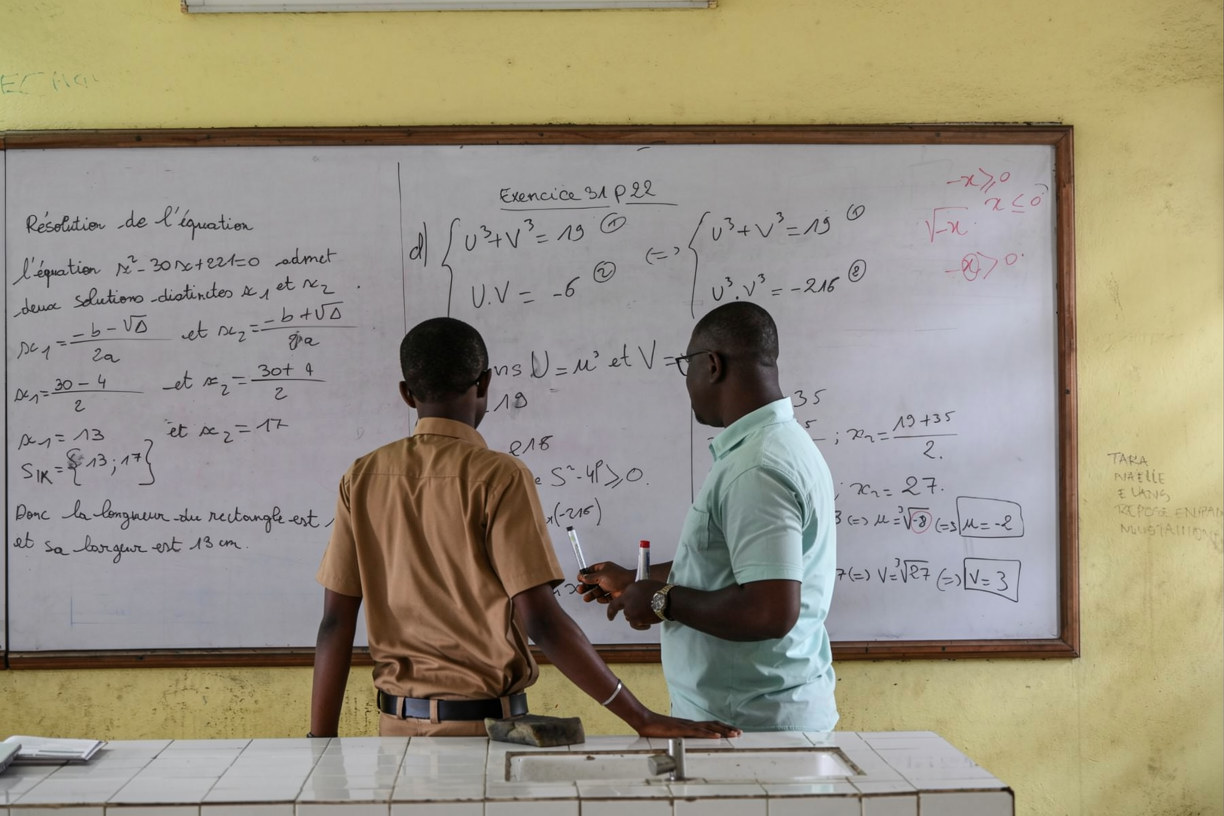
Au tableau, un enseignant explique un exercice de mathématiques à un élève
