

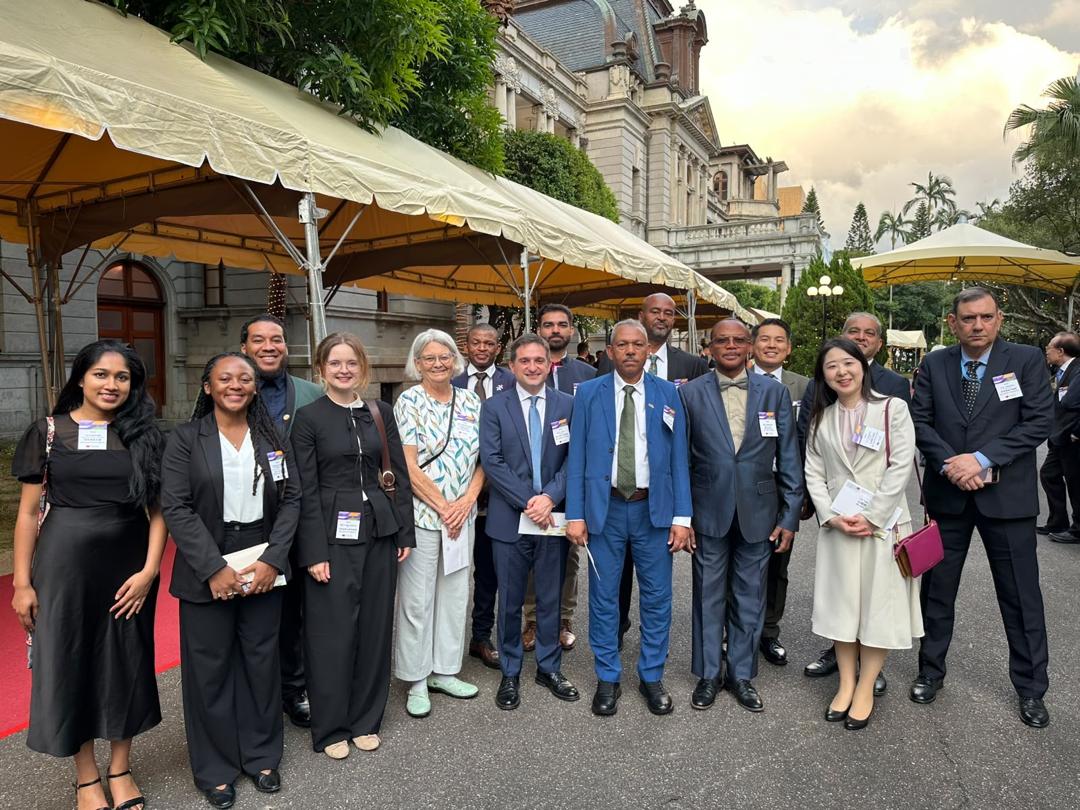
The official reception held at the Taipei Guest House on Saturday, October 10, 2026, on the occasion of the National Day of the Republic of China (Taiwan), provided a unique opportunity for meetings and exchanges with personalities from diplomatic, economic, and institutional backgrounds. Beyond its ceremonial nature, this event allowed for discussions on various issues related to international relations, cooperation, and development prospects for Haiti.
During this reception, our presence sparked interest among several participants, particularly Francophone representatives who, hearing us converse in French, spontaneously came to engage in conversation. These exchanges revealed that, despite the geographical distance separating Haiti from Taiwan, our country remains a concern for certain international actors.
Among the personalities we met was Dr. Allen Lien, who had worked in Haiti after the devastating earthquake of January 12, 2010. He holds fond memories of his stay in our country and is currently collaborating with Acer Medical, a company specializing in medical technologies. This meeting reminded us how missions of cooperation and interventions carried out in difficult circumstances can create lasting human and professional ties between Haiti and Taiwan.
We also had the pleasure of meeting Mr. Lex Kaufhold, Executive Director of the Luxembourg Trade and Investment Office in Taipei. Our discussions also allowed us to converse with Mr. Lutz Gullner, Head of the European Union Office in Taipei, part of the European Economic and Trade Office.
Furthermore, we were honored to be approached by Mr. Frédéric Laplanche, Ambassador of France to Taiwan, as well as by other Francophone diplomats who seemed well-informed about the Haitian situation. These encounters were particularly interesting, as they demonstrated that several interlocutors are following the political, social, and economic evolution of Haiti, some due to their professional responsibilities, others due to direct contacts with our country.
These conversations thus offered an informal yet enriching framework to discuss Haiti's place in international relations and the possibilities for cooperation that could contribute to its development.
Exchanges on relations between France and Haiti
Among the topics discussed during these meetings was the cooperation between France and Haiti. Our discussions notably focused on the commitments announced by French President François Hollande during his visit to Haiti in May 2015, as well as on the prospects for development support, particularly in the field of education.
We sought to understand why certain planned initiatives had not produced the expected results. During these exchanges, insecurity was mentioned as one of the main obstacles to implementing large-scale cooperation projects.
It is undeniable that the deterioration of the security situation, particularly in the metropolitan area of Port-au-Prince, complicates international partners' interventions significantly. However, we argued that such a situation should not necessarily prevent any initiative in other regions of the country. Some provincial cities, depending on their security conditions and hosting capacities, could potentially serve as starting points for educational, social, or economic projects.
A differentiated territorial approach would thus allow for the continuation of certain programs while taking into account the specific realities of each region. The goal would not be to minimize security challenges but to prevent them from condemning all development efforts to inertia.
Francophonie, a strategic asset for Haiti
Our exchanges also provided an opportunity to recall the unique place Haiti occupies in the Caribbean due to its history, culture, and Francophone linguistic heritage. The historical ties between Haiti and France are an important element of this relationship, despite the differences and wounds inherited from the past.
We argued that France has a vested interest in further supporting Haiti, not only because of this shared history but also to contribute to the promotion of the French language in a region largely dominated by Spanish and English.
Francophonie indeed represents a space for cultural, educational, and institutional cooperation from which Haiti could benefit more. However, it is essential that this linguistic affiliation translates into concrete programs, sustainable investments, and increased training opportunities for young Haitians.
In this perspective, we also discussed the case of Rwanda, a country that has gradually strengthened the role of English in its institutions and educational system. This example illustrates how linguistic orientations can evolve based on political choices and development strategies of a state.
The aim was not to advocate for a linguistic change in Haiti but to highlight that languages are also instruments of cooperation, economic integration, and international positioning. For Haiti, the essential question remains that of enhancing its linguistic heritage while equipping its population with the tools to master the languages necessary for opening up to the world.
Transforming meetings into opportunities for cooperation
At the end of these discussions in Taipei, one conviction has strengthened: Haiti is not as distant from international concerns as one might think. Diplomatic, economic, and institutional figures know our history, follow our current events, and some maintain personal or professional ties with our country.
These contacts do not, by themselves, constitute commitments to cooperation. Nevertheless, they represent opportunities for dialogue that would be beneficial to extend through structured approaches, realistic proposals, and appropriate institutional follow-up.
The Taiwanese experience, relations with European partners, and historical ties with France invite reflection on ways to diversify Haiti's partnerships and better mobilize available skills, networks, and resources abroad.
However, exchanges also highlighted a major difficulty: insecurity and political instability limit intervention possibilities and sometimes discourage partners eager to support the country. Thus, restoring a safer environment, ensuring the stability of institutions, and the ability to devise coherent projects remain essential conditions for turning intentions into realizations.
The reception on October 10 in Taipei was therefore much more than an official ceremony. It allowed for Haiti's voice to be heard in an international meeting space, to recall the links that connect our country to several foreign partners, and to emphasize the need to transform human and diplomatic relations into concrete prospects for cooperation and development.
