

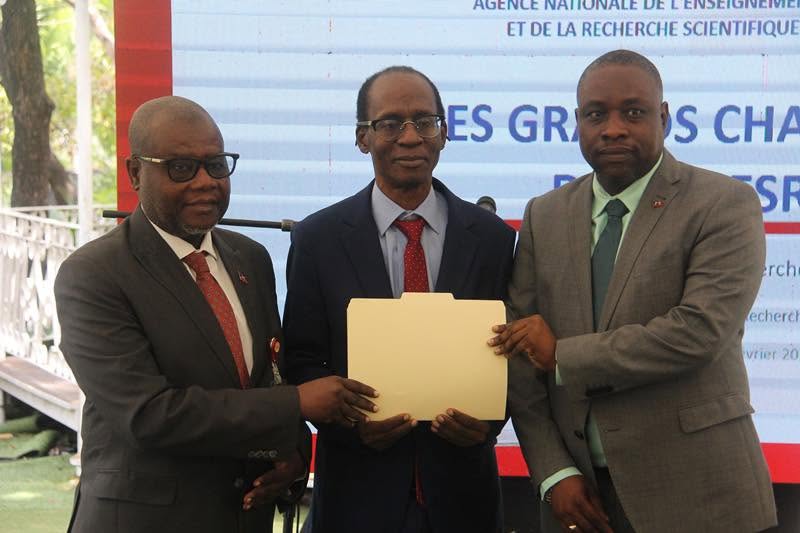
Mr. Vijonet Déméro
Minister of Higher Education and Scientific Research
Subject: the insignificant budget allocated to ANESRS by the government: a systematic blockage of academic reform, an affront to knowledge and science
Dear Minister,
The Council of the National Agency for Higher Education and Scientific Research (ANESRS) - an independent body created by the amended Constitution of 2011, in its article 211 and established by the decree of June 30, 2020 - is honored to inform you, with the utmost firmness, of its profound indignation following the information it has received regarding the budget envelope that would be reserved for the Agency for the fiscal year 2026-2027.
Reducing a budget proposal from approximately 500 million gourdes (which amounts to about 15%) to 75 million gourdes, developed based on the real needs of the institution and the scope of its responsibilities, constitutes a form of humiliation and a true repudiation of ANESRS.
Dear Minister,
Since the installation of its members on January 14, 2026, the Agency has been fighting daily for its survival against the pitfalls and obstacles of all kinds deliberately placed in its path, which systematically block its progress. Nearly a year without salary, aside from fees granted to the Advisors at the end of the fiscal year. Results are expected of us, but with what means? 75 million gourdes for an entire year of operation of a national institution responsible for contributing to the regulation, evaluation, and strengthening of higher education and scientific research across the various geographic departments of the country cannot reasonably be considered a budget commensurate with the stakes.
How can we ask ANESRS to contribute, among other things, to restoring the credibility of higher education, to work on accreditation and the quality of programs, to participate in the fight against establishments operating outside the norms and the false diplomas in circulation in Haiti and abroad (about 85% of Haitian diplomas submitted for admission to HEC - Higher Commercial Studies - are fake, according to the officials of this prestigious institution affiliated with the University of Montreal), while denying it the indispensable resources for the effective exercise of its responsibilities?
At this stage, a troubling question becomes inevitable. What political logic can justify publicly proclaiming the necessity to reform, modernize, and strengthen higher education and scientific research while depriving ANESRS of the means necessary to accomplish precisely this mission? The treatment reserved for the Agency unfortunately gives the impression that its existence and consolidation disturb several actors in the system and that, in power arbitrations, the preservation of alliances, positions, and immediate interests may overshadow the greater interest of the State. If this is indeed the calculation, that is, to reassure certain interests and secure one's political back at the expense of weakening ANESRS, it would constitute a major institutional fault. One does not sacrifice a regulatory institution on the altar of political conveniences. One does not stifle ANESRS to satisfy the powerful of the moment. One does not condemn a country's academic future to protect a career. History will judge harshly all those who, faced with the choice between defending knowledge and preserving their immediate interests, chose to bow before the calculations of power rather than stand alongside the institution tasked with restoring order, quality, and credibility in higher education and scientific research.
There is here a contradiction that we cannot silence or trivialize. One cannot proclaim the necessity to reform higher education while financially weakening the institution called upon to participate in its regulation. One cannot demand quality without financing quality control. One cannot denounce academic disorder while maintaining the regulatory body in a situation of institutional precariousness. A State that intends to make knowledge, science, and university training instruments of development must translate this ambition into its budgetary choices.
Our incomprehension grows even larger when some private universities would receive public subsidies exceeding 300 million gourdes, while ANESRS, whose field of intervention concerns the entire higher education and research system, should settle for 75 million. It is not for ANESRS to contest support granted to any establishment, but to question the coherence under which a national regulatory institution could be placed in such a restrictive budget situation in light of the extent of its responsibilities?
Beyond the figures, it is therefore the place given to knowledge, scientific research, university quality, and the regulation of higher education in national priorities that is being questioned here. The very low international recognition of many Haitian diplomas continues to plummet in value and credibility, the absence of rigorous quality assurance mechanisms, the uncontrolled proliferation - like mushrooms - of higher education establishments across the country, in disregard of State requirements and international standards, the inadequacy of several academic programs with contemporary labor market norms and international benchmarks, the chronic weakness of national scientific production, etc., constitute, among others, the symptoms of a system urgently in need of structural reforms, for which ANESRS was established.
Thus, depriving the Agency of the minimum resources necessary for its functioning amounts, in fact, to compromising the implementation of this national mission and reinforcing Haiti's degrading image both domestically and internationally. Such a situation risks sending a particularly concerning, even negative, signal to the university community, technical and financial partners, and the entire Haitian society: that of a country that does not formally recognize the importance of science and knowledge and hesitates to grant them the necessary means for their promotion and governance.
The Council of ANESRS rightfully questions the vision that underlies such a decision. What society do we intend to build if the institution responsible for ensuring the quality of higher education and promoting scientific research is deprived by the State of the elementary resources allowing it to fulfill its mandate? How can we expect to train competent professionals, innovative researchers, and citizens capable of contributing to the modernization of the country if the regulatory and quality assurance mechanisms remain inoperative? Can we accept that, over the next decade, the national university system will continue its gradual weakening, even as development challenges demand more academic skills and greater scientific rigor?
The members of the Council, professionals and academics called to put their expertise at the service of the Republic, cannot accept that their institution be reduced to a nominal existence, endowed with a vast mission in texts but devoid, in fact, of the means to accomplish it. An institution without sufficient resources becomes an impeded institution, and an impeded regulation necessarily leaves more room for the disorder it was precisely called to combat.
Mr. Minister, ANESRS asks for neither favor nor privilege. It demands the means to fulfill the mission that the State itself has entrusted to it. That is why the Council respectfully requests a revision of this situation so that the necessary budgetary provisions are made promptly to allow the Agency to fully assume the responsibilities entrusted to it by law in the service of the State and the Nation.
Hoping that this démarche will catch your full attention and that a rapid solution can be considered in the higher interest of the country, the Council of ANESRS extends to you, Mr. Minister, the expression of its highest consideration.
Cc:
Mr. Alix Didier Fils-Aimé
Prime Minister of the Republic
Mr. Serge Gabriel Collin
Minister of Economy and Finance
