

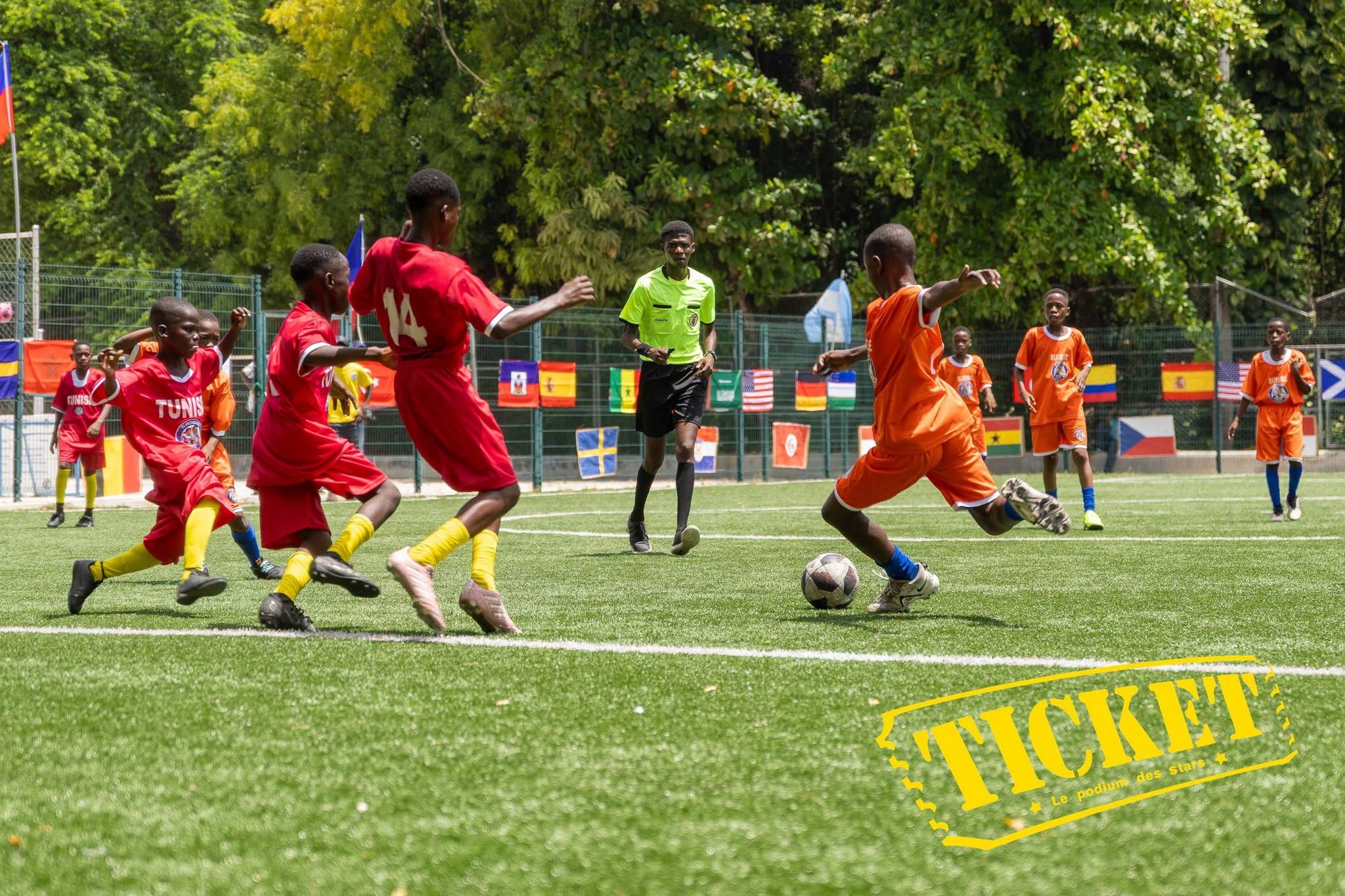
What if, to keep a child away from violence, we also needed to start by offering them something else? A field. A jersey. A team. The opportunity to leave their neighborhood to meet other youths. And above all, something big enough to nurture a dream. Through TiMondyal, hundreds of children from different neighborhoods have shown that an alternative is possible when we create spaces for them to choose another path.<\/strong><\/p>
At 12 years old, Steve already knows what he wants to become.<\/p>
"I want to become a great player like Andy Pierre, Nazon, or Bellegarde. I believe I will make it," he asserts.<\/p>
Steve is a student at a school in Village de Dieu Bicentenaire. His daily life is far from the conditions in which great sports careers typically begin. His school bears the marks of difficult years. The walls are cracked. Insecurity complicates movements and weighs on families' lives.<\/p>
But Steve has a dream.<\/p>
And when he talks about his future, he does not speak of a weapon.<\/p>
He talks about a ball.<\/p>
Giving the Youth Something to Choose From.<\/strong><\/p>
This may be one of the most important lessons from TiMondyal.<\/p>
For several weeks, hundreds of children from different schools in difficult neighborhoods gathered around football. Each school represented a country, transforming the sports competition into an experience of meeting, discovery, and coexistence.<\/p>
The Becky Dewine School in Cité Soleil, representing Tunisia, won the competition. The National School of Corail, defending the colors of Saudi Arabia, came in second. The Community School of Bicentenaire, representing Switzerland, completed the podium.<\/p>
But behind the rankings, TiMondyal tells another victory.<\/p>
That of children meeting each other while their neighborhoods may be separated by fear, tension, and sometimes violence.<\/p>
For Christelle, project manager at Vivario, one of the strengths of TiMondyal lies precisely in its ability to bring together different social strata around football. She also praises the support of Swiss Cooperation in Haiti, which helped make this new edition possible.<\/p>
A Story Born Twenty Years Ago.<\/strong><\/p>
TiMondyal did not start in 2026.<\/p>
Its story goes back to the 2006 FIFA World Cup, in a Haiti that was already going through a particularly difficult time.<\/p>
At that time, Brazilian Blue Helmets, with Vivario, created TiMondyal in neighborhoods like Cité Soleil, Cité Militaire, and Simon Pelé.<\/p>
The idea was as simple as it was powerful: to use the passion for football to create a space where children and young people from different neighborhoods could meet differently.<\/p>
The Brazilian ambassador to Haiti, Mr. Luis Guillerme Nascentes da Silva, recalls a time when communities facing tension and violence still saw their youth gather around a ball.<\/p>
Twenty years later, in 2026, this story resonates strangely.<\/p>
The circumstances are not identical. But many children continue to grow up in territories fragmented by violence and movement restrictions.<\/p>
And once again, the ball manages to cross certain borders.<\/p>
According to the ambassador, this new edition has notably allowed young people from neighborhoods that have experienced conflicts to meet. Some were able to leave their area to meet other children and discover other spaces in the capital.<\/p>
For a few, TiMondyal was even the opportunity to visit Pétion-Ville for the first time in their lives.<\/p>
Just a few kilometers.<\/p>
But when a child's geography is drawn by insecurity, a few kilometers can represent another world.<\/p>
They Walked to Be Able to Play.<\/strong><\/p>
The journey of the team representing Switzerland provides a particularly strong illustration.<\/p>
During a decisive quarter-final match, the young players walked several kilometers to reach the field.<\/p>
They could have chosen not to come.<\/p>
They walked.<\/p>
Then they played.<\/p>
They won the match and continued their journey to the semi-finals, where they were ultimately eliminated after a closely contested penalty shootout, 4-5.<\/p>
Nevertheless, they finished third in the competition.<\/p>
For Mr. Valet, the director of their school, this participation went far beyond the sporting outcome.<\/p>
"Despite all the difficulties, our children managed to represent Martissant and Village de Dieu with dignity. They wanted to show that youths are resilient, that they believe in football, and that they believe football can contribute to changing certain things."<\/p>
This several-kilometer walk perhaps better tells what an alternative represents than any speech.<\/p>
They walked because at the end of the road, someone was waiting for them.<\/p>
There was a match.<\/p>
A team was counting on them.<\/p>
They had a jersey to defend.<\/p>
They had a goal.
An Alternative Does Not Solve Everything. But It Opens a Door.<\/strong><\/p>
It would be naive to claim that a tournament can, by itself, address the violence affecting some Haitian neighborhoods.<\/p>
TiMondyal does not replace school, nor the protection of children, nor safety, nor the humanitarian responses that communities need.<\/p>
But the experience raises an essential question:<\/p>
What alternatives do we offer children before others present them with choices? <\/strong><\/p>
A child grows up with what they see around them.<\/p>
When their movements become impossible, when their school operates under precarious conditions, when the spaces where they can meet, learn, play, and project themselves gradually disappear, their horizon shrinks.<\/p>
Creating an alternative means reopening that horizon.<\/p>
It allows a child to discover that there is something beyond the borders of their neighborhood.<\/p>
It gives them an appointment on Saturday.<\/p>
A team waiting for them.<\/p>
Rules to follow.<\/p>
An opponent who is not an enemy.<\/p>
A victory to celebrate.<\/p>
A defeat from which they will have to rise again.<\/p>
And above all, a reason to dream.<\/p>
Exceptional Support for a Unique Initiative.<\/strong><\/p>
For Swiss Cooperation in Haiti, supporting TiMondyal was particularly significant.<\/p>
In a humanitarian context where children and young people are among those most affected by violence, displacement, and community fragmentation, the initiative drew attention for its ability to create positive spaces and bring together youths from different realities.<\/p>
For Nina Astfalck, head of Swiss Cooperation in Haiti, the results observed at the end of the initiative reinforce the relevance of this support.<\/p>
[Proposed quotation for validation]<\/strong>
"We are delighted to see the impact that TiMondyal has had on the participating children and communities. In such a challenging context, seeing young people meet, create bonds, overcome certain barriers, and continue to dream is particularly encouraging. It is a peace promotion initiative. This is precisely what convinced us to support this initiative."<\/p>
Beyond the sporting results, it is thus the encounters created, the barriers crossed, and the perspectives opened that give the experience its full significance.<\/p>
What If the Alternative Was Part of the Answer?<\/strong><\/p>
The story of TiMondyal now connects two generations.<\/p>
In 2006, during a difficult period, Brazilian Blue Helmets and Vivario chose football to bring young people from neighborhoods marked by tensions closer together.<\/p>
In 2026, twenty years later, children from neighborhoods still affected by violence once again left their areas, crossed invisible borders, and played together.<\/p>
Some discovered Pétion-Ville.<\/p>
Others met children they probably would never have encountered.<\/p>
Steve, for his part, may have discovered something even more important: a possibility.<\/p>
This does not mean that every child who receives a ball will become a professional football player.<\/p>
This is not the promise.<\/p>
The promise is simpler: to enable them to know that another path exists.<\/p>
That is why the experience of TiMondyal also deserves to call on public institutions, international organizations, humanitarian actors, the private sector, and all those who work with youth.<\/p>
Because protecting a child is not only about keeping them away from danger.<\/p>
It is also about giving them something to move towards.<\/p>
A field.<\/p>
A school.
A team.<\/p>
A dream.<\/p>
At 12 years old, Steve already knows what he would like to become.<\/p>
He dreams of football.<\/p>
He dreams of a future where children can go to school without fearing violence.<\/p>
And when he looks at his hands, he already knows what he wants to hold.<\/p>
Not a gun.<\/strong><\/p>
A ball.<\/strong><\/p>
