

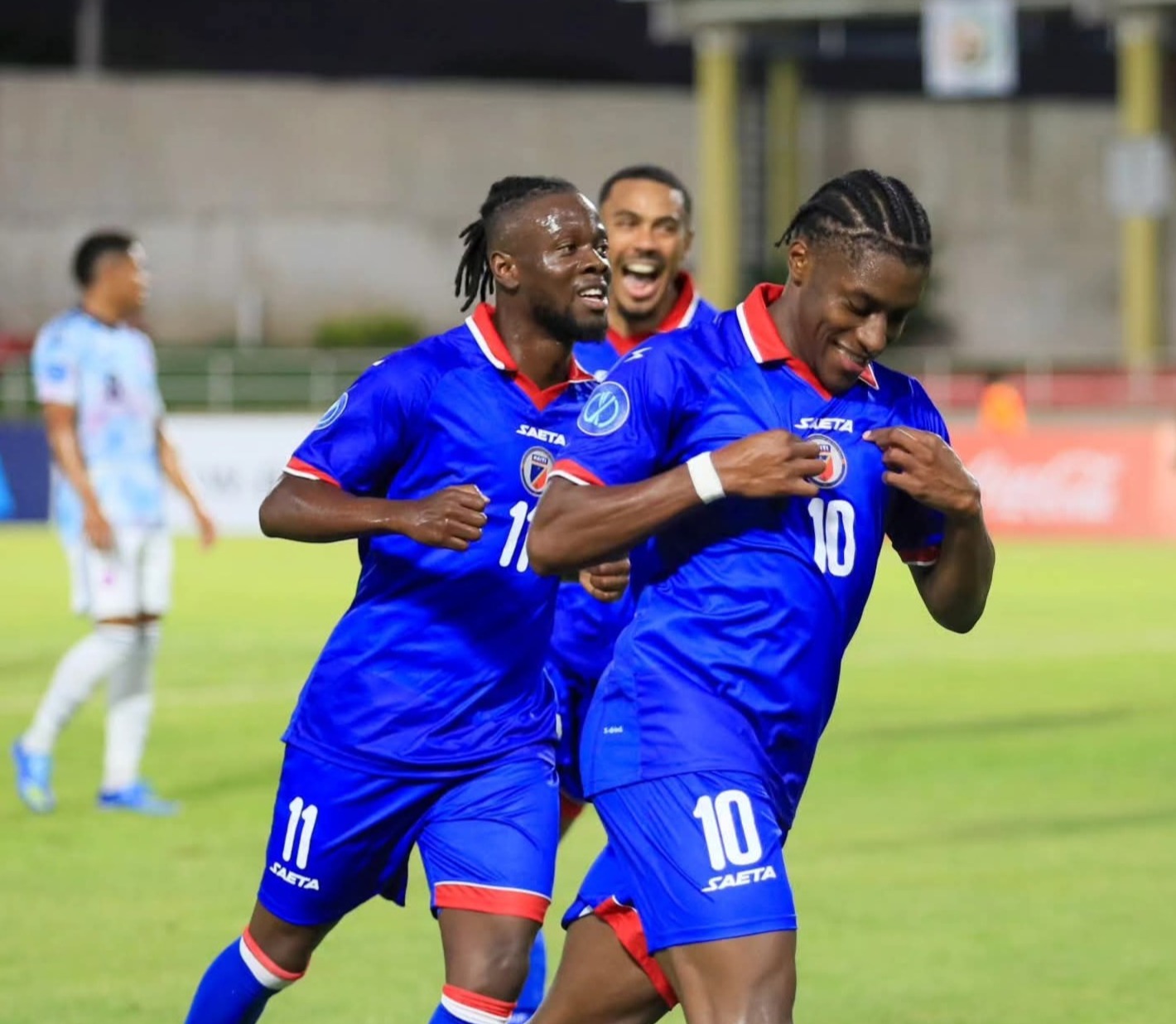
There are victories that are measured in rankings, points, and statistics. And then, there are those that go beyond the simple result of a match to become symbolic victories.
On October 1, 2026, in Santo Domingo, Haiti defeated the Dominican Republic 4-1 at the Félix Sánchez Olympic Stadium. But beyond the score, something deeper took place: for ninety minutes, the opponent's territory ceased to be psychologically that of the adversary.
The Haitians came to play away. Yet, at the final whistle, it was their flag, their chants, and their victory that occupied the space.
Here, it's Haiti.
This phenomenon is not new in football.
In 2017, in Mexico, the Tigres UANL won the Clásico Regiomontano against the Monterrey Rayados in their own stadium, the BBVA, before claiming the title. The slogan "Aquí es Tigre" summarized this symbolic appropriation of the opponent's field: the stadium may officially belong to the rival, but for the duration of a match, the narrative belonged to the Tigres.
Football knows this mechanism very well.
In 2022, Paris Saint-Germain defeated Real Madrid 1-0 at the Parc des Princes. After this victory, Neymar reiterated on social media the famous "Ici c’est Paris".
And a few weeks later, when Real Madrid eliminated PSG after turning the situation around at the Santiago Bernabéu, the Madrid club turned the Parisian slogan around: "Aquí, es Madrid". Carlo Ancelotti also echoed this phrase after Real Madrid's victory in the 2022 Champions League final.
In 2021, Liverpool also transformed Old Trafford into a red stage by crushing Manchester United 5-0. The famous "The city is red" was part of this old football logic: when a team wins authoritatively at its rival's home, it doesn't just win a match. It temporarily imposes its narrative on the other's territory.
This is precisely what happened in Santo Domingo.
Haiti didn't just win 4-1.
Haiti won on its home turf — symbolically.
The stadium was Dominican. The country was Dominican. The organization of the match was Dominican. But on the field, it was Haiti that set the rhythm, the efficiency, and ultimately the narrative of the evening.
The symbol is all the stronger because this match marked the return of the Haitian national team to Dominican soil after a long period without such confrontations. And when Wilson Isidor, who scored two goals, spoke after the match, saying "La Española es Haití" and "Haiti is here", the sporting celebration immediately took on a much more sensitive dimension. The comments sparked political reactions in the Dominican Republic.
One must obviously distinguish between the sporting metaphor and the political reality: La Española is an island shared by two sovereign states, Haiti and the Dominican Republic. A football victory neither alters borders nor a country's sovereignty.
But football does not only speak the language of legal boundaries. It also speaks of belonging, pride, memory, and symbolic territory.
And on that field, Haiti had just made a strong statement.
The next day, the response came from the Dominican government
On October 2, 2026, following this victory, Dominican Sports Minister Kelvin Cruz announced that the Haitian national team would no longer be able to play matches in the sports facilities of the Dominican Republic.
Cruz explained this decision by the incidents that occurred at the Félix Sánchez entrances before the match, which he deemed "unacceptable", citing the ministry's disciplinary rules regarding the protection of sports infrastructures.
The decision was then backed at the government level: President Luis Abinader stated that the position expressed by the Sports Minister was that of the Dominican government.
Thus, in less than twenty-four hours, football had produced an almost perfect scene to narrate its own symbolic power.
On October 1, Haiti enters the Dominican stadium and leaves with a 4-1 victory.
On October 2, the Dominican Republic announces that it no longer wants to host the Haitian national team in its sports facilities.
Football had just transformed a simple match into an event.
But it would also be too easy to reduce this story to a rivalry between two peoples or a simple territorial provocation. Haitian football deserves better than that.
Because what this victory reveals above all is a reality that some may still underestimate: Haitian football is no longer what they thought they knew.
For too long, we have looked at the Haitian national team through its difficulties: infrastructure problems, instability, traveling, matches played far from home, administrative and logistical obstacles.
But a national team is never defined solely by the difficulties of its environment.
It is also measured by what it produces when it steps onto a field.
And that night, Haiti produced four goals.
Four goals in the opponent's stadium.
Four goals that changed the atmosphere, the narrative, and the memory of the evening.
None of this is new in football.
Football has always had this strange ability to temporarily transform the opponent's home into its own territory.
The Tigres did it with "Aquí es Tigre".
Paris did it with "Ici c’est Paris".
Madrid responded with "Aquí es Madrid".
Liverpool turned Manchester into red territory.
And on October 1, 2026, Haiti wrote its own version:
Here, it's Haiti.
The Dominican Republic must now learn to view Haitian football differently.
Not as a team simply coming to participate.
Not as a team condemned to play with its difficulties.
Not as the opponent one believes they know in advance.
But as a team capable of coming to its neighbor's home, playing, winning, and leaving behind an unerasable result.
The stadium was Dominican.
The field was Dominican.
But that night, football belonged to Haiti.
And if football is also a way of telling who we are, then the message of October 1, 2026, will remain simple:
Haiti is here.
___________________
About the Author*:
Consultant and Specialist in public and international policies, Human Rights and Democracy, Social and restorative justice. Alumni of the United Nations Fellowship Program for People of African Descent (2024).
Email: jacksonjean.intl@gmail.com
Instagram: @jacksonjean.es
Twitter (X): @jacksonjean_es
WhatsApp: (+54) 911-3095-9600 / +41 79 845 89 08
