

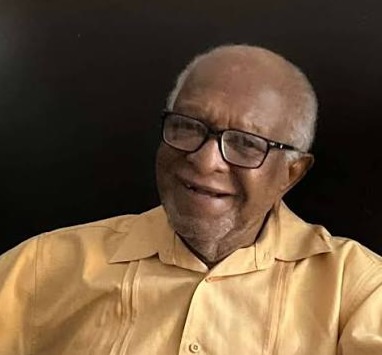
Just like him… and more
On the morning of September 15, 2026, at Palmetto Hospital in Florida, the Reverend Doctor Mario André Jean passed away.
That morning, angels came to escort him to eternal bliss. His departure was gentle, accompanied by the angelic voice of his youngest singing to him:
“Be without alarm, without fear,
God will take care of you.
He is your Father and your Savior,
God will take care of you…”
These words, drawn from number 133 of the Songs of Hope, in the French section, take on a very special significance at that moment. The one who, for so many years, taught faith has now fully surrendered into the hands of the One in whom he believed. He has entered into the joy of his Master. “He fought the good fight, he finished the race, he kept the faith.”
The Reverend Doctor Mario André Jean has finished his earthly race. But some lives do not completely end with the last breath. When a life has been dedicated to God, education, youth, and the training of others, it continues to live in what it has sown: in the teachings passed on, in the institutions built, in the vocations awakened, in the children who have become adults, and, above all, in the transformed lives.
His earthly race is complete. But his work continues. The runner has stopped. The baton, however, continues to circulate. And today, it is in our hands. It is up to us to take it. It is up to us to continue to run. Just like him… and more.
A man of faith and knowledge
There are men who can be summarized by a list of titles, functions, and responsibilities.
Mario André Jean was a theologian. He was a professor. He was an academic. He was a pastor. He was a trainer. He devoted several decades to education and theological training, particularly at the Baptist Theological Seminary of Haiti and the Christian University of the North of Haiti. He held significant academic responsibilities there, including that of Vice-Rector for Academic Affairs. He contributed to training generations of pastors, theologians, academics, and young Haitians. His journey was rich. His work was considerable. But the essence of Mario André Jean was not held in his titles. For some builders build walls. Others build institutions. And then there are those who build human beings. Mario André Jean belonged to the last category. He didn’t just build institutions. He built people.
In Fort-Liberté, his mark remains visible through the educational and community works to which he dedicated his energy, particularly the Eben-Ezer College and other initiatives aimed at serving the community. But behind the public man, behind the theologian, the professor, and the academic, there was another Mario André Jean. The one that titles could not tell. And that one… I knew him.
Ti Pouchon, Tête blanche, Tigranmoun tèt blanch, Past, Pa, Papi, Papili…
I met him. I grew up with him. I received his advice, his encouragement, his warnings, and his affection. Depending on the circumstances, he was Ti Pouchon, Tête blanche, Tigranmoun tèt blanch, Past, Pa, Papi, or Papili. But for me, he was above all the one who called me: “Pitan wen an.” These words, so simple in appearance, take on a new depth today. He advised me. He guided me. He warned me. He sought to spare me from certain dangers and misfortunes that I did not always discern myself. With Ti Pouchon, affection was never far from responsibility. For him, to love was also to care. And to care was sometimes to advise, to warn, to protect — even when the one being protected did not yet recognize the danger. Perhaps that is why, when I think of him today, I do not only think of the professor, the theologian, or the pastor. I think of the one who watched over.
And I remember an episode, among so many others, that helps me understand even more what this presence meant for us.
He was also our protector
It was 1991, at the time of the coup d'état. Our parents, François and Évangeline, were in Fort-Liberté. He was passing through Port-au-Prince. The situation was becoming worrying. He came to our house and asked us to leave Port-au-Prince immediately. We were several children. To the older ones, he gave the money needed to pay for transport to Fort-Liberté. As for the younger ones, he took them in his own car to drive them himself. Then, with that affectionate authority that characterized him, he said to us:
“I am also your relative. I don’t need to wait for Cois and Évan's advice to move you.” I have never forgotten that phrase. That day, he was not just the pastor, the professor, or the family friend. He was our relative. He took on a responsibility that was not officially his, but which he nevertheless considered a given. He did not question whether he should protect us. He protected us. He did not ask whether he had the right to feel responsible for us. He felt responsible. And perhaps that is one of the most beautiful things you can receive from an adult when you are a child: to feel that, in an occasionally uncertain world, someone is watching over you.
Many years later, when he says to me:
“You are my daughter, Pitan wen an,” I understand that these words are not just a term of endearment. He means it.
Past knew how to be young with the youth
He had his own way of entering the world of young people without ever ceasing to be the one who guides them. At the church, he paid particular attention to the youth association. He wanted to keep it alive, awake, and joyful. With him, mentoring youth was not just about talking to them, teaching them, or reminding them what they should do. He lived with them.
Past organized games — and, even rarer, he played with us. He told stories. He made us laugh. He organized contests. He rewarded our efforts with small prizes. He taught us to sing. During the summer vacation, he organized conferences that were both informative and entertaining. He understood something that many adults forget: you do not train youth by simply asking them to resemble us. You train them by helping them become fully themselves. And his attention did not stop at church activities. When a young person needed medical care, he would take the road with us and drive us to the doctor, sometimes as far as Limbé and even Port-au-Prince.
On the road from Cap to Port-au-Prince, at Morne Pilboreau, the children recognized Pastor André's car from afar. As soon as it began to climb the hill, their voices would ring out: “Here comes Tigranmoun Tèt blanch! Hey, here comes Tigranmoun Tèt blanch! Tigranmoun Tèt blanch, give me something!”
He would slow down, stop, take out some bills from his pocket — or from a small stash kept especially for them — and encourage his passengers to do the same. He always did it with a smile on his lips, with joy and compassion. For these children, “Tigranmoun Tèt blanch” was the name of a man they waited for with happiness, who never passed by without giving them something.
Tête blanche did not separate education from life. For him, taking care of a young person also meant being concerned with their health, their difficulties, their questions, their talents, their dreams. He wanted to see young people live, learn, think, sing, laugh, and grow. In hindsight, I understand better what he was doing. We thought we were playing. We thought we were singing. We thought we were participating in a contest, listening to a story, or eagerly waiting for the little reward that would crown our efforts. We did not yet know that behind these games, a man was patiently building us up. He educated us without boring us. He disciplined us without extinguishing our joy. He helped us grow without preventing us from being young. That was his way of educating. And perhaps one of the most beautiful lessons he leaves us is: forming a person is not just about filling their mind with knowledge; it is also about awakening in them the taste for learning, confidence, responsibility, and the desire to become better.
We were too young to understand.
We simply thought that Past knew how to make vacations more beautiful. We did not know that Tête blanche was sowing. Seeds of curiosity. Seeds of discipline. Seeds of confidence. Seeds of service. Seeds that, decades later, continue to sprout.
The baton
Over the years, some things take on a different meaning. We sometimes discover that what we thought was simply a childhood memory was in reality a seed. This attention to youth, this conviction that education can change a destiny, this willingness to create opportunities where none yet exist… Perhaps we sometimes receive an inheritance before we even know we have received it.
Years later, I myself created the Youth Organization Center of Haiti (COJEHA), with the desire to contribute, in my own way, to the education, development, and future of youth and vulnerable communities. And, in this new adventure, Pastor André never ceased to be there. Every time we called on him, particularly during the organization's activities in Fort-Liberté, he was present. He came to accompany us. And often, even before our activities began, he would take a few moments to raise a prayer. He prayed for us. He prayed for the youth. He prayed that God would accompany our initiatives and bless the work we were there to accomplish. This gesture, which might seem simple, held a profound significance for me. He did not simply watch the baton pass from his hands to ours. He continued, in his own way, to run with us.
His presence reminded us that our work was not just a human endeavor but also, for us, a commitment under the gaze of God. And I believe there was something deeply coherent with the man he had always been. He had sown. He had trained. He had accompanied. And when we began to sow in turn, he continued to accompany us. I do not claim that everything I do comes from him. But I know that some seeds were sown very early. And I also know that he continued to water them long after their first germination. Perhaps that is what true heritage is: something that never quite belongs to us because it is entrusted to us to be passed on in turn.
A legacy that continues
Today, we mourn a man. But beyond our tears, we contemplate a legacy.
Mario André Jean leaves behind much more than titles, functions, or responsibilities. He leaves institutions. He leaves students who have become teachers, pastors, leaders, and builders in their own right. He leaves young people who grew up under his watch. He leaves families he has accompanied. He leaves people he advised, encouraged, warned, and protected.
He leaves memories. But above all, he leaves lives to which his own gave something. A word. A teaching. A piece of advice. A prayer. A gesture of protection. An open door. A presence at the moment it was needed. Perhaps that is the true sum of a life. Not just what one has possessed. Not just the titles one has borne. Not even just the institutions one has helped to build. But the human beings one has helped to become what they could be. And from this perspective, the work of Mario André Jean is immense.
To his family, his children, his grandchildren and great-grandchildren, to the Jerusalem Baptist Church of Fort-Liberté, to the Eben-Ezer Baptist College, to the Christian University of the North of Haiti, to the Baptist Theological Seminary of Haiti, to his former students, to his colleagues, to his friends, and to all those who had the privilege of crossing his path, I extend my sincere condolences. May God comfort each and every one. May He give his family the strength to get through this ordeal and the peace that comes from the certainty that the one who dedicated his life to serving his Master now rests beside Him.
But for those of us who have received something from him, condolences are not enough. We also have a responsibility. We have received. Now it is up to us to pass it on. We have learned. Now it is up to us to teach. We have been accompanied. Now it is up to us to accompany. We have been encouraged.
Now it is up to us to encourage. We have been protected. Now it is up to us to watch over those who come after us.
The baton is in our hands.
And a baton is not meant to be kept.
It is meant to be passed on.
Pastor Mario André Jean fought the good fight. He finished the race. He kept the faith.
And now, let us rise. It is our turn to run. Let us run in his footsteps, not to reproduce them exactly, but to extend the path he opened. Let us run towards those who still need to be trained, encouraged, protected, and loved. Let us run with what he has passed on to us: the taste for knowledge, faith, the sense of service, love for youth, and this deep conviction that a life takes on its full value when it contributes to the growth of other lives.
We are not called to become Mario André Jean. We are called to continue. To multiply the seeds he has sown. To transmit the light we have received. To open, in turn, paths for those who come after us.
Some beings leave this earth, but never truly leave the lives they have helped build.
The baton is in our hands.
So, let us rise.
And let us run, to win the prize.
Just like him…
And more.
