

Waste management, an environmental and strategic issue
In March 2026, the Ministry of Environment (MDE), through Minister Valéry FILS-AIMÉ, mobilized the National Solid Waste Management Service (SNGRS) as an operational institution to contribute to the implementation of the "Konbit Haïti Zero Waste" program, in accordance with the guidelines of the environmental policy of the government led by His Excellency Mr. Alix Didier FILS-AIMÉ.
However, despite the structural, institutional, financial, and logistical difficulties it faces, this program continues on its path, with the ambition to contribute to improving the living conditions of citizens and reducing environmental pollution.
In this dynamic, the search for international partnerships, funding, technical expertise, and innovative solutions is a strategic necessity for Haiti.
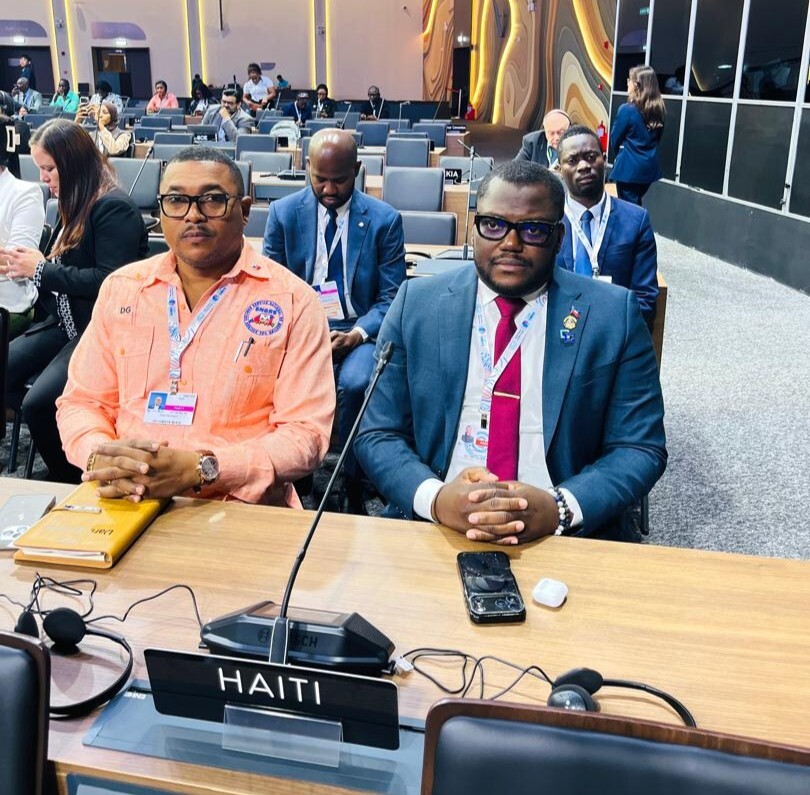
It is in this perspective that the Minister of Environment, accompanied by the Director General of the National Solid Waste Management Service (SNGRS) and a Haitian delegation, participated in the activities of the 31st Conference of the Parties (COP31), which involves 198 parties to the United Nations Framework Convention on Climate Change (UNFCCC), held in Antalya, Turkey, located in the Southwest of Asia from November 9 to 20, 2026.
This participation reflects a desire to position the SNGRS within international forums for dialogue, negotiation, and cooperation dedicated to climate, environmental issues, and sustainable development.
COP31: transforming commitments into concrete actions
COP31 fits into the international dynamics aimed at translating climate commitments into public policies, operational programs, and concrete investments. Discussions particularly focused on climate financing, energy transition, urban resilience, waste reduction, and strengthening mechanisms for international cooperation.
Among the highlighted directions are the acceleration of electrification from 20% to 35%, improving energy efficiency in buildings, developing more resilient cities, and reducing waste growth by 50%.
These issues are particularly relevant for Haiti, whose cities are facing rapid urbanization, insufficient waste collection and treatment infrastructure, pollution of waterways and coastal areas, as well as high vulnerability to extreme climatic phenomena.
Thus, waste management cannot be regarded merely as a question of urban cleanliness. It is an issue of public health, protection of natural resources, territorial resilience, and economic development.
Why the SNGRS must engage in climate cooperation?
The excessive production of waste and its poor management contribute to environmental degradation and greenhouse gas emissions. The decomposition of organic matter in poorly controlled landfills can generate methane (CH₄), a potent greenhouse gas.
Open burning practices, in turn, produce polluting emissions and directly affect population health.
By participating in international climate discussions, the SNGRS aims to strengthen its institutional position and explore cooperation opportunities that allow for the modernization of national solid waste management systems.
This approach primarily seeks to mobilize technical, financial, and institutional partners capable of assisting Haiti in planning, designing, implementing, and operating modern and integrated solid waste management infrastructures.
These infrastructures include, among others, transfer centers, sorting and treatment facilities, composting units, recycling platforms, as well as sanitary landfills equipped with appropriate leachate collection and treatment systems and biogas capture and management.
It also aims to promote the structuring and development of reuse, recycling, and waste recovery pathways, with a view to transforming waste into economic resources. This orientation could stimulate investment, encourage the emergence of new productive activities, generate direct and indirect jobs, enhance local entrepreneurial capacities, and gradually support Haiti's transition to a development model based on the principles of the circular economy, environmental sustainability, and resource efficiency.
International exchanges bringing new perspectives
During COP31, the Director General of the SNGRS, Mr. Daril BALTAZAR, participated in several meetings, pavilion visits, and exchanges with institutions, environmental organizations, private sector actors, and international partners. The delegation notably visited the pavilions of Kazakhstan, Japan, as well as the one dedicated to the "Zero Waste" initiative, driven by Türkiye and supported by the United Nations.
These visits allowed for the discovery and exploration of various approaches to waste management and recovery. Kazakhstan notably presents recycling and recovery experiences, including in the industrial sector. Japan, for its part, is recognized for its treatment, sorting, and recovery technologies, particularly for food waste.
The "Zero Waste" initiative emphasizes source waste reduction, selective sorting, reuse, citizen awareness, and the development of practices promoting the circular economy.
For Haiti, these international experiences provide reference points for inspiration and avenues for reflection that can be contextualized and adapted to the country’s economic, social, territorial, environmental, and institutional realities. Their relevance does not lie in the systematic transposition or mechanical reproduction of foreign models, but rather in the ability to identify, analyze, and integrate appropriate technologies, proven practices, effective governance mechanisms, and innovative approaches that meet the specific needs of the Haitian context. This process involves adaptation based on national capacities, structural constraints, available resources, and sustainable development priorities.
Additionally, a meeting organized at the "Oceans and Seas" pavilion with Ms. Marine Lecerf, responsible for international policies of the Ocean and Climate Platform, allowed for exchanges on issues related to marine pollution, particularly that caused by plastic waste, and its consequences on marine ecosystems, biodiversity, fishery resources, and coastal communities.
Discussions particularly focused on perspectives for technical support, mobilization of financial resources, strengthening of institutional capacities, and developing international cooperation mechanisms that could support initiatives for preventing, reducing, and managing marine pollution, while contributing to the protection and restoration of Haiti's coastal and marine ecosystems.
In the same context, exchanges with Ms. Mariame Berete, president of Challenge Tech International, an organization based in France, helped explore cooperation perspectives related to technical support and the development of waste treatment infrastructure projects, particularly in controlled incineration and energy recovery. However, these orientations require prior assessment of their technical, economic, environmental, and social feasibility, as well as consideration of regulatory requirements, national operational capacities, and waste management hierarchy principles.
These different contacts constitute preliminary opportunities that could facilitate the establishment of cooperation relationships, the realization of expert missions, the transfer of knowledge and technologies, the potential conclusion of institutional partnerships, and the mobilization of funding for structuring projects. However, their realization will depend on the establishment of monitoring mechanisms, the formalization of cooperation proposals, and their translation into operational programs and projects that respond to the national priorities of the SNGRS and Haiti's environmental policy.
"Zero Waste": an approach to adapt to Haitian realities
The initiative promoted by Türkiye and supported by the United Nations represents one of the approaches highlighted during the COP31 exchanges.
It is based on an integrated vision of waste management, prioritizing prevention, source reduction, reuse, sorting, recycling, and recovery, rather than exclusive reliance on landfill disposal.
For the SNGRS, this approach serves as a source of inspiration for developing a national strategy for reducing and recovering solid waste.
However, adapting this approach in Haiti requires coordinated mobilization of public authorities, local communities, businesses, community organizations, schools, environmental associations, and the population.
Transforming consumption habits and behaviors regarding waste management is a fundamental element in this regard. The success of a "zero waste" policy does not rely solely on infrastructure: it also requires ongoing environmental education, adapted regulations, control mechanisms, and economic incentives.
International cooperation, financing, and sustainable development
International cooperation represents a strategic opportunity for the SNGRS, provided it leads to concrete and measurable results.
The needs of Haiti in the field of waste management are considerable. They include waste collection and transport equipment, treatment infrastructure, recovery facilities, human resources training, technical assistance, technology transfer, and strengthening institutional capacities.
In this perspective, mobilizing concessional financing, climate grants, public-private partnerships, and technical assistance programs remains essential. This ambition aligns directly with Sustainable Development Goal (SDG) 17, dedicated to partnerships for achieving sustainable development goals. It also fits within SDG 11, which aims to make cities and human settlements inclusive, safe, resilient, and sustainable; SDG 12, focused on responsible consumption and production patterns and waste management; and SDG 13, which calls for urgent action against climate change.
The SNGRS thus intends to align its actions with the United Nations 2030 Agenda by making waste management a transversal lever for development, resilience, and environmental protection.
This orientation must also consider climate justice. Haiti contributes relatively little to global greenhouse gas emissions at 0.05%, but remains particularly exposed to the consequences of climate change, given recurrent disasters. This reality reinforces the need to advocate, on the international stage, for equitable access to financial resources, technologies, and support mechanisms intended for vulnerable countries, including all island nations.
From environmental diplomacy to national action
The participation of the National Solid Waste Management Service (SNGRS) in COP31 should not only be appreciated in light of diplomatic meetings, institutional exchanges, or pavilion visits during this conference. Its strategic significance lies essentially in the institution's ability to convert the identified cooperation opportunities into concrete commitments, structuring projects, operational partnerships, financing mechanisms, and tangible results for the national solid waste management system.
The cooperation perspectives opened during this occasion require the establishment of an institutional monitoring, evaluation, and coordination mechanism for international partnerships, the development of project files that are technically, economically, financially, and environmentally sound, as well as the definition of a strategic roadmap clarifying national priorities regarding collection, treatment, recycling, recovery, and environmentally sound waste disposal.
This dynamic also implies strengthening inter-institutional coordination between the Ministry of Environment (MDE), the National Solid Waste Management Service (SNGRS), local authorities, the relevant public institutions, civil society organizations, private sector actors, and technical and financial partners.
In this perspective, environmental diplomacy should be viewed not only as a tool for representation and international negotiation but also as a lever for strengthening institutional capacities, mobilizing resources, transferring technologies, territorial development, and sustainable transformation of the SNGRS. Its true effectiveness will be measured by its ability to align international commitments with coherent public policies, adapted investments, and concrete achievements that respond to the environmental, health, economic, and social needs of the Haitian population.
Conclusion
At the end of his participation in COP31, the Director General of the SNGRS, Mr. Daril BALTAZAR, emphasizes the need to make dialogue, consensus, and action the three fundamental principles of effective international cooperation aimed at concrete and sustainable results.
These three principles are essential levers in the search for adapted responses to the environmental challenges faced by Haiti. As recommended by COP31, dialogue fosters partnership establishment, knowledge sharing, and experience transfer; consensus facilitates defining common priorities and developing concerted projects; while action enables the translation of institutional and diplomatic commitments into concrete, measurable, and sustainable interventions.
In this perspective, source waste reduction by 50%, development of reuse, recycling, and recovery pathways, promotion of the circular economy, as well as modernization of collection, treatment, and disposal infrastructures are priority axes for transforming the national solid waste management system.
For Haiti, the real challenge now is to move beyond the stage of international commitments to convert them into national achievements.
Ultimately, international cooperation should not be limited to a succession of statements of intent or diplomatic promises. It must translate into operational commitments, structuring investments, and tangible results, for a cleaner, more resilient Haiti that is resolutely committed to sustainable development.
