

The insurrection seems to be nothing more than a facade for a more classic power ambition. In Haiti, the rhetoric of gang leaders, who vehemently denounce the corruption of the economic elite and the complicity of politicians in arms trafficking, masks a striking sociological and political reality: that of an exact reproduction of the structures they claim to fight against. Under the guise of a struggle against an unjust system, they do not seek to overturn the hierarchy, but to establish themselves within it, creating their own miniature and violent versions of power circles.<\/p>
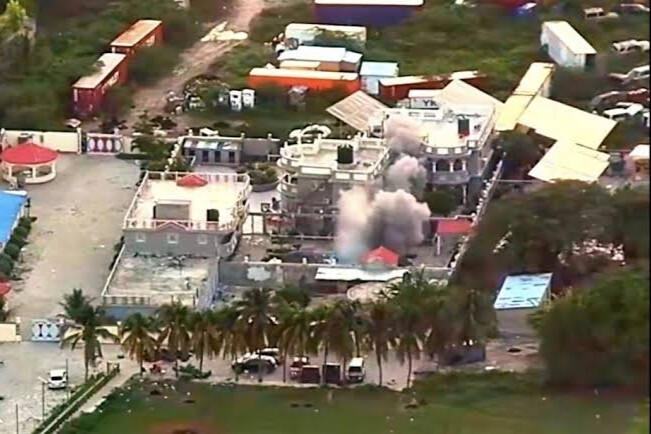
This mimicry first manifests itself through the ostentatious accumulation of wealth. Where the economic elite and political elite rely on capital and institutional networks, the gang leader builds his prestige on terror and the capture of resources. We see, at the heart of the poorest areas, imposing residences and outward signs of wealth that abruptly break with the surrounding landscape. By appropriating the codes of opulence, these men seek not only to survive but to assert their belonging to a higher class, transforming violence into a tool of social distinction and symbolic legitimation.<\/p>
For several years, cyberspace has been inundated with gangs, many of which use social networks such as TikTok and Facebook to showcase their opulence: luxurious homes, prestigious goods, diversified car fleets, and frequently, the arsenal of weapons they possess. Among these figures, we notably distinguish Joseph Wilson, aka "Lanmò 100 Jou," leader of the Croix-des-Bouquets gang; Jeff Larose, aka Jeff Gwo Lwa, head of the Talibans (Kanaan gang); Johnson André, aka "Izo," who leads the Village gang; Béliose Louis-Jeune, aka Bout Ba, leader of the Mariani gang; as well as Micanor Altès, alias Wa Mikanò, head of the Wharf Jérémie gang. These gang leaders, who systematically claim to be victims of the social inequalities plaguing the country, continually denounce the economic elite and the political class. They condemn an instrumentalization for electoral purposes, aimed at increasing their influence, only to be abandoned once power is conquered.<\/p>
Thanks to operations carried out by Salvadoran armed forces, it is now possible to closely observe certain areas where the bandits have established their strongholds. Not only is there a certain elitism in their constructions, but there is also a glaring absence of homes of comparable standing to those of the gang leaders. This disparity suggests that their claims do not stem from a class struggle, but rather aim at satisfying their personal needs and ambitions. In certain neighborhoods under their control, the populations they claim to protect are forced to flee their homes, as most of the dwellings are looted or burned. As for residents unable to leave, they are compelled to collaborate with them, at the risk of their safety. This situation leads to tragic consequences: many women and young girls are victims of rape, while young boys are forcibly recruited to serve as spies or executors during kidnappings, some ultimately becoming active members of these criminal organizations. In a report published by UNICEF, its representative in Haiti stated that, according to data from the Ministry of National Education and Vocational Training (MENFP), the metropolitan area of Port-au-Prince is experiencing massive school closures: 772 schools in Croix-des-Bouquets, 446 in Tabarre, 274 in Cité Soleil, as well as 200 others spread across Martissant, Fontamara, downtown, and lower Delmas.<\/p>
More deeply, this new hierarchy relies on a nearly identical exploitation of the base. Just like traditional power structures, gangs have established a pyramid where loyalty is bought through the distribution of weapons, food, or resources to the most vulnerable. By turning the youth of the neighborhoods into instruments of strength, gang leaders recreate a system of clientelism where the survival of subordinates depends on their absolute obedience to commanders. This command structure, often unpredictable yet strictly hierarchical, reflects the informal governance patterns that have long characterized the relationships between central power and the provinces.<\/p>
The mimicry also extends to the realm of representation. Since their federation in 2020 with the contribution of the National Commission for Disarmament, Demobilization, and Reintegration (CNDDR), formed by President Jovenel Moïse, their spokesperson, Jimmy Cherizier, aka Barbecue, very present in the media or on social networks, adopts a "revolutionary" posture, using populist rhetoric to justify their actions. The coalition presents itself as the only bulwark against a disconnected elite while employing the same opinion manipulation levers as career politicians. This attempt at political legitimacy, although based on brute force rather than on the vote, demonstrates a desire to integrate into the game of high national politics, seeking to destroy the state, as well as all social and moral orders, to better replace it with their own authority.<\/p>
This phenomenon transcends traditional sociological frameworks, making a political approach imperative in order to place the individual outside the social structure and interpret their actions as deviance. It can no longer be understood as a simple causality mechanism, as the succession of acts perpetrated by these individuals far exceeds the definition of a social fact and resentment. In "Social Structure, Anomie, and Deviance" (1965) [1970], Robert K. Merton identifies various modes of adaptation, and the series of actions undertaken by the gang directly falls within the rebellion mode, driven by scenes of violence and destruction that respond to no demands but stem from a pure enjoyment impulse, illustrated by the staging and dissemination of their crimes. By reproducing the mechanisms of exclusion and corruption, the gangs merely perpetuate the same predatory system that has led to the current instability. Insurrection is therefore not a historical rupture, but a transition to a new form of domination: a hybrid structure where street violence and elite interests converge in the same logic of resource control and maintenance of social order, to the detriment of the population.<\/p>
