

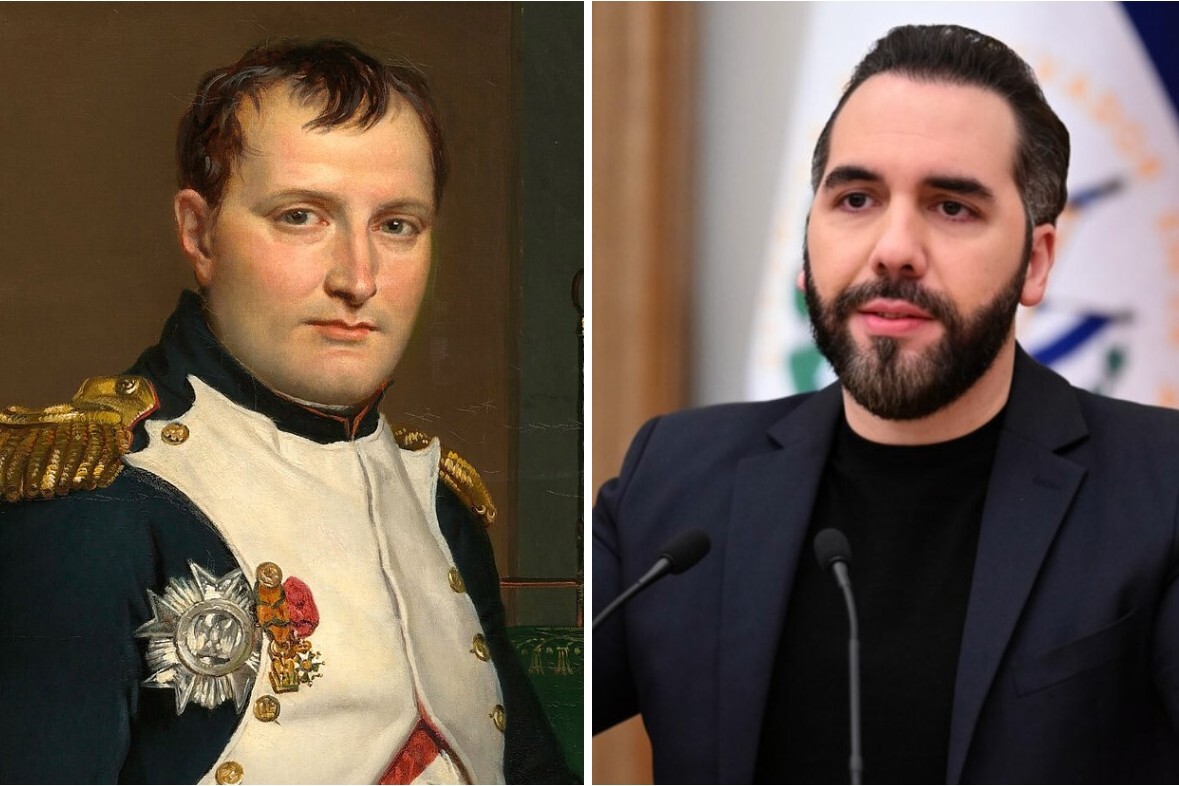
When a people who conquered their freedom through arms come to celebrate a foreign president for accomplishing what falls within the basic obligations of their own leaders, the question is no longer just about insecurity. It is about the failure of the state, the accountability of the elites, and the very meaning of our independence.<\/i><\/p>
There are images that should provoke a national jolt. Seeing Haitians applaud Salvadoran President Nayib Bukele for his action against gangs reveals a striking paradox: the people who wrested their independence from French armies are now waiting for a foreign force to restore their freedom to move within their own country. I do not condemn the terrorized families who hope to finally live in safety. I question a society that risks thanking an external savior without holding its own leaders accountable.<\/p>
Vertières: a victory, not an eternal guarantee<\/h2>
On November 18, 1803, the indigenous army achieved a decisive victory at Vertières against French forces. On January 1, 1804, Haiti proclaimed its independence. This revolution was a major rupture in the history of slavery and freedom [1]. Our ancestors did not win simply because they were indignant: they organized their resistance, built alliances, and pursued a common political objective. Their legacy is therefore not only courage. It is also the ability to act collectively.<\/p>
But legal independence has never been enough to guarantee lived sovereignty. What good is it to celebrate Dessalines if children cannot go to school, if merchants cannot work, and if families have to flee their neighborhoods? A nation does not remain free only because it remembers its victory. It must build the institutions that make that freedom real.<\/p>
However, the memory of Vertières should not become a weapon to humiliate today's victims. The insurgents of Saint-Domingue succeeded because they built alliances, organization, and leadership within a particular historical context. A population held hostage by armed groups does not automatically possess these means. Courage is a moral resource; it does not replace justice, professional policing, or institutions that are accountable for their actions. The issue is not to measure the bravery of generations, but to ask why the independent state has failed to ensure the freedoms for which its founders fought.<\/p>
Bukele is not the President of Haiti<\/h2>
The security policy pursued in El Salvador has fed the international image of an effective leader against gangs. However, human rights organizations have also documented arbitrary detentions and serious violations of judicial guarantees in this country [2]. The lesson is twofold: security is essential, but it never relieves a power from respecting the law.<\/p>
Any foreign cooperation also responds to national and strategic interests. It can help Haiti, but it cannot replace the responsibility of its authorities. Applauding soldiers who protect civilians is understandable. Transforming their head of state into a providential liberator is a political mistake. Bukele can help neutralize armed groups; he cannot rebuild justice, policing, public finances, and the legitimacy of the state for us.<\/p>
The fascination with Bukele also has a trap: it sometimes confuses immediate security results with sustainable political solutions. Even a spectacular drop in violence does not, by itself, indicate whether judicial procedures are being respected, if citizens have recourse, or if institutions can survive the leader who embodies repression. For Haiti, the goal cannot be to replace the fear of gangs with the fear of unchecked power. We must demand both security and the rule of law, not choose one over the other [2].<\/p>
Who protects those who terrorize the country?<\/h2>
The most urgent debate is not only: who holds the weapons? It is also: who supplies them, who finances the armed groups, who protects them, and who profits from their violence? The governance diagnosis by the International Monetary Fund (IMF) and reports from the UN Expert Group describe links between organized crime, corruption, and certain political or economic networks [3, 4]. These findings do not justify indiscriminately accusing all elites. They demand, however, independent investigations and prosecutions based on evidence.<\/p>
A military operation can retake a neighborhood and neutralize operatives. But if arms trafficking, financial circuits, and institutional protections persist, other leaders can emerge. That is the risk: winning a battle against gangs without dismantling the system that makes them possible. Sustainable security depends as much on financial investigations, justice, and the fight against impunity as it does on operations on the ground.<\/p>
It would therefore be insufficient to assess an international mission by only counting neutralized leaders or reclaimed streets. One should also measure the investigations opened into alleged sponsors, seizures of weapons, prosecutions for money laundering, protection for witnesses, the safe return of displaced families, and the ability of Haitian authorities to maintain reclaimed territories. IMF and UN documents remind us that violence is embedded in governance dynamics and organized crime that do not disappear when the troops leave [3, 4].<\/p>
Resistance is not resignation<\/h2>
Article 35 of the Declaration of the Rights of Man and of the Citizen of 1793 qualifies insurrection against oppression as a sacred right [5]. This historical reference should not be read as an invitation to blind violence. Today, to resist can mean organizing non-violent civic pressure, defending independent media, demanding accountability, and insisting on effective institutions. Haitians have already protested against insecurity and impunity; the challenge is to transform this anger into lasting collective action.<\/p>
Responsibility is not equal for all. One cannot ask a displaced family, stripped of means and threatened by armed men, to accomplish alone what the state has failed to do. But political leaders, public institutions, and influential actors cannot hide behind this distress. Foreign aid must strengthen Haitian capacities, under public control, with guarantees for civilians and a strategy for transferring responsibilities.<\/p>
A credible civic mobilization must therefore articulate indignation and specific demands: regular publication of verifiable security results, independent oversight of public spending, protection for journalists and magistrates, evidence-based sanctions, and a public timetable for strengthening policing and justice. These are demands that can unite beyond party affiliations. Sovereignty is not a cry raised on the occasion of a commemoration; it is measured by the ability for each citizen to demand accountability without fear of being silenced.<\/p>
Our next Vertières<\/h2>
The next Vertières should not be a new war: it should be the victory of justice over impunity, of the common good over complicity, and of the rule of law over terror. It is necessary to disarm the gangs, but also to pursue their financiers and protectors, control arms flows, and give young people other prospects than criminal recruitment.<\/p>
In 1804, our ancestors refused to let our freedom depend on a foreign master. In 2026, we must not make our survival a permanent delegation to a foreign president. The scandal is not that a people ask for help. The scandal is that they must seek elsewhere the protection that their own leaders owe them.<\/strong> Before crying "Long live Bukele!", let us ask: who will be accountable for insecurity when the last foreign soldiers have left?<\/p> Our duty is neither to deny the relief that external aid can provide, nor to make it a political religion. It is to transform every success obtained with this aid into sustainable national capacity. Without this demand, the next Haitian leaders will continue to inaugurate operations they do not control while the networks of violence will simply wait for their next opportunity. The true tribute to Dessalines will be the day when no Haitian child needs a foreign president to safely traverse their city.<\/p> [1] Encyclopaedia Britannica. “Haitian Revolution”. https:\/\/www.britannica.com\/topic\/Haitian-Revolution<\/p> [2] Human Rights Watch. “World Report 2025: El Salvador”. https:\/\/www.hrw.org\/world-report\/2025\/country-chapters\/el-salvador<\/p> [3] International Monetary Fund (2025). Haiti: Governance Diagnostic Report. https:\/\/doi.org\/10.5089\/9798229007801.019<\/p> [4] United Nations Security Council (2025). Report of the Group of Experts on Haiti, S\/2025\/597. https:\/\/digitallibrary.un.org\/record\/4091504<\/p> [5] Declaration of the Rights of Man and of the Citizen (1793), article 35. https:\/\/www.conseil-constitutionnel.fr\/les-constitutions-dans-l-histoire\/constitution-du-24-juin-1793<\/p>References<\/h2>
