

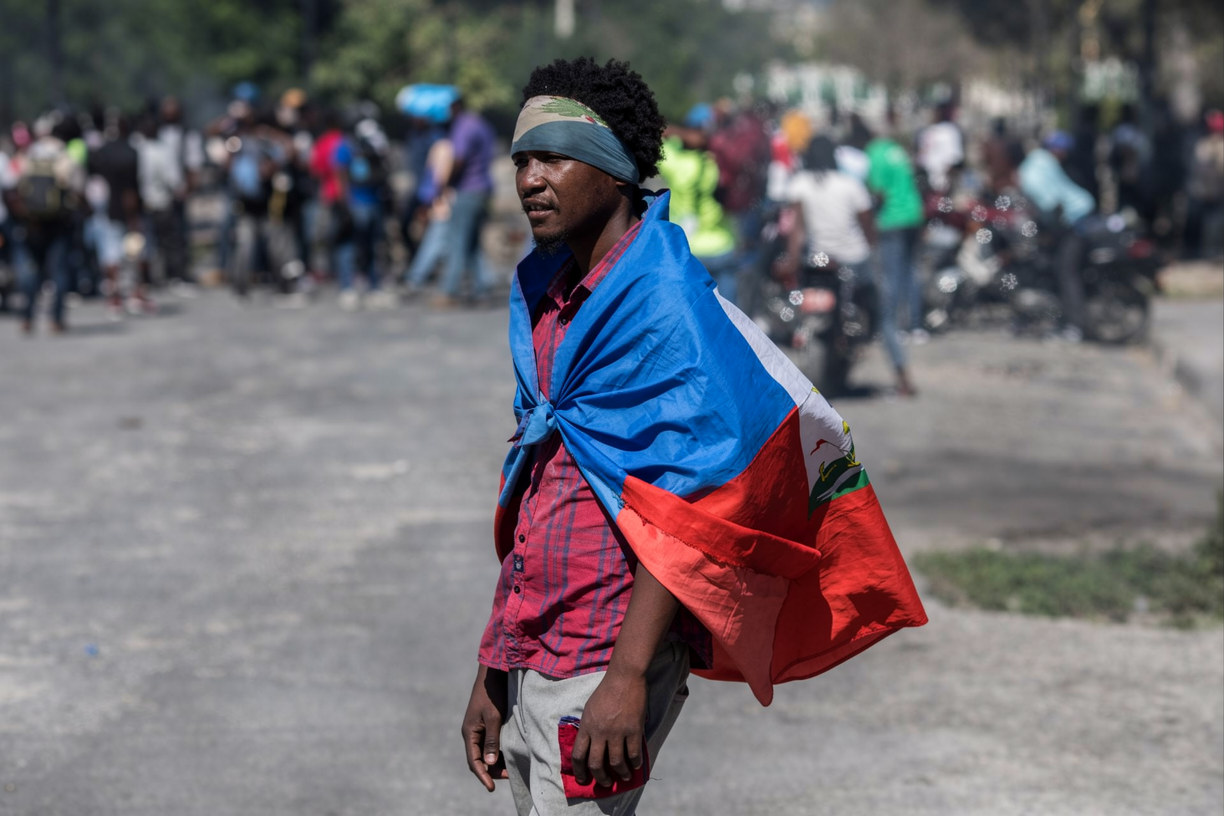
From the student strikes of 1997 to the mobilizations of "peyi lòk", Haiti's recent history shows that the streets have always been the thermometer of citizen hope. A look back at my experience over three decades of struggles, repression, and resilience in the face of powers that prefer to stifle dissent rather than listen to it.<\/p>
When a people protests, it is proof that they still have hope. They still believe in a common destiny. This should even be a reassuring signal for leaders. It shows that their people rely on them or, quite simply, still judge them useful. And yet, leaders are often afraid. Why do they fear a people that takes to the streets to demand change, whether it be changing the government or ending practices contrary to the values they believe in? I still do not know how to answer that question. But the reasons cited and the methods used to suppress protests are, to say the least, questionable.<\/p>
I was very young when I witnessed the first waves of protests in 1997. Students were demanding only one thing: teachers in their classrooms. In my eyes, it was such an obvious request that it shouldn't have required a protest. It was a childishly naive perspective. It took months, confrontations between high school and college students, literally children dying for the state to intervene. I could not understand how adults, if we can still call them that, could display such anti-republican laxity.<\/p>
On one side stood the unionist Josué Mérilien, an emblematic figure of the National Union of Haitian Normalists (UNNOH); on the other, Jacques-Édouard Alexis, then Minister of Education. All this for an initial commitment to a 82% salary increase. The government ultimately disbursed only an initial tranche of 50%. The remaining 32%, along with other social components, was never executed. Thus began the long desert crossing for the students.<\/p>
In 2000, a little more mature and hardened, I had the chance or mischance to live in Port-au-Prince. I nearly had a heart attack upon learning that militants from Fanmi Lavalas had doused a group of peaceful protesters, including Ms. Mirlande Hippolyte Manigat, with urine that had been collected for several days. These militants proved to me, for the first time, that I was wrong to believe that among "serious and civilized" people who engage in politics or aspire to govern, such things are not done. I was shocked. And yet, they may have done me a service, given what was yet to come. They were preparing me to enter Haitian political life. I discovered that a political opponent could be viewed not as a citizen to convince, but as an enemy to humiliate.<\/p>
In 2002, I left the country for university studies. I returned in 2008, the year of the food riots, the "grangou klowòks", during René Préval's presidency. During these events, rioters almost stormed the National Palace. Rumors circulated at the time that the president had declared he too wanted to protest because he was also suffering from the high cost of living. In this context, President Préval would make the famous statement, "Dezyèm mitan an se pou mwen".<\/p>
However, it must be recognized, objectively and with numbers to support it, that 2009 was the best year Haiti has seen in the past thirty years. Everything changed in 2010, with the first earthquake on January 12, then with the electoral process, marred by accusations of fraud, which led Michel Martelly to power. Under his term, protests multiplied. Citizens demanded better living conditions, denounced corruption, and contested certain government practices. The administration of PHTK displayed indescribable contempt for the people. The population endured police violence, and universities were directly targeted, as if to convey the message: "Do not protest anymore, we already know the problems." But knowing the problems of a people does not mean solving them. And governing does not consist of asking citizens to be silent while their difficulties worsen.<\/p>
In 2017, Jovenel Moïse came to power. Aside from protests against the "criminal budget" in September 2017, he governed for more than twelve months without facing any major protests, until he made the ill-advised choice to raise fuel prices on the night of July 6 to 7, 2018. From that day on, the protesters refused to go home. There was a lot of destruction, but they were determined to change what they called "the system", hence the term "peyi lòk". Many of them fell, shot in the head, a practice that Haitians would attribute to mercenaries on the government's payroll.<\/p>
After having outmaneuvered Parliament by declaring its expiration, President Moïse boldly claimed to have taken control of protests in the country. Anyone who wanted to finance protests, he declared, would do better to find another use for their money: it was over. What he did is unknown, but it was noted that the protests ceased. Perhaps he had found the formula, for since that declaration, there has not been another massive protest demanding better living conditions even after his assassination.<\/p>
Is it a lack of hope, a rupture of the common destiny, or did the "Jovenel formula" simply kill hope? Perhaps the leaders have simply succeeded in exhausting the capacity of citizens to protest. In any case, hope seems to be revived with what is called the "Bukele effect": massive protests have resumed in Port-au-Prince and in provincial cities on November 17 and 18, 2026 to express this resurgence. However, it would be equally dangerous to believe that every protest necessarily signals a better future. The streets can topple a government without transforming institutions. They can express anger without building an alternative. They can bring down leaders without eliminating the practices that caused their rejection.<\/p>
That is why popular hope must be able to transform into a collective project, into citizen organization, and into sustainable institutional demands. A people that protests has not necessarily found its way. But it still refuses to have its destiny dictated without it. And when it stops protesting, the first question a responsible leader should ask is not: "Have we finally won?" It should be: "Does our people still believe in us, or have we ultimately taken away even their hope of being heard?"<\/p>
Dacely Bertrand<\/strong><\/i><\/p> Telecom Engineer | Master in IT<\/i><\/p> Professor, University of the People (California)<\/i><\/p> Professor, American University of the Caribbean (Les Cayes)<\/i><\/p>
