

"Who is uprooted uproots. Who is rooted does not uproot." (Simone Weil, On Rootedness)
You do not burn the house where you know you belong. You do not desecrate the temple where you prayed as a child. You do not line up, in front of a camera, the grandmothers and infants of your own people to threaten them with death. If Haitian gangs do all this, it is because they lack something essential: not just the law, but the bond. This article argues a thesis: the inhumanity of the gangs arises from a double collapse — that of the sense of belonging to a homeland, and that of the capacity to think — the result of which, observable wherever they settle, resembles a psychopathology that has become a collective norm.
The Testimony of Ruins
We must begin by looking. On November 12, 2026, the National Police of Haiti, supported by armed forces, a private security force in the service of the state, and Salvadoran special forces, reclaimed the Sylvio-Cator stadium, occupied by gangs since February 2024. The images broadcast on that occasion are worth all the charges. Vines cover the fences, trees have grown in front of the stands, the goal posts have been torn out, and the concrete of the bleachers is cracked. And, among the rubble, human skulls.
The symbol is staggering. This stadium is named after Sylvio Cator, a silver medalist in the long jump at the Amsterdam Olympics in 1928 — one of the first Haitians to have made the bicolor flag wave on the world stage through body and effort. While the gangs transformed this temple of sport into a charnel house, the national team, ousted from their home, played their qualifying matches in exile, in Curaçao, on the way to the 2026 World Cup. A people celebrated their Grenadiers abroad while, at home, the place of their glory served as a mass grave. There could be no clearer representation of the rupture between the gangs and the nation.
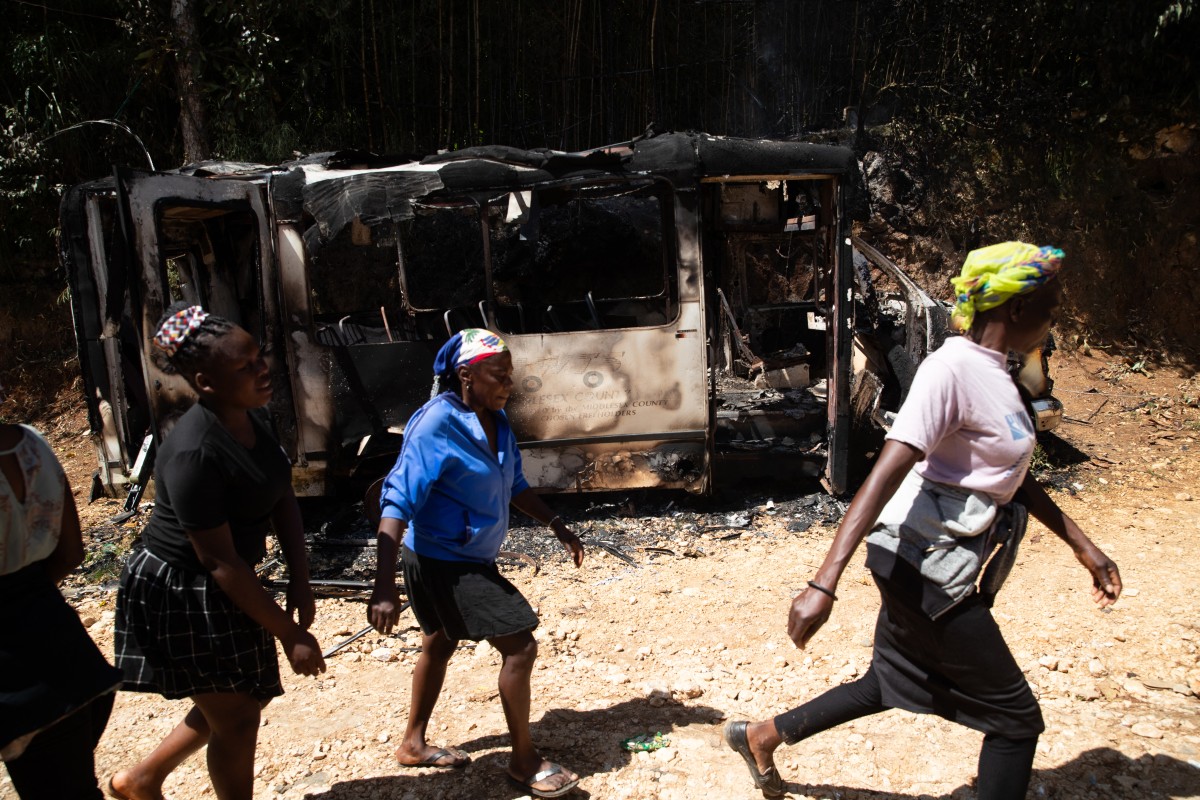
The stadium is just one example among a thousand. Everywhere they have settled, the gangs have left the same signature: police stations set ablaze, schools and hospitals looted, markets reduced to ashes, private homes burned down in entire neighborhoods, businesses extorted and then destroyed. The Oloffson Hotel, a gingerbread jewel that inspired writers and artists, was reduced to ashes in 2025. Beyond the material value, it is the memory of the country that burns — and the gang watches it burn without feeling what anyone would feel who knows that these stones are also theirs.
Then there are the videos. Bandits, filming their own crimes, expose residents of Saut-d’Eau — women, children, the elderly — whom they are about to execute. The process is not isolated: in August 2026, after the Kenscoff massacre, which left at least 47 dead, a gang leader nicknamed "Izo 2" published a video showing about twenty hostages, including three children, threatening to kill them all if even one of his men fell. Saut-d’Eau, it must be recalled, is not just any place: it is the city of the sacred waterfall, which the gangs had already profaned by bathing there in front of the camera and where they prevented the centuries-old pilgrimage of Our Lady of Mount Carmel. Exposing the elderly and children at the foot of this sanctuary makes the act of killing a spectacle and the sacred a backdrop.
The German sociologist Wolfgang Sofsky, in his Treatise on Violence, showed that filmed cruelty, displayed, repeated, is never merely a means: it becomes an end in itself, a liturgy of omnipotence. The executioner who films himself does not seek merely to terrorize; he seeks to exist in the gaze of others, to transform the annihilation of others into proof of his own importance. This is the first sign of a profound disorganization of personality.
"Bèt sovaj pa konn kay." — The wild beast does not know home: who has no home does not respect that of others.
The Lack of Patriotism: An Existence Without Roots
What is a homeland? Ernest Renan, in his 1882 lecture titled, What is a Nation?, replied that the nation is a soul, a spiritual principle made of two things: the common possession of a rich legacy of memories, and the current consent, the desire to continue to live together. The nation, he said, is "a plebiscite of every day." The gang is radical abstention from this plebiscite. It shares no legacy — Dessalines, Pétion, Cator, or Our Lady of Saut-d’Eau mean nothing to it — and it does not desire to live with others, but on or against them.
Jean-Jacques Rousseau made love of the homeland the highest civic virtue, the one that allows the individual to transcend narrow self-love to embrace a common self. It is precisely this common self that the gang lacks. Its horizon is the controlled territory, the "base", the loot of the day. It inhabits the country like a parasite inhabits its host: it feeds on it without recognizing it, and kills it without understanding that it will die too.
Simone Weil wrote in On Rootedness, pages of prophetic lucidity: "Rootedness is perhaps the most important and most overlooked need of the human soul, and the uprooted, almost fatally, becomes an uprooter." There is no better description of the Haitian gang. Often coming from abandoned neighborhoods, broken families, non-existent schools, these men grew up without roots; they do nothing but tear out those of others — the houses, the businesses, the places of worship, the graves. The destruction of public goods is not collateral damage for them: it is the very expression of their relationship to the world. What belongs to all belongs, in their eyes, to no one; what belongs to no one can be burned.
Émile Durkheim would have spoken of anomie, this dissolution of norms that leaves the individual without moral regulation. But the gang goes further than anomie: it substitutes a counter-community for the national community, with its leaders, its nicknames, its rites, its exclusive loyalty. One no longer belongs to Haiti; one belongs to "400 Mawozo", "Canaan", "Viv Ansanm" — the ultimate irony of a coalition that calls itself "living together" and has only been able to make die together.
"Sa ou pa konnen pi gran pase w." — What you do not know is greater than you: ignorance of what exceeds him renders man small and dangerous.
The Weakness of Mind: When Instinct Takes the Place of Thought
Kant defined Enlightenment as man's emergence from a state of minority for which he is himself responsible, this minority consisting of the inability to use his own understanding without the direction of another. The gang member is the perfect example of this minority. He does not think; he obeys; he does not deliberate; he executes. The leader thinks for him, and the group feels for him. His weakness of mind is not a defect of intelligence in the psychometric sense: it is a reflexive incapacity, an inability to represent the consequences of his actions, to put himself in another's place, to judge.
Hannah Arendt, at Eichmann's trial, uncovered what she called the "banality of evil." What struck her about this desk criminal was neither hatred nor demonic depth, but the absence of thought: the inability to think from another's perspective. Arendt concluded that thought — this silent dialogue of oneself with oneself — is the last bastion against evil. The gang is an organized apparatus to prevent this dialogue: the noise of weapons, drugs, alcohol, music that glorifies murder, the pressure of the group, all work to silence the inner voice that might say: "What you are doing is monstrous."
Gustave Le Bon, in his Psychology of Crowds (1895), described how the individual, melted into the mass, descends several degrees on the scale of civilization: isolated, he was perhaps a cultured individual; in the crowd, he becomes instinctual, thus barbaric. He acquires an invincible feeling of power, extreme suggestibility, and an irresponsibility that liberates what consciousness was holding back. Sigmund Freud would reprise and deepen this analysis in Group Psychology and the Analysis of the Ego (1921): in the group, the individual replaces his ideal of self with that of the leader; moral conscience is delegated, and with it the sense of guilt. Elias Canetti, in Crowds and Power, adds that the hunting or war pack finds in collective killing a moment of release and communion. The Haitian gang is a permanent pack: instinct governs, thought is suspect, pity is a weakness.
Finally, Spinoza called servitude the impotence of man to govern his affects. The man led by sad passions — hatred, fear, envy — is not free, even when he believes he dominates others. The gang leader who parades before the camera threatening the elderly believes himself master; he is merely the most complete slave of his impulses. His apparent power is just the flip side of a radical inner impotence: that of governing himself.
"Bourik chaje pa kanpe." — The loaded donkey does not stop: who advances under the weight of orders and instincts never has the leisure to think.
A Psychopathology That Has Become a Collective Norm
The American psychiatrist Hervey Cleckley, in The Mask of Sanity (1941), followed by Canadian psychologist Robert Hare, whose assessment scale is now referenced, described psychopathy by a set of traits: absence of remorse and guilt, insensitivity and lack of empathy, superficial charm and a grandiose sense of one's own worth, impulsivity, irresponsibility, constant search for stimulation, inability to assume the consequences of one's actions. One needs only to confront this list with the images from Sylvio-Cator and the videos from Saut-d’Eau to see the portrait emerge: laughter in front of bodies, posing in front of the camera, threatening children, indifference to ruins.
We must be rigorous: psychopathy, in the clinical sense, is an individual diagnosis, which only an examination can establish, and it only affects a minority of the general population. Speaking of "generalized psychopathy" in the gang milieu does not mean that every member was born psychopathic. It means something even more alarming: that the gang is a factory of psychopathy, an environment that selects, rewards, and generalizes psychopathic traits until they become the norm of the group.
The history of collective violence has amply demonstrated this. Historian Christopher Browning, in Ordinary Men, studied a battalion of German policemen, family men without prior records, who became mass executioners in just a few months. Stanley Milgram showed in the laboratory how far obedience to authority can lead ordinary individuals. Philip Zimbardo described how deindividuation and unchecked power tilt behaviors. Finally, Albert Bandura described the mechanisms of moral disengagement: justification (“we are defending our territory”), euphemism (“soldiers”, “operation”), dehumanization of the victim, dilution of responsibility within the group. These mechanisms, in Haitian gangs, are not accidents: they are the very culture of the milieu.
The recruitment of minors — which international reports insistently signal — completes the picture. A child torn from his family, initiated through violence, exposed from adolescence to murder and torture, sees his moral development blocked at the age where empathy should have flourished. One does not become psychopathic in the gang; one becomes one, through a kind of inverted education. That is why the observation of inhumanity, however severe, is not a verdict on Haitian nature — which the history of 1804 alone would suffice to refute — but on an environment that must be dismantled and on a society that has allowed this environment to thrive.
René Girard reminded us that human societies have always had to contain mimetic violence, this contagious violence which, left free, spreads from one to another until everything is destroyed. The gang is the contagion that has become an institution. It imitates, competes, escalates: each massacre calls for a more spectacular massacre, each video a more cruel video. Collective psychopathy is also a race to the abyss.
"Rache manyòk, bay tè a blanch." — Tear out the manioc and clean the land: against rooted evil, one must go to the root.
Conclusion: Relearning Humanity
The observation is therefore double and sheds light on everything else. Lack of patriotism: the gang feels no connection to the land it occupies, which is why it destroys public goods, houses, businesses, temples, and graves without the slightest tremor. Weakness of mind: the gang does not think, it reacts; and in this space left vacant by reflection, instinct reigns supreme. From this double void arises a psychopathy that is no longer the exception of an individual, but the rule of an environment.
Thomas Hobbes described the state of nature as a war of each against all, where the life of man is "solitary, poor, nasty, brutish, and short." The gangs have brought part of Haiti back to this state. The reclaiming of Sylvio-Cator Stadium, if confirmed and extended, is not just a military victory: it is the first gesture of an exit from the state of nature, the return of the common rule over the arbitrariness of the pack.
But brute force will not suffice. If evil arises from uprooting and absence of thought, the remedy can only be rooting and education: a school that teaches history and the sense of the common good, neighborhoods where the state becomes present again, a justice that judges and does not avenge, programs that offer the youngest an alternative to the gun. Simone Weil said it: "Everyone must be given roots." Only then can a country stop producing men capable of burning their own house.
The day the Sylvio-Cator Stadium reopens its stands to the crowd, when the children of Saut-d’Eau can bathe again in the waterfall without fear, when the elderly can sit in front of their door without dreading a phone's lens and the barrel of a gun, humanity will have regained its rights over instinct. That day, the homeland will no longer be a word, but a home.
References and Sources
France 24 and L’essentiel/AFP, "In Haiti, police recover the stadium of the national football team from gangs," November 13, 2026; The Haitian Times, November 12, 2026; Haïti-Tempo, "Sylvio Cator Stadium, the gangs have chased away football," November 11, 2026; SOFX, November 13, 2026.
UPI and ABC News/AP, Kenscoff attack and hostage video released by "Izo 2," August 26-28, 2026.
Juno7, "Saut-d’Eau, a major pilgrimage site and symbol of Haitian religious syncretism, under the control of gangs"; L’actualité/AP, "Gangs disrupt a sacred day celebrated by thousands of Haitians," July 2025.
Wikipedia, "2025 in Haiti" (destruction of the Oloffson Hotel by arson).
Ernest Renan, What is a Nation? (1882); Jean-Jacques Rousseau, Discourse on Political Economy, and On the Social Contract; Simone Weil, On Rootedness (1949); Émile Durkheim, Suicide (1897).
Emmanuel Kant, What is Enlightenment? (1784); Hannah Arendt, Eichmann in Jerusalem (1963) and The Life of the Mind; Baruch Spinoza, Ethics, IV; Thomas Hobbes, Leviathan (1651).
Gustave Le Bon, Psychology of Crowds (1895); Sigmund Freud, Group Psychology and the Analysis of the Ego (1921); Elias Canetti, Crowds and Power (1960); René Girard, Violence and the Sacred (1972); Wolfgang Sofsky, Treatise on Violence (1996).
Hervey Cleckley, The Mask of Sanity (1941); Robert D. Hare, Without Conscience (1993); Christopher Browning, Ordinary Men (1992); Stanley Milgram, Obedience to Authority (1974); Philip Zimbardo, The Lucifer Effect (2007); Albert Bandura, research on moral disengagement.
