

Summary
This article argues that Haiti is undergoing a "double zombification": on one hand, illiteracy weakens citizens' ability to understand, contest, and sanction the actions of leaders; on the other hand, economic misery forces even graduates to prioritize survival, encouraging the capture of public resources and the normalization of corruption. The analysis is sociological and economic: it does not present illiteracy or poverty as "flaws" of the people, but rather as structural conditions produced by history, the state, education, the labor market, and elites. Solutions must therefore combine functional literacy, quality public education, productive employment, institutional accountability, and anti-corruption justice.
Keywords: Haiti; illiteracy; poverty; governance; corruption; employment; citizenship; development.
Introduction
The term "zombification" refers here to a sociological metaphor: a people can be deprived of its full capacity to act when it is simultaneously deprived of the intellectual tools of citizenship and the material means to live with dignity. In Haiti, these two deprivations reinforce each other. Illiteracy limits access to information, rights, public debates, and power control mechanisms. Poverty, unemployment, and informality weaken economic autonomy and make daily survival more urgent than civic participation.
This dual constraint does not mean that the Haitian people are passive or irresponsible. On the contrary, it explains why social anger does not always transform into organized, lasting pressure aimed at concrete reforms. It also explains why some graduates, once close to power or public resources, may replicate the practices they criticized: not because a diploma destroys morality, but because the absence of stable employment, precariousness, and impunity transform access to the state into a rare resource to be captured.
Issue
The central question is as follows: to what extent do illiteracy and economic misery constitute complementary mechanisms that weaken citizenship, facilitate the impunity of leaders, and encourage the reproduction of corruption in Haiti?
This issue unfolds into three questions:
- How does illiteracy reduce citizens' ability to inform themselves, claim, and control leaders?
- How do poverty, unemployment, and informality push even educated people to adopt survival or quick enrichment strategies?
- What public policies can simultaneously break the cycle of educational exclusion and economic exclusion?
Theoretical Framework
The article relies on three sociological ideas.
- Citizenship as the ability to act: being a citizen is not just about voting; it entails being able to read a law, understand a budget, denounce an abuse, organize, and demand accountability.
- Social reproduction: education and the labor market can reproduce inequalities when access to knowledge, diplomas, and jobs remains reserved for a minority.
- The political economy of corruption: when the state is one of the few places offering income, contracts, protection, and social status, the competition for public resources becomes intense. Corruption then becomes a survival strategy for some and a strategy for accumulation for others.
Illiteracy: A First Zombification
Illiteracy is not just the inability to decipher words. It is also a difficulty accessing rules, contracts, public services, history, and political debates. A person who cannot read easily depends more on intermediaries: neighborhood leaders, bosses, politicians, radios, rumors, armed groups, or clientelistic networks.
The available data shows the extent of the problem. UNESCO indicates that in Haiti, over 57% of the population over 13 years old could neither read nor write according to sources cited by the UNESCO Institute for Lifelong Learning; other more recent estimates speak of about 41.2% of illiterate adults in 2013, or nearly four million people. The World Bank and UNESCO also have series on the literacy rates of adults and youth, but the quality and freshness of the data remain limited by the weakness of national surveys.
This situation produces several political effects:
- It weakens the ability to read an electoral program, a contract, a law, or a public report.
- It facilitates manipulation through identity, religious, partisan, or clientelistic discourses.
- It limits the use of rights: many citizens do not know the administrative, judicial, or electoral procedures.
- It reduces the formation of organized counter-powers, such as unions, peasant associations, cooperatives, and women’s organizations.
Thus, the first "zombification" is not the absence of popular intelligence. It is the confiscation of the instruments that allow popular intelligence to become a collective political force.
Economic Misery: A Second Zombification
The second zombification is material. It arises from poverty, insecurity, unemployment, inflation, and the weakness of productive employment. The World Bank estimates that about 50.8% of Haitians lived on less than 3 US dollars a day in purchasing power parity terms in 2021, and that this proportion could reach 51.2% by 2028. It also indicates that the Haitian economy contracted for several consecutive years, notably due to insecurity, political uncertainty, disruptions in trade and transportation.
The labor market exacerbates this picture. In 2025, only 31.7% of employed Haitians held a salaried job, indicating a very large informal sector. The modeled unemployment rate according to the ILO reached 14.9% in 2025, but this indicator does not fully capture underemployment, precarious activities, and insufficient incomes. In other words, many people "work", but do not earn enough to live with dignity.
This misery has a major political consequence: it transforms survival into an absolute priority. When one needs to eat, pay for transportation, care for a child, or flee from violence, participating in long-term civic oversight becomes difficult. The poor citizen is not apathetic; they are overwhelmed.
The Case of Graduates: Education Without Opportunities
The hypothesis of this article is that education does not automatically produce a responsible elite if it is not accompanied by jobs, decent wages, and accountable institutions. A young person may obtain a bachelor’s, a master’s, or a doctorate, and then remain several years without stable employment. When they finally access a public position, an NGO, a company, or a political role, they may be tempted to quickly reclaim what they feel has been denied them.
This phenomenon should not be simplistically moralized. It reflects a social structure in which:
- The diploma is often perceived as the only capital convertible into income.
- Formal opportunities are rare and unevenly distributed.
- Political, family, and partisan networks often determine access to positions.
- Impunity reduces the cost of corruption.
- Precariousness pushes individuals to prioritize immediate gain over collective interest.
The World Bank emphasizes that the lack of productive jobs limits the prospects for poverty reduction in Haiti and that poverty at work is spreading, as jobs are too unproductive to guarantee economic security. In such a context, the diploma can become an instrument of competition for public rent rather than a tool for public service.
The Double Zombification: A Vicious Cycle
The two mechanisms reinforce each other.
| Mechanism | Effect on the Citizen | Effect on Power |
|---|---|---|
| Illiteracy | Less access to information, rights, and collective organization | Less citizen control, more manipulation |
| Economic Misery | Priority for survival, clientelist dependence | Capture of public resources, exchangeable vote or support |
| Weak Employment | Frustration among graduates and widespread precariousness | Corruption, plundering, rent-seeking |
| Impunity | Loss of trust in institutions | Reproduction of abuses by elites |
The result is a vicious cycle: illiteracy weakens citizen vigilance; poverty weakens autonomy; institutional weakness allows for impunity; impunity discourages investment and destroys jobs; the lack of jobs exacerbates poverty and pushes some educated individuals toward state capture.
Appropriate Solutions
1. Functional Literacy and Creole Literacy
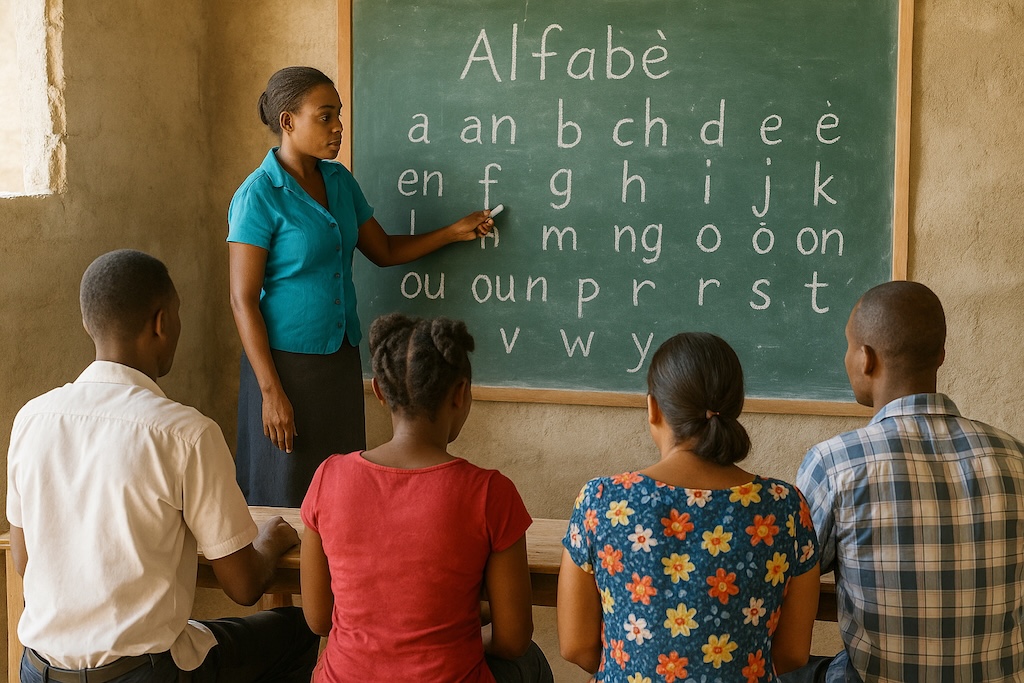
We must go beyond symbolic campaigns. Literacy must be functional: learning to read, write, and calculate to manage a business, understand a contract, access a health service, defend a right, or participate in a local assembly.
Programs should be:
- In Haitian Creole, the language actually spoken and understood by the majority.
- Linked to practical needs: agriculture, trade, health, civic rights, digital technology.
- Offered in markets, churches, schools, community radios, and grassroots organizations.
- Evaluated by concrete results, not just by the number of enrollments.
UNESCO reminds us that the control of literacy in Haiti is the responsibility of the state and that pedagogies must adapt to the crisis.
2. A Free, Secular, and Quality Public School System
The Haitian school system must become an instrument of equality, not a privilege. This requires:
- Construction and rehabilitation of public schools, especially in rural areas.
- Proper training and compensation for teachers.
- Textbooks in Creole and French, adapted to the Haitian context.
- School canteens, transportation, and materials to reduce school drop-out rates.
- Civic education covering rights, duties, institutions, and the fight against corruption.
The goal is not only to reduce illiteracy but also to train citizens capable of analyzing, debating, and controlling.
3. Creation of Productive Jobs
Economic dignity requires real jobs. Public policies must support:
- Local agriculture: irrigation, seeds, rural credit, storage, agricultural roads, and product processing.
- Small and medium enterprises: access to credit, administrative simplification, protection against insecurity.
- Infrastructure: electricity, water, roads, ports, and digital connectivity.
- Vocational training linked to real market needs: construction, agri-food, health, digital, energy, craftsmanship.
Without production and employment, education produces frustrated graduates; without education, the economy remains weak. Both must progress together.
4. Economic Security for Young Graduates
A national professional integration system must be created:
- Paid internships in administrations, companies, and local communities.
- Service grants: the young person works in a school, a health center, or an agricultural project in exchange for an allowance and professional experience.
- Transparent public employment offices, based on merit and published online.
- Support for youth entrepreneurship, with technical and financial assistance.
This would reduce the temptation to view the state as prey to be captured.
5. Fight Against Corruption and Impunity
No educational or economic reform will suffice if corruption remains unpunished. We must:
- Mandatory publication of budgets, public contracts, and assets of senior officials.
- Independent audits of public institutions.
- Effective protection for whistleblowers, journalists, and judges.
- Independent justice, with real prosecutions against those guilty of embezzlement.
- Digitization of public services to reduce intermediaries and informal payments.
Accountability must become visible: citizens must know who received what, for which project, and with what results.
6. Decentralization and Citizen Participation
Municipalities and departments must have budgets, competencies, and local control mechanisms. Citizens must participate in the planning and monitoring of projects: schools, roads, markets, clinics, water systems.
This participation must be accessible to the illiterate: assemblies in Creole, community radio, illustrated posters, discussion groups, monitoring committees that include women, youth, and representatives of popular neighborhoods.
Conclusion
The "double zombification" of the Haitian people refers to a structural process: illiteracy deprives part of the population of the instruments of citizenship, while economic misery deprives society as a whole of the material conditions for autonomy. These two forms of exclusion produce a weakness of citizen control, a dependence on political bosses, and a temptation for some graduates to transform access to the state into a source of enrichment.
The solution is therefore neither the stigmatization of the people nor the simple moral condemnation of leaders. It lies in a simultaneous transformation of education, the economy, and the state: genuinely promoting literacy, massively enrolling students, creating productive jobs, securing young graduates, punishing corruption, and making institutions accountable to citizens. As long as the people remain deprived of knowledge and bread, some of their political energy will remain captive to survival and manipulation.
References
- World Bank. Haiti Poverty and Equity Brief, October 2025.
- World Bank. Haiti Country Overview, 2026.
- World Bank. Haiti Education Statistics.
- UNESCO. "Literacy in Haiti: UNESCO Advocates for the Political Discourse to Align with Reality", 2020.
- UNESCO Institute for Lifelong Learning. Basic Literacy and Vocational Training of Young Adults in Haiti.
- United Nations Development Programme (UNDP). Sectorial Education Report – Haiti.
- International Labour Organization / World Bank. Employment and Unemployment Data in Haiti.
- Le Nouvelliste. Contact Us, lenouvelliste.com/contact.
