

Pradel Henriquez, who lived and studied in France, where he notably obtained a DESS in cultural policy and underwent training in public audiovisual management under the auspices of the École nationale d'administration (ENA), in partnership with CIRTEF, offers an informed perspective on the crisis currently shaking French society. Drawing from his numerous observational visits to major French and francophone media institutions, including France Télévisions, TV5Monde, France 24, France 3, RFI, Radio France, and the newspaper Le Monde, he presents a reflection on the fractures of a society in search of references and renewal.
On Tuesday, November 10, 2026, an elected official from the regional council in Chelles (Seine-et-Marne department) was attacked by an individual who allegedly threw a bottle filled with gasoline at her face, while the smell of fuel spread everywhere and flames engulfed the surroundings.
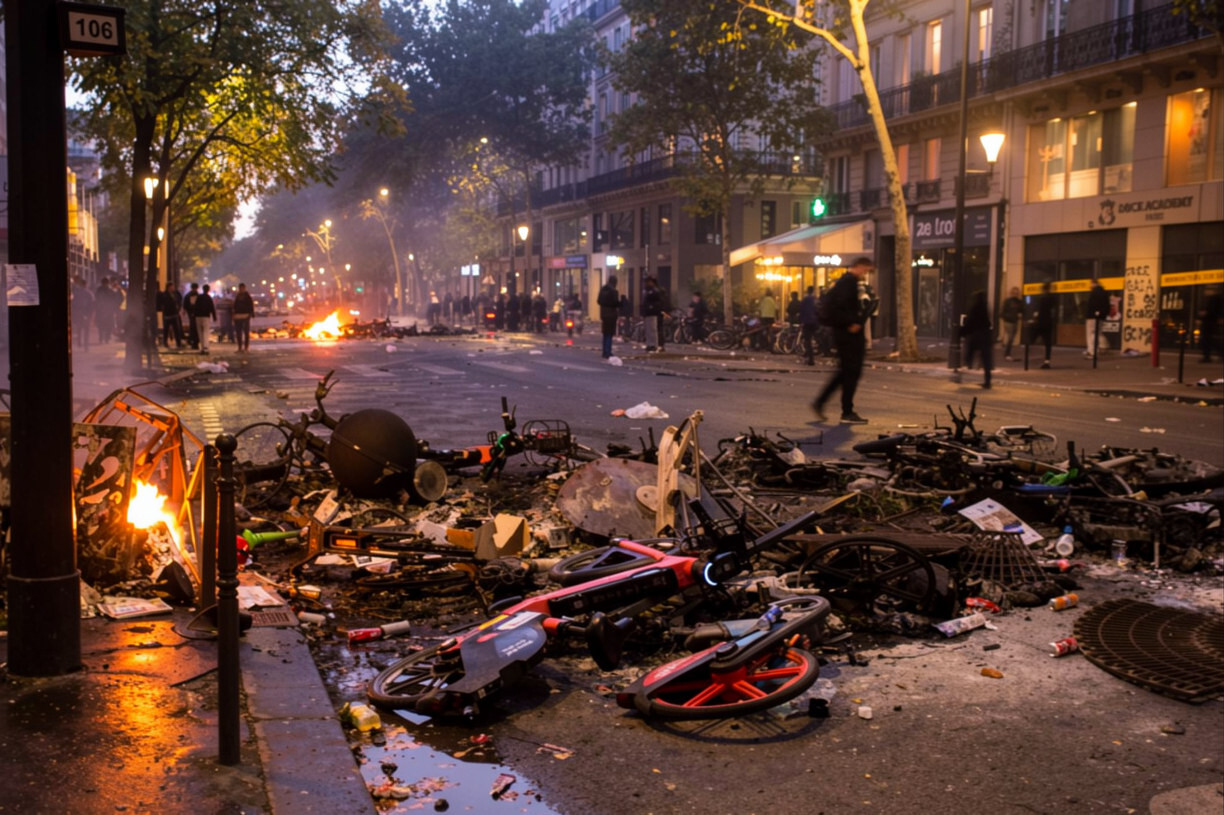
This was compounded by an abundance of burning trash cans. Here in Haiti, we burn tires. In France, they burn the trash cans that remain and persist in the French imagination as an invention of the famous prefect of the Seine in Paris, Eugène Poubelle, between 1883 and 1884.
A journalist from French television, who may not have fully grasped the gravity of the act, hastily categorized the problem as urban violence in his comments. However, in my view, this is an attempted murder.
Urban violence refers to everything happening here and there in the streets and cities: all these wrecks, all these flames, and these endless fires. Just like what has happened at home, in Haiti, over the past forty (40) years, there is a feeling of a country slowly destroying itself: France. My France, would say Jean Ferrat.
However, attacks of this nature against peaceful individuals are not part of the demands.
That said, in France, high schools are burning. The police are beating. For months, the violence has taken all forms: physical assaults of protesters against law enforcement and vice versa, arrests that seem completely arbitrary when observed from afar. And often, there is chaos experienced live on French television. I saw an elderly couple of tourists waving a white flag to escape the scenes of barbarism that the streets of Paris offer us through television and social networks.
There is a simple principle in democracy: the right to express oneself and to protest in crowds, as one wishes, in the streets or even near their training institution. But I always advise decision-makers, this time, to anticipate these phenomena that pertain to our fundamental rights. In the best-case scenario, it is always necessary to act quickly to defuse the crisis before it escalates.
In reality, when a crowd goes out and takes possession of the streets to protest, we know when it goes out, but we never know when or how it will return home. Injured, dead, blinded, destruction of material goods, sometimes even of heritage: and what about the small businesses belonging to people with limited financial resources, whom looters or bandits, taking advantage of the general confusion, sometimes decide to sabotage outright?
Indeed, for several months, the demands of young high school girls and boys have gone unanswered, particularly concerning their operating and living conditions in their schools. If I understand correctly, in some cases, they demand a minimum of operating conditions for a country as powerful on several levels as France. The high school students are asking for teachers. They demand sincere and pragmatic dialogue.
They want their institution to be restored. As André Malraux would say, they want hope. By the way, a principal reports that her institution has been restored. But the work has been poorly done. Odd, isn’t it?
It’s a genuine feeling of underdevelopment and mediocrity. Not to mention the lost time, the time that passes amid all these endless violences, with no end or adequate solutions. Not to mention all these conciliatory meetings between the authorities and the young students or pupils that lead to no real reconciliation. Much ado about nothing.
Not to mention these images of decline and degradation of a country that has exported its models worldwide.
Once upon a time...
It’s more complicated than what we see in politics...
I know this is not just a sectoral matter of education and reform. Everything is connected. Everything is a real plate of spaghetti: bad governance, undervaluation of youth and their values, collective disarray, migration, employment, family education, loss of values in general, end of reign, crisis of conscience.
Political opportunism. Change of system has become mandatory. Lack of overcoming. Disconnection between the rulers and the ruled. Etc.
At this stage, more than the five traditional senses of human beings are needed: hearing, sight, smell, taste, and touch. It is necessary to multiply the senses and demonstrate common sense. One must govern by positioning themselves upstream, acting during the crisis, and always knowing how to project into the future.
Let’s say that the French presidential elections are forthcoming!
René Préval, former president of Haiti, would say in his own way that election periods in a country are never moments of peace and stability.
So to speak, connecting the current demands of high school girls and boys to the approaching electoral stakes concludes, barring a political and civic miracle, that peace is not on the horizon in the land of Voltaire and Emmanuel Macron.
