

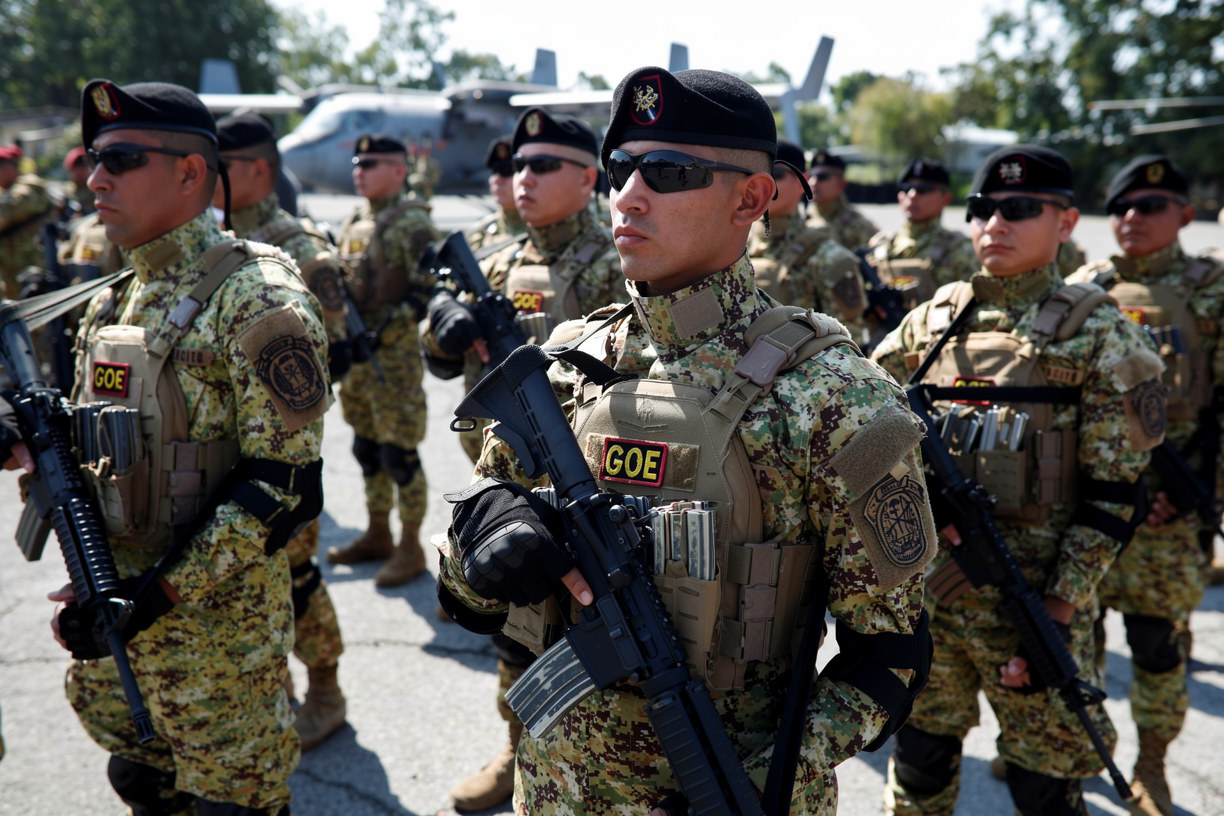
For several weeks, the presence of new Salvadoran military forces in Haiti has sparked a heated debate, which sometimes resembles a true controversy. The positions taken by Salvadoran President Nayib Bukele, as well as the reactions they provoke within Haitian society, reveal deep divergences around three main concerns: national security, sovereignty, and the political future of the country.
Following the disappearance of four Salvadoran citizens, members of the Gang Suppression Force (FRG/GSF), during an armed attack that occurred on October 18, 2026, in Santo, in the municipality of Croix-des-Bouquets, President Nayib Bukele decided, outside the mandate of the United Nations (UN) and in the absence of any signed agreement with Haiti, to send military troops from his country to Haitian territory. While this incident constitutes the immediate cause of this decision, the strategic motivations and political ambitions that may lie behind such an operation deserve a closer analysis.
Indeed, the deployment of over 2,000 heavily equipped Salvadoran troops, as part of the operations to search for the four missing nationals and combat armed groups, raises serious questions. Even though Haitian authorities stated that this cooperation was part of the Gang Suppression Force, some information indicates that the majority of Salvadoran reinforcements may not fall directly under the operational structure of this international force supported by the UN. This situation creates a certain confusion regarding the chain of command, coordination of operations, and the respective responsibilities of the various forces present on the territory.
Thus, several fundamental questions arise: who is really in command of these troops? To whom are they accountable for their operations? What is the exact nature of their mission? What is the duration of their presence? And above all, what guarantees exist regarding the respect for Haitian sovereignty, international law, and the fundamental rights of the population?
These questions are not secondary. They directly touch on the ability of the Haitian state to exercise its authority over its own territory. For, in a sovereign state, no foreign armed force should be able to act without a clearly defined legal and institutional framework, without a control mechanism, and without an obligation to be accountable.
Some compatriots, claiming nationalism and the legacy of Jean-Jacques Dessalines, view this military presence as a form of invasion or, at the very least, as a threat to national independence. Others, on the other hand, see it as an opportunity to escape the hellish cycle of insecurity, after so many years of national institutional impotence and repeated failures of international interventions.
In my opinion, it would be intellectually dishonest to reduce this debate to a simplistic opposition between patriots and anti-patriots. Defending national sovereignty does not necessarily mean rejecting all foreign assistance. Similarly, calling for military intervention to fight gangs does not mean abandoning all democratic and institutional control over the foreign forces present in the country.
The real question is therefore elsewhere: how can we accept foreign security assistance without compromising our sovereignty, national dignity, and our ability to decide our own future?
Bukele's Security Model: An Experience to Consider with Caution
It should also be acknowledged that President Bukele seems to want to project beyond Salvadoran borders a method of fighting against criminal organizations that has enabled him to achieve significant security results in his own country. However, the Salvadoran experience cannot be mechanically transposed to the Haitian reality. Social structures, institutions, political dynamics, and the characteristics of armed groups are not the same.
The Salvadoran model relies, in particular, on a massive mobilization of police and military forces, as well as on exceptional measures that have raised numerous criticisms regarding human rights, arbitrary arrests, and judicial guarantees. Haiti cannot simply import a security model without examining its political, legal, and social consequences.
Moreover, a security policy cannot be evaluated solely based on the number of criminals arrested or neutralized. It must also be assessed in terms of respect for human rights, judicial guarantees, civilian protection, and the sustainable strengthening of public institutions. A military victory that is not accompanied by institutional reconstruction risks producing a temporary lull rather than true stability.
The Security Crisis: A Reflection of the Collapse of the Haitian State
It would be equally naïve to ignore the responsibilities of successive Haitian authorities in the aggravation of this crisis. For several years, the state's inability to guarantee the safety of its citizens, to control its territory, and to restore trust in institutions has gradually created a political and security vacuum that armed groups have largely taken advantage of. Thus, foreign intervention appears, in part, as a consequence of the collapse of our own governance mechanisms.
But we must go further in the analysis. The presence of these forces in Haiti is not merely a response to a security crisis; it also reveals a profound crisis of state authority. When a country can no longer ensure the protection of its citizens, it becomes progressively dependent on the military capabilities, decisions, and strategies of external powers. This dependency can, in the long run, further weaken its institutions and reduce its political maneuverability.
In this regard, it is appropriate to question the true causes of our security dependence. How can a state that won its independence at such significant historical sacrifices find itself in a situation where its security mainly depends on decisions made by foreign leaders? How can we explain that the country of Dessalines, Christophe, and Pétion is experiencing so much difficulty in building institutions capable of guaranteeing its independence and security?
Certainly, the Haitian population, exhausted by violence, forced displacements, kidnappings, massacres, and the lack of prospects, expresses a deep aspiration for the restoration of public order. The protests and statements in favor of vigorous action against the gangs testify to this collective exasperation. It would therefore be unjust to disdain those who see the arrival of Salvadoran military personnel as a hope for liberation from the territories controlled by armed groups.
However, the despair of a population should not be interpreted as a blank check granted to external forces. The legitimate aspiration for security does not exempt authorities from their obligation to ensure transparency, legality, and respect for fundamental rights.
A Military Response Alone Cannot Solve the Haitian Crisis
It is also necessary to avoid confusing security urgency with a sustainable solution to the Haitian crisis. Gangs are not exclusively a military or police problem. Their expansion is also linked to institutional weakness, corruption, social inequalities, impunity, arms trafficking, and political and economic complicities. Therefore, no military operation, no matter how powerful, will be able to solve the crisis sustainably if these structural factors are not addressed.
Ultimately, I believe that the presence of Salvadoran forces in Haiti must be examined with lucidity, without excessive passion or political complacency. We must acknowledge the urgent need to combat gangs, while demanding clear guarantees regarding the legal status, command, duration, and modalities of intervention of these troops.
Our fight against insecurity must not become a pretext for further weakening our sovereignty. Haiti needs security, certainly, but also legitimate institutions, an effective national police, a republican and professional army, an independent judiciary, and a true state reconstruction project.
Thus, it is not about systematically rejecting the necessary assistance from Salvador, nor accepting it blindly. It is about defining the conditions under which this assistance can contribute to restoring security without turning Haiti into a mere testing ground for the military and political strategies of other states.
Sovereignty is not merely about refusing the presence of foreigners on our territory; it is primarily about having institutions capable of deciding, controlling, and fully assuming the responsibilities of the state.
That is why, beyond Bukele's personality and the controversies it raises, the presence of Salvadoran forces should lead us to a more important reflection: are we still masters of our collective destiny, or have we progressively become dependent on the security decisions and strategies of other countries?
A country does not necessarily lose its sovereignty the day it seeks foreign assistance; however, it risks gradually losing it when it is no longer able to define the conditions, limits, and objectives of this assistance.
However, the population, which has suffered for too long from the inertia of our so-called leaders, incapable of fully assuming their regal missions, seems to welcome the help proposed by President Bukele. The various demonstrations of gratitude organized throughout the country in his favor clearly testify to this.
In short, if military assistance from Salvador can genuinely contribute to restoring security in Haiti, it already seems to enjoy the support of a significant part of the population. For any decision regarding the future of a nation should be made taking into account the voice of its people. As a famous Latin adage traditionally attributed to Alcuin, an English intellectual and theologian of the 8th century, reminds us: "Vox populi, vox Dei" (the voice of the people is the voice of God).
