

16% of the national GDP. This is the share that remittances from the Haitian diaspora currently represent in the country's economy, according to data from the Bank of the Republic of Haiti (BRH): nearly 5 billion US dollars sent in 2025, a 20% increase compared to 2024. An indicative figure that reflects a rather brutal reality: a large part of the Haitian economy survives on external life support. However, while this money supports household spending such as purchasing food, school fees, rent, hospital care, etc., the channels through which it flows are today directly threatened by the pressure of international anti-money laundering regulations from the Financial Action Task Force (FATF).
On June 19, 2026, in a statement, FATF kept Haiti on its gray list alongside about twenty other countries like Venezuela, Kenya, and Syria. This ranking is not just a diplomatic symbol. It also entails significant economic risks, and this is where the subject directly intersects with the daily lives of Haitians. In a context where remittances without counterbalancing represent a real lifeline for an economy experiencing nearly eight (8) consecutive years of negative economic growth coupled with a climate marked by a difficult social and security situation. This international compliance threatens far more than local banks; it directly targets families who mostly depend on these remittances from the Haitian diaspora. The triggering indicator of urgency is found in this same statement where FATF indicated that all deadlines for action plans granted to Haiti to exit this list have expired. Consequently, Haiti remains in a vulnerability zone where each foreign bank can, at its own discretion, choose to reduce a relationship deemed too costly to supervise with it.
Haiti and FATF, more than five years of enhanced scrutiny
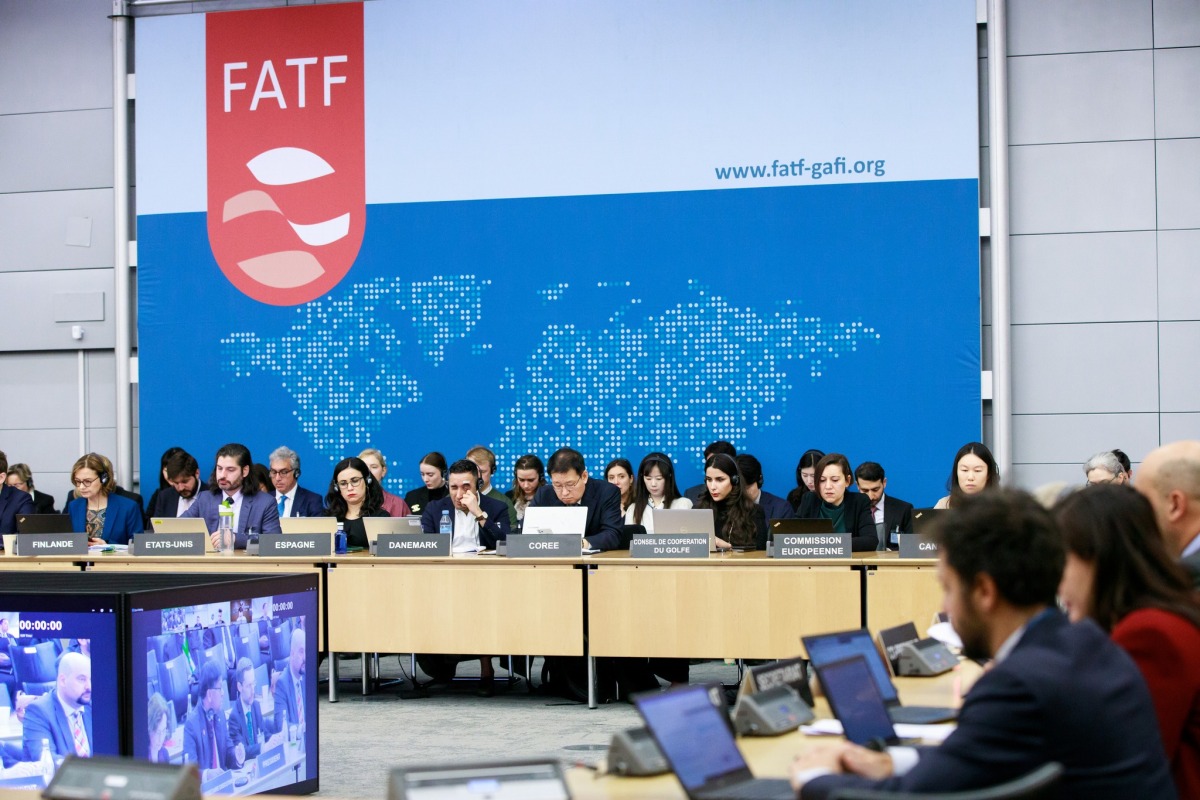
Haiti has been on the Financial Action Task Force (FATF) gray list since June 2021, when the country committed to working with FATF and the Caribbean Financial Action Task Force (CFATF) to correct strategic deficiencies in its anti-money laundering and counter-terrorism financing system. FATF is a global organization that monitors money laundering and terrorist financing; it sets international standards to prevent these illegal activities and the damage they cause to society in general. A country is placed on a gray list when certain strategic deficiencies are identified in its economy through an initial diagnosis: insufficient oversight of financial institutions, lack of transparency regarding the beneficial owners of companies, and persistent weaknesses in handling financial intelligence. While FATF has kept Haiti among the jurisdictions under enhanced scrutiny, it should also be noted that there is a distinction between the gray list, which Haiti is part of, and the black list, the latter being reserved for a limited number of jurisdictions deemed high risk such as North Korea, Iran, and Myanmar.
The country has nonetheless made progress: FATF acknowledges the completion of the national risk assessment concerning money laundering and terrorism financing, as well as the dissemination of its findings. From the Haitian side, Ronald Gabriel, Governor of the Bank of the Republic of Haiti, provides an even more precise figure: out of the 18 actions required to exit the gray list, 2 have been completed, 9 are largely accomplished, and 6 are partially realized. On FATF's official website, six (6) major projects remain identified: strengthening risk-based supervision for certain non-financial professions vulnerable to money laundering; rapid access to information on the beneficial owners of companies; more tangible results in identifying, investigating, and prosecuting money laundering; a demonstrated increase in the recovery of proceeds from criminal activities; correction of technical gaps in targeted financial sanctions; and risk-based monitoring of non-profit organizations, without disrupting their legitimate activities.
The de-risking mechanism: when banks withdraw out of caution
The key concept to understand the real impact of the gray list is called "de-risking". It refers to the strategy by which an institution or company chooses to reduce or cut business relationships with other correspondents deemed too risky. Faced with the reputational and legal risk associated with jurisdictions classified as risky, international correspondent banks—those enabling local financial institutions to operate internationally—sometimes reduce or even sever their relationships with banks and transfer operators from the affected countries. These measures, although hypothetical, nevertheless represent risks that the Haitian economy may face if the current economic situation further deteriorates. Between the reduction of banking correspondent relationships and the higher transfer costs, extended delays, and more restricted banking access for operators; under this scheme, remittances without counterbalancing risk not being able to find channels to transit to Haiti, which would be a huge blow to Haitian families.
A clarification is necessary, without weakening this observation: FATF itself advises against widespread de-risking and does not require any financial institution to automatically sever its relationships with a gray-listed country. Haiti is not, therefore, excluded from the international financial system by decree. But this is precisely what makes the phenomenon harder to combat: it does not result from any written rule that could be contested or evolved. It is an accumulation of individual decisions, made bank by bank, each evaluating whether the maintenance of a relationship with a Haitian institution is worth the cost of the enhanced scrutiny it entails.
This mechanism is not theoretical: the BRH itself illustrates it concretely, albeit in the opposite direction. In a notice dated June 22, 2026, the Bank of the Republic of Haiti reminded the financial institutions in the country of their obligations for enhanced vigilance regarding high-risk jurisdictions on FATF's black list. The notice mentions, among possible countermeasures, "the limitation, suspension, or cessation of the business relationship". This is exactly the type of enhanced vigilance logic that can lead to the termination of a relationship that foreign banks apply, at their own discretion, towards Haiti itself since its ranking. From within the Haitian system, one can better understand what the country endures from the outside.
The Haitian institutional response
In response to these requirements, two (2) Haitian institutions are on the front lines, each with a distinct but complementary role. The Bank of the Republic of Haiti acts as the regulator: a series of circulars (114, 114-1, 114-2, 114-3, 118-1, 95-5, 121-1, 129-1, among others) has progressively strengthened the framework for monitoring transfers and financial operations. Circular 114-3, in particular, channels foreign currencies from diaspora transfers to the formal foreign exchange market; 121-1, published in February 2026, specifically targets money laundering and terrorist financing. This system also relies on a broader legal basis: the Decree of April 30, 2023, which penalizes money laundering, terrorism financing, and the financing of the proliferation of weapons of mass destruction. The Central Unit for Financial Intelligence (UCREF), which is the second state institution, essentially acts as the executor on the ground. Established in 2002 following Haiti's admission to CFATF (the Caribbean branch of FATF), this financial intelligence unit receives suspicious activity reports transmitted by banks and transfer houses, analyzes them, and forwards sensitive cases to the judiciary.
Towards an exit from this gray list
The gray list is not a permanent condemnation. In June 2026, Algeria and Namibia exited it after completing their respective action plans and successfully undergoing on-site visits by which FATF verifies that the reforms are genuinely applied and not merely announced. For Haiti, this is a task that goes beyond the sole responsibility of the BRH: it involves regulators as well as financial operators, the diaspora itself, and international partners who support Haiti's compliance efforts. For a country like Haiti, with 11 of the 18 actions already completed or largely accomplished according to the BRH, exiting the list is therefore not out of reach: it simply requires finalizing a complete institutional chain between financial regulators, financial intelligence unit, judicial police, prosecutors, and courts. A bank, however rigorous it may be in its checks, cannot solely investigate money laundering networks, prosecute their perpetrators, or construct public registries of beneficial owners: the entire state apparatus must function in concert.
Bibliographic references
Financial Action Task Force. (2026, June 19). Public statement on jurisdictions under enhanced scrutiny. https://-www.fatf-gafi.org/fr/countries/detail/-Haiti.html
Caribbean Financial Action Task Force. (2019). Fourth round mutual evaluation report: Republic of Haiti. CFATF. https://-www.cfatf-gafic.org/home/cfatf-news/565-fourth-round-mutual-evaluation-report-for-the-republic-of-haiti
Bank of the Republic of Haiti. (2026, June 22). Notice to financial institutions: high-risk jurisdictions.
Republic of Haiti. (2023, April 30) Decree sanctioning money laundering, terrorist financing, and financing of the proliferation of weapons of mass destruction. Le Moniteur, (Special No 12)
Press
Alphonse, R. (2026, October 7). When Governor Ronald Gabriel addresses the “economic and financial issues of migratory dynamics in Haiti”. Le Nouvelliste
Joseph, L. (2026, July 22). BRH: the update on the economic and financial situation of the country. Le National. https://www.lenational.org/article/politique/8174/brh-le-point-sur-la-situation-economique-et-financiere-du-pays
Moreau, J.F. (2026, September 24). FATF: why Haiti's position on the gray list threatens far more than its banks. Juno7
