

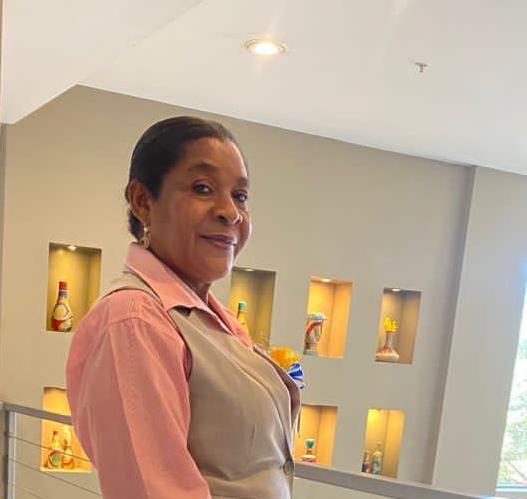
What a moment of profound sadness this Saturday evening, October 31, 2026! As nothing prepared me for such news, Phoebe, Claudette's eldest daughter, called me from the United States, where she is continuing her university studies. With a voice full of emotion, she simply said to me: "Uncle Cadet, be brave, I no longer have a grandma."
Those few words were enough to turn my world upside down. I was literally devastated. For a few moments, I felt like I was living a nightmare, facing a reality that my mind refused to accept. How could I believe that Claudette, such a dear friend, such a sister of the heart with whom I shared more than forty years of exceptional friendship, would no longer be among us?
A few months ago, Master Claudette Belfont had expressed her concerns about her health. Her doctors in Haiti had recommended that she continue her investigations and treatment abroad, following concerning gastric problems. She had then gone to the United States, where, upon her arrival, welcomed by her younger sister Yolette and her two daughters, she had to be rushed to the hospital. Unfortunately, medical examinations revealed stomach cancer.
This was followed by a particularly challenging period. She underwent two chemotherapy sessions, facing the disease with courage and determination. Despite the seriousness of her condition, she kept in touch with me almost daily. She asked me to pray for her and to also ask her friends and loved ones for their prayers. These exchanges testified to her attachment to life, her faith, and her immense desire to overcome this terrible ordeal. Unfortunately, despite her courage, will, and the efforts made, the disease ultimately took its toll on her resilience.
With Claudette's departure, a part of myself goes with her, a part of my history that is brutally amputated.
I met this exceptional woman, originally from Torbeck, at Collège Frère Bourvier in October 1984. Our relationship quickly transformed into a deep and sincere friendship. Immediately after obtaining our baccalaureate, we both embraced a teaching career, alongside another mutual friend, John Wesley Charles, who would later become my wedding godfather.
Since then, no event, circumstance, or distance has managed to weaken the bonds that united us. Our friendship has endured the decades without any breaks, distrust, or enmity. Her house was mine; her brothers and sisters considered me their brother, while her parents welcomed and treated me like their own son.
Claudette was, for more than forty years, my best friend, a true friend, whose presence in my life went far beyond the limits of a simple friendship. She was much more than a sister to me. She was that person with whom you can share everything, without fear of being judged, without the need to justify oneself, and without doubting the sincerity of one's feelings.
An anecdote perfectly illustrates the uniqueness and strength of our relationship. My photograph was on her WhatsApp profile. One day, a friend of her husband Jean-Robert Charles, a doctor and biology professor, called her to ask, in an astonished tone: "What's going on? Isn't it true that your wife has put another man on her profile?"
Dr. Charles's response was as simple as it was revealing: no one could meddle in the old and solid friendship that united these two people.
This anecdote, which might make one smile, actually conveyed a truth known to all who frequented us: our friendship was transparent, respectful, and profoundly fraternal. My wife herself, who knew perfectly well the nature of our relationship, had become much more than a friend to Claudette: she was her sister. This is what we had built over the years: an unambiguous relationship, based on trust, respect, loyalty, and an unshakeable mutual affection.
Claudette was a woman of remarkable simplicity, well-educated, cultured, and deeply humane. Generous, sensitive, helpful, dynamic, and always available for others, she possessed that rare quality of knowing how to listen, advise, reassure, and provide comfort. She meant a lot to me: a loyal friend, a sister of the heart, a wise legal advisor, a precious confidante, and a dedicated lawyer.
Master Claudette Belfont's professional journey also deserves to be highlighted, as it reflects her competence, determination, and commitment to the service of law and Haitian institutions.
Before taking the helm of her own law firm, she had already gained solid professional experience, particularly by taking over the office of the late Master Pierre Delva. This experience had allowed her to consolidate her knowledge, assert her management skills, and further develop her legal practice.
However, her experience was not limited to private legal practice. She also put her skills at the service of the Haitian public administration. She notably served as director of Legal Affairs at the National Penitentiary Administration (APENA), then led by Mr. Cliford Larose. She also worked as a lawyer at Electricity of Haiti (ED'H) and the Office of Third Party Vehicle Insurance (OAVCT).
These various responsibilities illustrate the diversity of her experience and the trust that several institutions placed in her professional skills. From private legal practice to public administration, Claudette was able to put her legal knowledge, sense of responsibility, and experience to the service of various structures in Haitian society.
The management of her own law firm thus constituted the culmination of a professional journey built progressively, through hard work, perseverance, and the acquisition of diverse experience. She was not simply a lawyer practicing a profession; she was a fulfilled professional, whose journey deserves recognition and whose disappearance also leaves a void in the Haitian legal community.
Her influence extended far beyond her personal relationships. All the people who had the privilege of knowing her could appreciate her human and professional qualities. The members of my office, at the time when I served as Minister of National Education and Vocational Training, notably DC Jackson Pléteau, Charlotte B. Cadet, Haspil Rivière, Ronyde B. Imbert, Miloody Vincent, Karine Sanon, Harold Narcisse, Emmanuel Bernard, Micheline Louis, Raphaël Joseph Antoine, Jean Mary Clerveaux, Lourdes Édith, Johnny Mertilus, and Théophile Yolmide, to name just a few, held her in deep esteem. They appreciated her availability, intelligence, sense of human relations, and the quality of her contributions.
This consideration was equally evident in the judicial world, where she had managed to earn the respect and esteem of many legal professionals, including the dean of the Port-au-Prince Court of First Instance, Me Bernard Sainvil, as well as in the academic community.
At the Faculty of Law and Economic Sciences (FDSE) of Port-au-Prince, as in several private universities where she taught, Claudette was particularly appreciated by her students. She did not just convey legal knowledge; she was invested in their intellectual and human development. She was attentive to their concerns, eager for their success, and always willing to provide her support.
In reality, Claudette was not just a teacher, a lawyer, or a woman of duty. She was a true school of humanity. She embodied kindness, wisdom, generosity, and a sense of sharing. Her culture, experience, and knowledge constituted a wealth that she willingly put at the service of others. She knew how to find the right words in difficult moments and offer a comforting presence when circumstances became challenging.
