

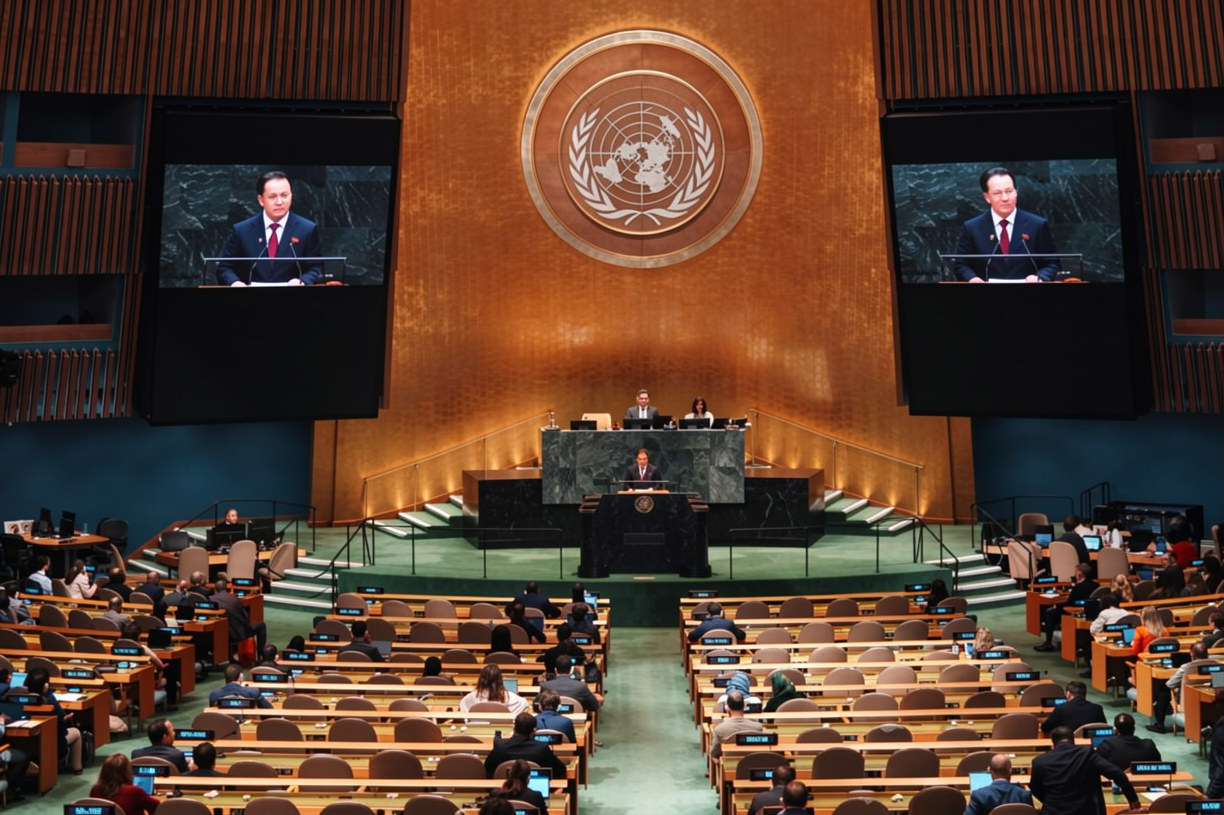
The general debate of the 81st session of the United Nations General Assembly, held from September 22 to September 28, 2026, at UN headquarters in New York, USA, has concluded after the participation of 194 delegations and 113 Heads of State and Government around the theme "Restoring Trust, Driving Transformation." The most striking feature of this debate is a structural paradox: the rhetorical defense of multilateralism has reached its highest level in years, while doubts about the real effectiveness of multilateral institutions have deepened in equal measure. Artificial intelligence, which has moved in four (4) years from a marginal concern mentioned by five (5) delegations to a central issue discussed by one hundred twenty-eight (128), embodies precisely the dilemma of contemporary global governance: humanity possesses unprecedented technical capabilities but increasingly lacks the collective political will necessary to master them. Indeed, the tone of this general debate was aptly summarized by the President of the General Assembly, Khalil Rahman, in his closing remarks: "One word dominates all others, peace." However, the meaning of peace has undergone a subtle but significant shift during this debate. It is no longer presented as a distant ideal, but as an urgent defense of the 1945 United Nations Charter and international law. In fact, this rhetorical shift betrays a profound anxiety about the ability of existing security architecture to function effectively. The debate took place in the context of multiple and overlapping crises: a fragile ceasefire in Gaza, a stalemate in the war in Ukraine, persistent tensions with the Islamic Republic of Iran, while the Security Council repeatedly bogged down in disagreements between major powers. President Rahman stated bluntly at the closure: "The UN truly functions when the Security Council plays the role that is rightfully its own." This seemingly innocuous phrasing precisely suggests a worrying reality: the Security Council, on too many occasions, has not played that role. Hence the critical importance of the central question of our analysis: in a context of continuous widening of the trust deficit and acceleration of technological transition that disrupts existing governance frameworks, can the multilateral order embodied by the United Nations achieve the substantial shift from a discursive consensus on its indispensability to an effective institutional capacity to deliver results? The objective of this article is to critically analyze the 81st session of the United Nations General Assembly, from September 22 to September 28, 2026, in order to highlight the central paradox that runs through it. To this end, this text is structured around four (4) fundamental key themes: 1. The political moment of artificial intelligence: from a technical agenda to a governance fracture; 2. The temporal politics of development commitments: urgency of the SDGs and structural injustice; 3. The paradox of reform: restructuring and power avoidance; 4. Restoring trust: from rhetoric to institution.
1. The Political Moment of AI: From a Technical Agenda to a Governance Fracture
The most significant transformation of this debate undoubtedly lies in the spectacular rise of the issue of AI over the past several years. Indeed, in his closing speech, President Khalilur Rahman provided an unprecedented striking statistical comparison: four years ago, only five (5) delegations mentioned artificial intelligence in the General Assembly chamber; this year, that number rose to one hundred twenty-eight, surpassing the number of delegations that referred to climate change or human rights. In fact, the substance of this numerical change lies in the conversion of AI from a technical governance issue to a geopolitical distribution question. President Rahman precisely articulated the common anxiety of leaders: "Who designs it? Who benefits from it? Who bears the risks?" Citing a speaker, he formulated the issue thus: "No machine has democratic legitimacy, no algorithm inherits constitutional responsibility," thus shifting the core of the problem from technical efficacy to political legitimacy.
From the perspective of critical theory and the views of many geopoliticians, this turn reveals a fundamental flaw in the current architecture of global governance. As British political scientist David Jonathan Andrew Held has pointed out in analyzing the "fractures of global governance," when power shifts from nation-states to transnational actors and market forces, the chain of democratic accountability risks breaking. Indeed, the governance of AI is precisely the typical scenario of this break, with the control of computing power and data concentrated in the hands of a few states and companies, while all of humanity feels the effects. Therefore, President Rahman's warning about a "new divide," with a small number of countries and companies dictating the rules that shape the future, constitutes precisely the most recent manifestation, in the digital age, of the gap between governance and the governed diagnosed by the expert in political theory and international relations, David Held.
It is worth noting that President Rahman also emphasized that member states must be at the heart of this work. This is essentially a cautious correction of the multistakeholder governance model. In the field of AI, governance solely by technical experts as well as governance solely by the market have both proven inadequate in the face of distributional consequences and security risks. As a fundamental bearer of democratic legitimacy, the state must regain a central place in the regulatory framework, although this assertion itself clashes with the reality of a deep asymmetry of technological capabilities between developing countries.
2. The Temporal Politics of Development Commitments: Urgency of the SDGs and Structural Injustice
In fact, while AI represents the anxiety of the future that is already here, the Sustainable Development Goals (SDGs) embody the dilemma of a past that will not pass. President Rahman made an unequivocal judgment in his closing remarks. According to him, only a very small number of SDGs are progressing as planned, and advancements are at a standstill. He thus asked himself if he could have done more, and his answer was, "The answer must be a resounding yes."
Indeed, behind this self-criticism lies a deep temporal politics. With less than five (5) years until the 2030 deadline, we can observe that the development finance deficit, debt pressure, and climate vulnerability form mutually reinforcing vicious circles. President Rahman pointed out a structural injustice that has been denounced many times but never corrected. The countries that most urgently call for development financing are precisely those that bear the heaviest debt burden, thus having the most limited budgetary space and enjoying the weakest voice in the institutions that shape the global economic order.
This observation echoes Enrique Dussel's critical analytical framework on "dependence" and "liberation." Indeed, Dussel, in his Ethics of Liberation, demonstrates that the "center-periphery" structure of the global order is not the product of a natural evolution but of asymmetrical institutional arrangements that are continually reproduced. The distribution of voting rights in the international financial architecture, the technological monopoly in intellectual property regimes, the constant erosion of the principle of common but differentiated responsibilities in climate negotiations; these mechanisms together constitute the impasse that President Rahman describes as one where those who have a voice lack power, and those who have power lack a voice. He also called for a reform of the international financial architecture, for affordable and accessible financing, for the expansion of fiscal space, and for the strengthening of productive capacities. Thus, these recommendations are not new in themselves; their significance lies in the fact that they are articulated so directly by the President of the General Assembly in his closing remarks, indicating that this issue has moved from a claim for technical adjustment to a fundamental challenge to the legitimacy of the existing global economic governance.
3. The Paradox of Reform: Restructuring and Power Avoidance
For several years, reform of the United Nations has been another recurring theme in this debate. However, the definition given by President Rahman deserves very careful reading. Reform is not just about adjusting structures, reducing budgets, or reorganizing budget lines; its measure lies in the UN's ability to provide better, faster, and more equitable services to the populations it serves. The subtext of this definition is clear: discussions on reform that have been conducted for years often revolved around technical aspects, while avoiding fundamental political questions. He explicitly identified this central problem. For him, Africa's exclusion from permanent member status on the Security Council constitutes a persistent injustice, and any reform agenda that does not therefore address this question cannot be considered complete.
From the perspective of institutional theory, and the views of many experts in international relations, the Council's dilemma can be apprehended through the framework of path dependence and critical moments. For them, the UN system was formed in a specific power configuration in 1945, and its decision-making rules as well as the distribution of representation rights found themselves locked in the power balance of that moment. Paul Pierson, an American political science professor specializing in comparative politics and the holder of the John Gross Endowed Chair of Political Science at the University of California, Berkeley, in analyzing the mechanisms of increasing returns in political institutions, emphasizes that once established, institutions generate powerful self-reinforcing effects, such that the cost of deviating from the initial trajectory increases over time. If Security Council reform is constantly blocked, it is precisely because it requires current holders of power to voluntarily relinquish their institutional privileges or dilute them, which, in political science, is a paradox akin to self-revolution.
Many say that President Rahman's choice to make this paradox public thus has a strategic significance: to shift the discussion on reform from the discursive framework of improving efficiency to the normative framework of justice and representativity. For geopoliticians, the question of whether this shift could generate sufficient political pressure to break the pathway lock would constitute a crucial test for the remaining sessions of this General Assembly and for the tenure of the next Secretary-General.
4. Restoring Trust: From Rhetoric to Institution
Restoring true trust is the key theme of this debate and the heart of President Rahman's mandate. However, his discourse on trust contains a sharp judgment that risks being overlooked: trust is not decreed; it is earned through consistency between words and actions. In fact, the target of this formulation is clear: in international relations, the erosion of trust often stems from a systemic rupture between the commitments made and their implementation. States reaffirm in the Assembly their attachment to the Charter, their respect for international law, their guarantees of development financing, but the gap between these words and actual political choices constitutes the substantial source of the trust deficit. The conditions for restoring trust enumerated by President Rahman are the equal application of international law, respect for commitments, true representativity, transparency, accountability. Thus, these conditions point to concrete defects in the existing international order, rather than to an abstract moral appeal.
Anthony Giddens, British sociologist, university professor, Professor of Sociology at the University of Cambridge, and former Professor of Sociology at the London School of Economics, in analyzing the "consequences of modernity," distinguishes face-to-face commitments (trust established in person interaction) from faceless commitments (trust given to abstract systems). In fact, the UN's dilemma lies in the fact that it simultaneously depends on these two trust mechanisms, and both are under pressure. On one hand, face-to-face diplomacy among leaders, one of the essential functions of the general debate, continues to play a role in establishing personal trust during bilateral meetings. On the other hand, trust in the UN as an abstract governance system continuously erodes due to the paralysis of the Security Council, unfulfilled development promises, and double standards in human rights. Indeed, President Rahman's discourse on coherence between words and actions constitutes, at its core, a call to repair this second type of trust, trust in the system itself, which requires not more diplomatic rhetoric but rather commitments to institutional reform.
In conclusion, the general debate of the 81st session of the General Assembly closed with a meticulously calculated optimism. The interventions by 194 delegations and the presence of 113 Heads of State and Government in themselves constitute a reaffirmation of the ritual value of multilateralism. However, President Rahman's closing speech reads more as a diagnosis than as a panegyric: peace must be defended urgently, the time for development is running out, AI governance risks creating a new divide, and trust can only be earned through consistency between words and actions. The deepest paradox of this debate lies in this: the UN, as a central platform for global governance, sees its indispensable character confirmed more broadly than ever in the discourse, while its effective capacity to deliver results is subject to ongoing doubts due to multiple structural constraints. Many international relations specialists say that if the emergence of the issue of AI has revealing significance, it is precisely because it pushes this paradox to its extremes: humanity possesses technical power capable of transforming everything, but has not yet built the necessary collective political mechanisms to master it. President Rahman called for substantial results from the closure. The criteria for evaluating these substantial results may not lie in the number of resolutions passed or meetings held, but in the ability to achieve even a limited breakthrough on the following issues: Can AI governance move beyond human-centered rhetoric to establish binding international standards? Can the development financing architecture shift from a charitable model to a justice model? When the next Secretary-General succeeds António Guterres on January 1, 2027, what type of UN will he inherit from an Assembly shaped by the restoration of trust, a UN that has begun to honor trust, or a UN that is still waiting for it to be honored?
Bibliographical References
- DUSSEL, Enrique, Ethics of Liberation, Paris, Editions L'Harmattan, 2003.
- GIDDENS, Anthony, The Consequences of Modernity, Paris, Editions L'Harmattan, 1994.
- HELD, David, Democracy and Global Order: From Modernity to New Challenges, Paris, Editions La Découverte, 2005.
- United Nations, General Assembly, 81st session, Closing Speech by the President of the General Assembly, H.E. Mr. Khalil Rahman, New York, September 28, 2026.
- United Nations, General Assembly, 81st session, General Debate, agenda and list of speakers, New York, September 22-28, 2026.
- United Nations, United Nations Charter, San Francisco, June 26, 1945.
