

Should we wait until every child is enrolled in school before investing in university and research? The 1987 Constitution makes mass schooling the primary responsibility of the State. But this priority will not be realized without trained teachers, without knowledge about our schools, and without institutions capable of producing it.<\/strong><\/p> Article 32-2 of the 1987 Constitution establishes that mass schooling is the primary responsibility of the State and local authorities. A reader rightly pointed this out to me when I advocated for the development of higher education and research: in a country where access to school remains so difficult, shouldn't resources first go to children?<\/p> The question is legitimate, but Article 32-2 should be read alongside neighboring articles. Article 32 recognizes the right to education. Article 32-1 asks the State to make school freely available to all and to ensure the training level of teachers. Article 32-3 makes primary education compulsory. The phrase "primary responsibility" sets a priority order; it does not set a budget key nor prescribe the suspension of other levels. Conversely, invoking the needs of the university to downplay the obligation to educate children would be equally unjustified.<\/p> A system can increase the number of enrolled students without improving what they learn: expansion measures access, not learning outcomes. Educational sociology has long reminded us of this. Prost distinguishes quantitative democratization from qualitative democratization, Merle proposes a typology, and Dubet questions what constitutes a just school. When I facilitated, at the University of Paris-Est Créteil, the practical work of a sociology of education course, the study of the school map and the Haby reform of 1975 showed that these access reforms had not sufficed to eliminate social differences in success.<\/p> In Haiti, the disparities between establishments, territories, and families are well-known. The issue is therefore not to oppose quantity to quality: we need to expand access, reduce inequalities, and improve learning conditions. This requires financial resources, but also skills, knowledge, and institutions capable of organizing and evaluating interventions.<\/p> Article 32-1 charges the State with ensuring the training level of teachers. Data from the MENFP show the scale of the task: in 2024-2025, fundamental education had 82,180 teachers, of whom 36% were graduates of normal schools and 40% were CAPES holders. These figures do not measure teaching quality, but they indicate that initial and ongoing training remains a significant challenge.<\/p> Having knowledge is not enough to mobilize it in the classroom, and occasional training, detached from encountered problems, produces few lasting effects. In my work on communities of practice among teachers, carried out in the EFACAP networks of Marigot and Mersan, teachers confront their experiences, analyze their difficulties, and collaboratively build responses over time and within their institution.<\/p> The university is involved in initial training, preparing trainers, and producing knowledge about practices. However, it does not guarantee pedagogical competence: everything depends on the articulation between academic knowledge, professional experience, and reflective analysis, a guiding thread of my research on the validation of experiential learning.<\/p> Research is not an academic luxury distant from school. It primarily serves to understand: a rural school and an urban institution do not face the same challenges, and national policies need fairly precise knowledge to account for this. It also serves to design and experiment with solutions, whether for teacher training, pedagogical resources, student support, or governance of institutions.<\/p> Finally, it serves to evaluate. The number of trained teachers or organized meetings provides insight into how a system functions; it does not establish that learning improves. To do so, we need indicators, comparable data, and a method. Without national research capacities, a country finds it more challenging to define its priorities, to evaluate the models proposed by its partners, and to assess what is being done on its territory. It is not about refusing international cooperation, but about fully participating in defining problems, conducting research, and interpreting their results. However, there must be institutions that organize dialogue between researchers, public officials, and field professionals: knowledge does not automatically transform into decisions.<\/p> In 2024-2025, 86% of fundamental schools and 76% of students belonged to the non-public sector. In higher education, the diagnosis of the 2020-2030 ten-year plan reveals that 82% of surveyed institutions are private and that the lack of a normative and regulatory framework hinders its organized development, with two bills not having been voted on. Under such conditions, regulation, teacher training, and the production of reliable data cannot rely solely on the initiative of the institutions.<\/p> According to UNICEF, more than 1,600 schools were closed in 2024-2025. The safety of students and teachers, access to institutions, and pedagogical continuity are immediate obligations of the State, and no university investment substitutes for these responsibilities.<\/p> But the crisis also strengthens the need for national capacities: supporting students whose schooling has been interrupted, training teachers faced with new situations, reorganizing educational services, evaluating the responses provided. It is not about choosing between urgency and reconstruction, but about organizing their complementarity.<\/p> Three orientations follow from this. First, accompany<\/strong> each increase in school places with a reflection on the availability of teachers, their training, pedagogical resources, and team support. Next, make initial and ongoing training a priority<\/strong>, designed based on the needs of institutions with teachers, directors, pedagogical advisors, and higher education institutions.<\/p> Finally, integrate research into transformation policies<\/strong>, through programs that bring together universities, schools, and administrations around fundamental learning, school inequalities, and teacher training, without reducing research to a technical service. This also requires training researchers, financing them, and disseminating their work.<\/p> The real question is therefore not whether Haiti should choose between educating its children and developing its universities. It is about building a system capable of ensuring access to education, the quality of learning, and the production of the necessary knowledge for its own development at the same time. Fundamental schooling needs the university, just as the university needs a successful school.<\/p> Hervé Boursiquot is a doctor of educational sciences, author of Diplômes, compétences et validation des acquis de l’expérience en Haïti (L’Harmattan, 2023) and Communautés de pratique d’enseignant-e-s : défi du relèvement de la qualité de l’éducation en Haïti (L’Harmattan, 2024).<\/i><\/p>A constitutional priority, not a hierarchy<\/strong><\/h2>
Schooling does not mean making students learn<\/strong><\/h2>
Training teachers: the university is involved<\/strong><\/h2>
Research: understand, design, evaluate<\/strong><\/h2>
A largely non-public and poorly regulated system<\/strong><\/h2>
The urgency does not allow us to forgo construction<\/strong><\/h2>
For an integrated educational policy<\/strong><\/h2>
Fundamental Schooling Needs University
Should we wait until every child is enrolled in school before investing in university and research? The 1987 Constitution makes mass schooling the primary responsibility of the State.
Par Hervé Boursiquot, Ph.D.
15 Oct 2026 — Lecture : 5 min.
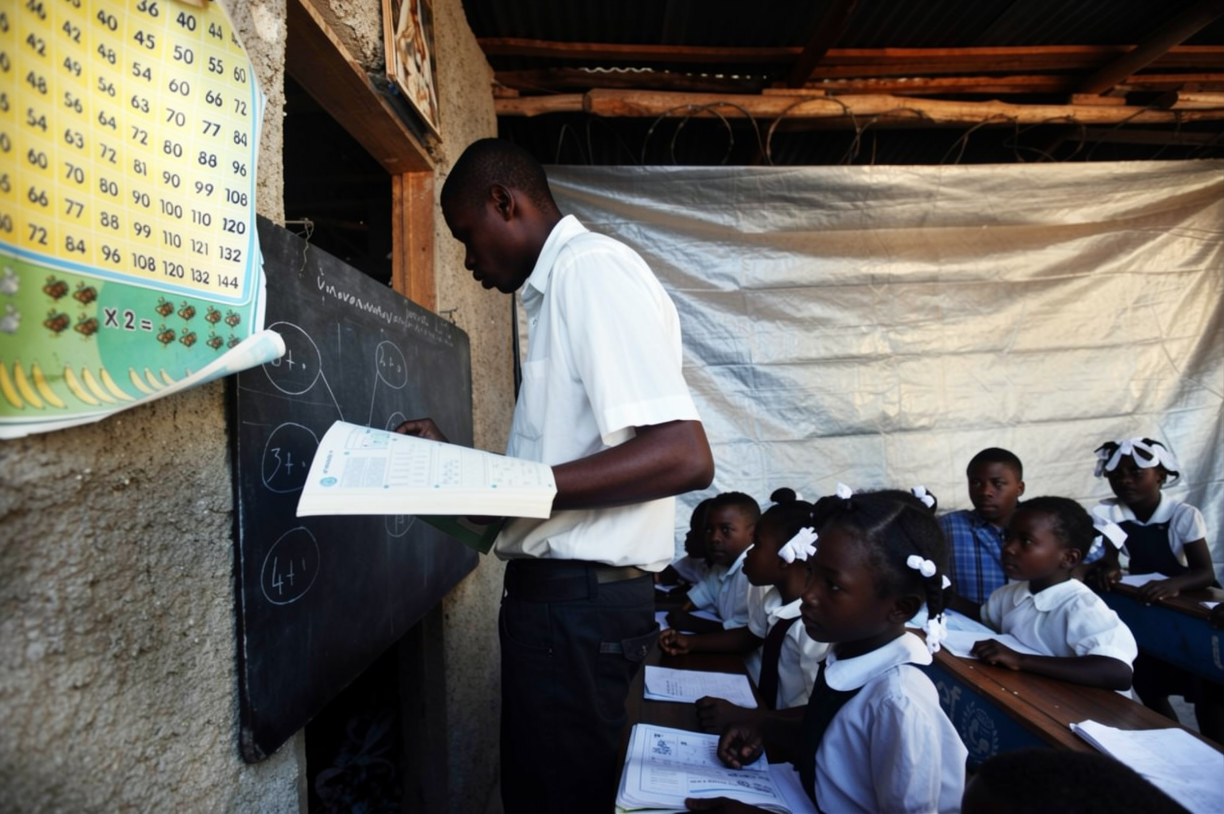
Enseignant dans une salle de classe
