

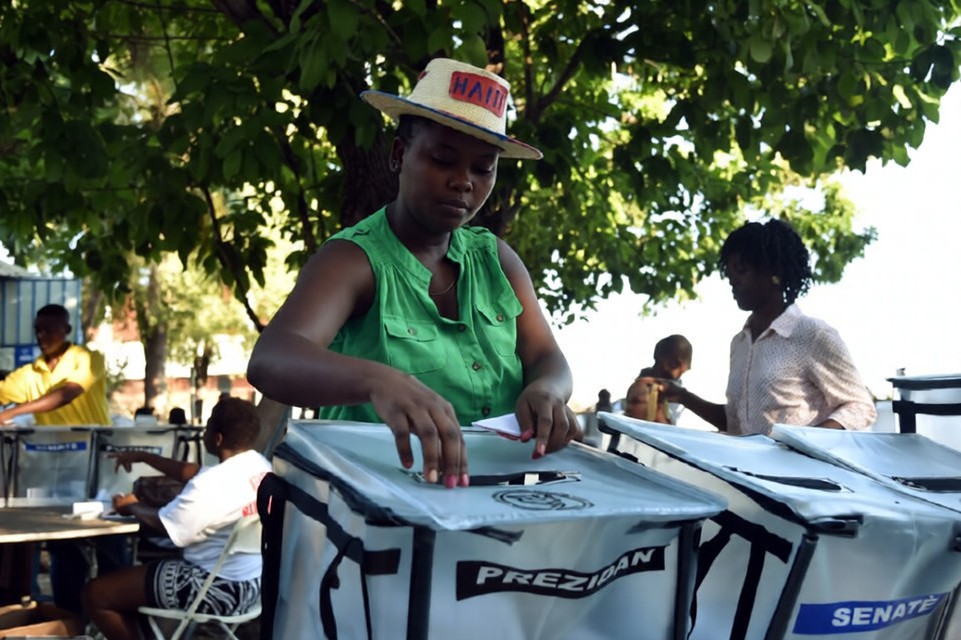
The recently amended electoral decree raises numerous questions, both within the political class and civil society, as well as among Haiti's friendly countries. For several months, the debate has crystallized around one question: should the participation of political figures who have been subject to bilateral or multilateral sanctions be allowed?
Some organizations call for the outright exclusion of all sanctioned individuals. This viewpoint seemed to prevail in one version of the decree, with a decisive impact on the participatory nature of the process. Several voices then rose against this approach, reminding of the need to scrupulously respect constitutional requirements in this matter and to prevent new post-electoral crises that would be triggered by the unconstitutional exclusion of major parties and political figures.
The situation took on a whole new dimension with the publication of a report by the United Nations Expert Group implicating numerous personalities in the political and social landscape. Its timing, coinciding with the release of the new version of the decree, suggests that foreign powers disapprove of certain provisions of this text.
However, upon analysis, a more subtle question arises: where is the fracture between the moral line and the legal line?
I. The Electoral Decree: Power, Scope, and Limits
The first point is to ask why we resort to an electoral decree and what its power, scope, and limits are.
As pointed out by barrister Dorval, to whom I pay tribute here, the Haitian Executive becomes legislator in the absence of Parliament. This is not a simple vacancy but a true absence: for six years, the legislative power has disappeared from the institutional and political architecture of the country. The first of powers according to Montesquieu, the one that makes the law, is erased from the landscape of Haitian governance. In light of the block of constitutionality and constitutional tradition, the decree thus becomes the path and instrument of normative production, even if it is exceptional and formally impossible, due to the inability to complete the constitutional formality.
It should be remembered that the process of law-making, whether using the project or proposal route, is scrupulously framed by the Constitution and Haitian parliamentary law. Beyond this procedural labyrinth, and without overlooking the constitutionally recognized right of objection of the Head of State, the law is always subject to public debate, accessible to all, which allows the population to know the political positions, the arguments and criticisms directed against the examined text. It often happens that the initial text substantially differs from the one that is finally promulgated and published, due to underlying stakes.
The drafting of a decree follows an entirely different route. When it is not the result of an internal office or financial or political interest groups, the text can simply be transmitted by an accredited diplomatic representation, without a cover letter or formal announcement. No prior public commitment, no identified political bearer, no political or technical debate: the Executive announces via a press release the adopted texts, the content of which is only revealed once published in the official journal.
This results in a true shock: a legislative standard adopted without prior communication or debate, whose gaps, shortcomings, discrepancies, and distortions the public only discovers afterward. At best, these provoke tensions; at worst, they lead to crises even more acute than the previous ones.
The recurrence of amendments to the electoral text only weakens the process. The value of a law lies in the strength of its drafting process and the legitimacy surrounding its adoption. The decree, for its part, is adopted in the Council of Ministers based on a text whose origin is often unknown and whose bearer remains outside of public debate. Should it be recalled that in participatory democracy, the population must be consulted, or even have the initiative of the norm, through referendum or popular consultation?
II. The Expert Group Report: The Moral Line
In light of the unanimous acknowledgment of the collapse of entire sectors of public power in Haiti, the United Nations has set up an Expert Group tasked with conducting investigations and producing reports for potential sanctions against individuals and personalities targeted by allegations. This externalization of the dual security and humanitarian crisis leads the international community to seek to identify the authors and intellectual co-authors of the current criminal debacle. This is an exceptional advance, though it confronts the rigorous examination of the principles of law and justice enshrined by our legal system.
This heavy reality invites us to situate the UN report on the moral line: it aims to raise awareness and, perhaps, lay the groundwork for potential legal actions, which must themselves submit to the rigors of norms and jurisprudence regarding any person implicated.
What emerges from this imbroglio is the endemic weakness of a judicial system that struggles to meet the aspirations of a population in absolute search of justice.
III. Elections Must Comply with the Legal Line
The organization of general elections, which aims to restore democratic and republican order and to sustainably prevent its disruption, must comply with the legal line. This line is conceived, studied, adopted, and enshrined by the Law, understood in the broad sense as the entirety of constitutional, conventional, and legal provisions that form our legal corpus. The hierarchy of norms, universally recognized, places the 1987 Constitution above any other text: law, convention, decree, regulation, or report. It is what sets the framework, raises shields, and establishes safeguards. The debacle for which we are currently paying the ineffable price stems precisely from its recurrent disrespect.
The tumultuous debate triggered by the adoption of the latest version of the electoral decree, overshadowed by the publication of the Expert Group report, highlights the decay and indignity into which our nation is sinking. Representatives of friendly countries take positions on fundamental issues affecting our sovereignty, even as, in several of these countries, repeat offenders run for election at all levels of internal and community elections. However, judicial sovereignty cannot be subjected to admonitions from friendly or third countries, whether large or small.
This debate also reveals a classic hypocrisy, marked by laziness and decay: an acknowledgment of irresponsibility. A text of legislative nature must respect the requirements of legality, from its production to its publication. The electoral decree cannot replace or establish moral safeguards, however legitimate they may be. The commitment must focus on the nature of the choices, not on their profile. Democracy adheres to rules and criteria that themselves are subordinated to the rule of law: this is the only way to escape the ruts of this long political crisis.
Conclusion: Make the Ballots a Popular Verdict
Finally, this debate compels us, as a people and society, to make the electoral process a genuine moment of political deliberation on people, ideas, and projects. Through the ballot boxes, the nation must take into account the existing institutional framework and the reality of the moment. All available information must serve as indicators to transform the ballots into true popular verdicts. The upcoming elections will thus express a commitment to men, women, projects, and visions, and a severe sanction against other men, other women, and other political parties, as has been seen elsewhere.
