

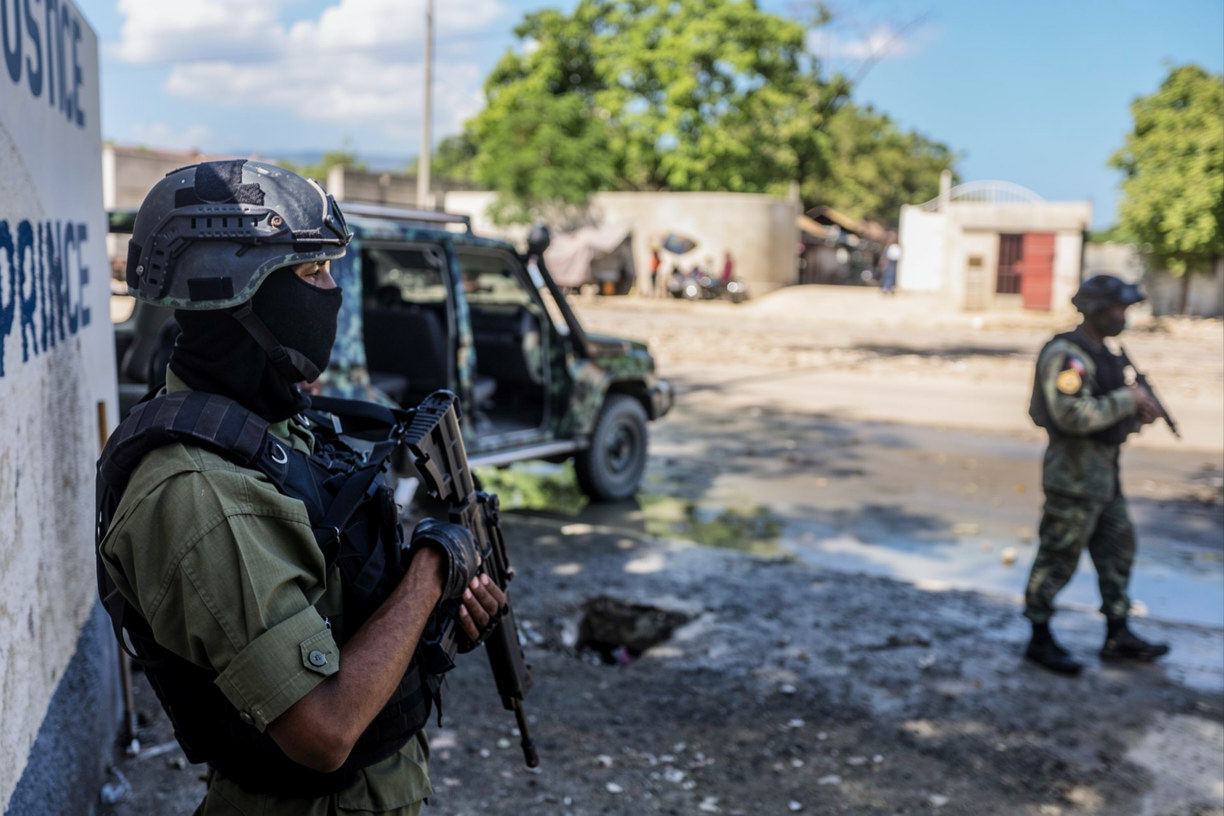
The famous maxim of Cicero, "Cedant arma togae, concedat laurea linguae" (Let arms yield to the toga and laurels to eloquence), resonates as a distant ideal in a country where the power of arms too often imposes the political calendar. While Haiti plunges into an unprecedented security and institutional crisis, marked by the grip of gangs and the use of lethal weapons, the Cicero aphorism embodies the great challenge of the current transition. It indeed calls for the triumph of civil legitimacy, law, and diplomacy over the law of arms and brute force. Yet, in 2026, transposing this adage into Haitian reality is rife with bitter irony. Worse yet, following the tumultuous dissolution of the Presidential Transition Council (CPT) in February 2026 and the indefinite postponement of the general elections by the Provisional Electoral Council (CEP) last October, the Haitian state finds itself increasingly paralyzed. The toga of justice and civil governance seems, ipso facto, powerless against the armaments of illegal armed groups, which control most of the territory and the capital. Furthermore, the rhetoric of political debates has silenced in favor of a persistent democratic void since the assassination of President Jovenel Moïse in July 2021. Even as the country endures the most devastating period in its history, this decision to transfer votes thus provides a striking lens through which to view contemporary Haitian reality.
I. The "Arms" in Power: A Sovereignty Confiscated by Terror
A posteriori, the national sovereignty of the Haitian state is nothing more than a theoretical illusion, as it is materially confiscated by the violence of criminal groups. In truth, they now control up to 90% of the capital, Port-au-Prince. Moreover, this territorial grip continues to alarmingly extend towards key departments essential for the country's economic survival, such as Artibonite and Centre. (Reports from the World Bank and Amnesty International: The World Bank and Amnesty International document the state's inability to uphold the rule of law, with the Haitian National Police (PNH) being massively understaffed and overwhelmed…).
The Grip of Armed Gangs
The security situation in Haiti is extremely critical, characterized by an almost total decay of state authority.
A priori, it is not the regular military forces that impose their law, but rather the coalitions of armed criminal gangs. Consequently, the local population finds itself trapped, as massacres, systematic rapes, and kidnappings for ransom brutally dictate its daily life.
Corruption as a Weapon of War on an International Scale
Simultaneously, it is important to note that Haitian banditry has now structured itself on an international scale so that the objective of gang leaders is not only to control the streets but to annihilate any customs, financial, or criminal control mechanisms that may hinder drug trafficking and arms smuggling. Wherever the rule of law tries to maintain a customs or court system, gangs employ a mix of aggressive corruption and physical elimination.
The Reign of Impunity and Absence of Accountability
Today, Haiti continues to face the structural reign of impunity and an almost total absence of accountability. Indeed, despite some efforts at institutional restructuring, the collapse of the judicial system and the grip of armed factions paralyze justice mechanisms. As a result, the majority of economic crimes and serious human rights violations remain unaddressed. While more than 5,700 people have been killed or injured in the first ten months of 2026, the penal system is now unable to investigate, judge, and sustainably incarcerate. (Official source: Minutes of the 37th meeting of the 63rd session of the UN Human Rights Council, published in early October 2026). Finally, the prisons themselves, when not directly stormed, suffer from total decrepitude, symbolizing the logistical and moral defeat of the judiciary.
The Failure of the Haitian National Police
Overwhelmed by now widespread violence, the Haitian National Police (PNH), timorous, can no longer cope alone, despite the support of the Gang Enforcement Force (FRG) backed by the UN. Nevertheless, international deployment remains significantly insufficient, with only 1,500 personnel on the ground compared to the initially planned 5,500. (The United Nations Support Office in Haiti (BANUH): Official statements from the head of BANUH, Daniela Kroslak, made in October 2026, confirm the operational figure of 1,500 personnel on the ground (notably in Port-au-Prince and Artibonite) and remind of the overall staffing objective). This is why brute force dictates its own law on a daily basis. Ultimately, the economy is completely paralyzed, and more than 1.5 million civilians are now forced into internal displacement.
II. The Ineptitude of Prime Minister Fils-Aimé and the Impossible Triumph of the "Toga" through the Ballot Box
At first glance, the most glaring evidence of this usurped power lies in the state's inability to organize a democratic transition. In reality, the current level of insecurity makes any electoral campaign or secure voting impossible, prolonging a total institutional void. It should be recalled that Haiti has not seen elections since 2016 and that its last president, assassinated in July 2021, has never been replaced.
As a consequence, the new postponement of the elections perfectly illustrates the current impotence of civil power to impose itself. This governmental ineptitude once again demonstrates the impossible triumph of courtroom garments through the ballot box in this context of security and institutional collapse. Simply put, the garb of peace is trapped by a ground reality where basic democratic rules cannot be applied.
Although the initial timetable scheduled the general elections in Haiti for December 13, 2026, the reality on the ground has just swept these forecasts aside. Indeed, the Provisional Electoral Council (CEP) officially announced the indefinite postponement of the voting on October 6, 2026. The authorities consequently cite the necessity to revise the schedule in light of an untenable security crisis and major logistical delays, as less than 800,000 voters have been able to register on the electoral rolls. (Le Devoir: The Quebec daily revisits the announcement from the Provisional Electoral Council (CEP) in Authorities postpone elections in Haiti, recalling the initial schedule which provided for the first round on December 13, 2026, and a second round on February 21, 2027).
As the list of presidential candidates attempts to take shape, the absence of public political offers remains glaring, making the analysis of national priorities all the more urgent. In this regard, the report from the World Bank published in September 2026, titled “Haiti: Growth Trajectories in the Face of Increased Risks,” stands out as essential reading for anyone aspiring to lead the country.
The Democratic Blockade
On one hand, the electoral authorities emphasize that the date of December 13 can no longer be held due to significant logistical and security challenges. On the other hand, the kakistocratic government of Interim Prime Minister Alix Didier Fils-Aimé is facing a major crisis, marked by the grip of gangs that paralyzes the delivery of electoral materials. Furthermore, less than 15% of potential voters have been able to register on the rolls, although the registration process continues officially. Additionally, the government published on October 6, 2026, a new version of the electoral decree in the newspaper Le Moniteur, removing some regulatory locks deemed too strict. Consequently, no new voting date has been communicated for the moment, prolonging the absence of democratic elections in Haiti since 2016. (Le National: Elections will not take place on December 13 - Edition of October 6, 2026).
The Suspended Right
The assertion that democratic institutions exist only on paper without elections is particularly true in contexts of institutional crisis. The opening of the judicial year 2026-2027 at the Court of Cassation symbolically reminds us of the importance of justice. However, in practice, the courts remain inoperative where the law of the strongest prevails. (Le Nouvelliste: Reopening of the courts: what justice for what results?)
III. “Laurels to Eloquence”: Restoring Voice and the Social Pact
Eloquence, in the Cicero sense, is not a vain rhetoric. Indeed, it represents democratic deliberation, diplomacy, and consensus. (Pierre Grimal, Cicero - Fayard, 1986). That is why, to rebuild the state, the Haitian political class and civil society must agree on a solid governance pact, even before hoping for credible elections. (The Agreement of April 3, 2024: This agreement laid the groundwork for the current Presidential Transition Council (CPT), illustrating the attempt of the political class and civil society to agree on a governance pact to stabilize the state).
To this end, Haiti must imperatively substitute dialogue and legal negotiation for the violence of arms by the end of 2026. In other words, rhetoric must now serve to build a historic consensus between civil society, political parties, and the Haitian private sector. Yet, as long as political speech is perceived as an instrument of corruption or distribution of state cake, it will lack the legitimacy necessary to disarm minds.
Concurrently, this loquacity must be that of the courts. The reconstruction of Haiti uncontroversially demands that gang leaders as well as their financial or political accomplices be brought to justice. Ultimately, the primacy of the toga implies subrogating the arbitrary of arms with the rigor of law and penalties.
So that finally, in Haiti, arms yield to the toga, Haitian actors and international partners must acknowledge that the election is not a miracle remedy, but rather the culmination of a republican restoration process. Indeed, the great challenge posed by the postponement of 2026 is not solely to set a new date on a fictional electoral calendar, but rather to restore the general interest and security sovereignty. However, as long as the Haitian state does not have the monopoly on legitimate force to protect its citizens, the garments of justice will remain eternally unfruitful in the face of the guns of gangs. This is why the challenge of post-2026 is to prevent the transition from becoming a permanent governance system, in order to gradually rebuild the physical and institutional conditions of democracy. Nevertheless, ensuring the triumph of the black robe (the law, justice, constitutional order) over artillery (the terror of gangs and political violence) requires prerequisites that the current transition authorities have not been able to gather, despite the mixed support of the UN-backed security mission. From this perspective, by postponing the vote, the CEP chose the principle of reality over the democratic illusion, thereby avoiding a facade vote that would have only added illegitimacy to chaos. Ultimately, the deep aspiration contained in Cicero's statement, let arms yield to the toga and laurels to eloquence, remains more than ever the unfinished great challenge of the Haitian transition.
