

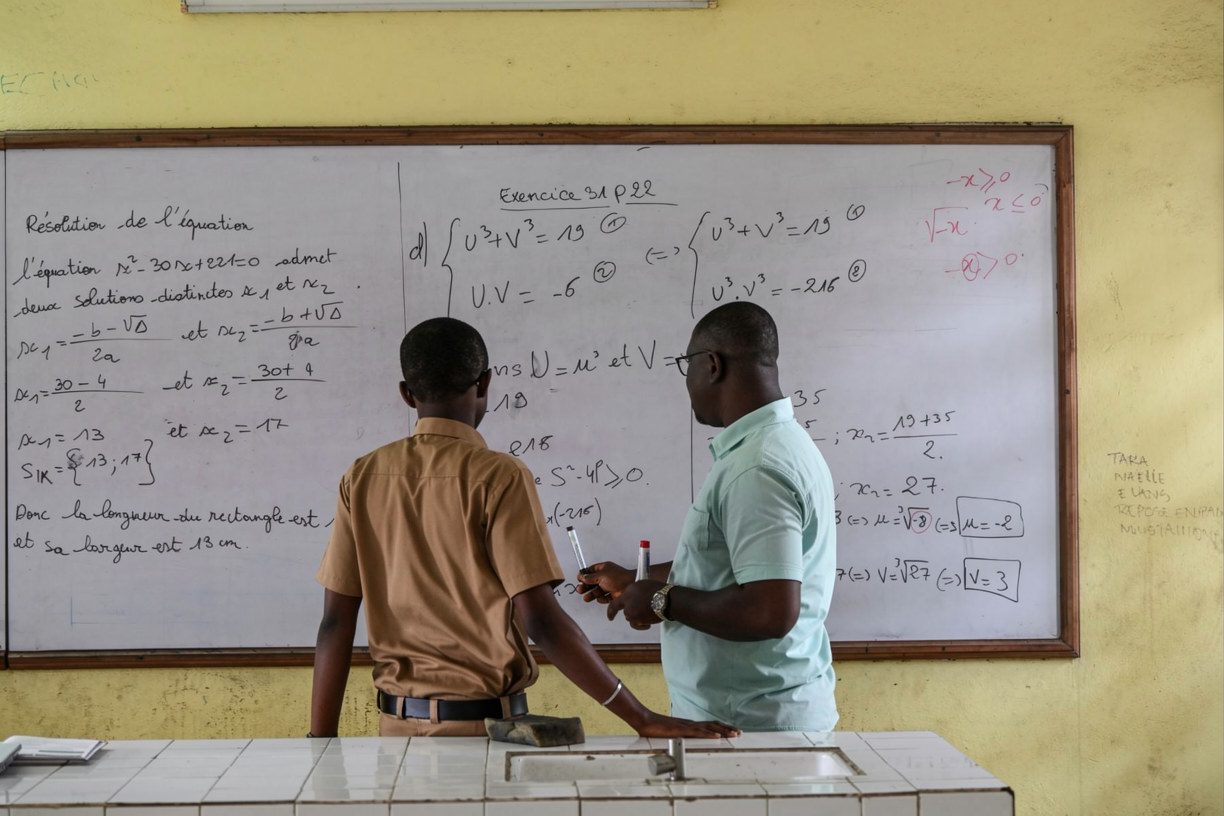
The new secondary education system aims to provide students with "the instruments, concepts and reference methods resulting from advances in science" and to prepare them "to adapt to the labor market and access higher or university education," as stated in the framework documents of the reform implemented by the Ministry of National Education and Vocational Training (MENFP) in September 2015. More than ten years after its generalization, a crucial question remains: have the expected results been achieved? Is there an evaluation mechanism in place to adjust the program? Are we not widening the gap between the level of mathematics in secondary education and that required by university education in the economic and social sciences (SES)?
The MENFP has developed, under the supervision of the Directorate of Secondary Education and the Multi-Sectoral Commission for the Implementation of the New Secondary Education System (COMINS), a renovation strategy titled Curriculum Orientation Framework (COC), accompanied by framework programs designed to facilitate its implementation. Three areas have been defined: general education, technological education, and pedagogical education. In 2007, a pilot project was launched in 100 public and private schools to experiment with the general education track, which includes four streams:
Mathematical and Physical Sciences (SMP);
Life and Earth Sciences (SVT);
Economic and Social Sciences (SES);
Languages, Literature and Arts (LLA).
In September 2015, the reformed secondary education system was generalized to all schools in the country. Beyond the constraints noted by astute observers, several indicators invite reflection on its effects in terms of university preparation, particularly in economic and social sciences. The gap between the prescribed content, the skills assessed in the baccalaureate, and the difficulties observed at university entry suggests that the announced objectives have not yet been fully achieved.
The first university year in Haiti, in scientific fields, is often considered a leveling year. Basic courses in mathematics and statistics are provided to bridge the gaps accumulated in secondary education. According to the objectives of the COC, the new secondary education was supposed to reduce this deficit. However, in the SES track, the observation is quite different.
In my teaching experience, many students aspiring to become economists experience significant difficulties in understanding basic concepts of mathematical analysis: functional relationships, limits, continuity, and differentiability. While I thought I was recalling the basics, they felt as if they were discovering new concepts. Their explanation often was: "Sir, it’s the SES track we followed in school." This field observation alone is not sufficient to measure the overall system, but it led me to examine the place accorded to mathematics in the program and in the SES baccalaureate exams.
The reform of the Haitian new secondary education has introduced an ambitious structuring of disciplinary content, including a specific mathematics program for the Economic and Social Sciences (SES) stream. Its content shows that students in this track study, over four years, a curriculum covering Algebra, Analysis, Statistics, Probability, Geometry, Trigonometry, as well as elements of matrix calculus and linear regression.
This curricular architecture demonstrates a desire to equip future economics students with a solid mathematical foundation. However, when comparing the program to the baccalaureate exams and then to international requirements for economic studies, several major anomalies and inconsistencies emerge. They weaken student preparation and jeopardize their transition to higher education. Four important observations deserve to be highlighted.
1. A Structural Anomaly in Baccalaureate Evaluation
This analysis focuses on the last five baccalaureate SES exams. For each, the text is divided into two main parts: i) part A comprising ten (10) compulsory questions covering all mathematics and statistics courses from NS4; ii) part B including five (5) exercises where the student must address three (3). These exercises relate to mathematical analysis, statistics, numerical sequences, probability, and complex numbers. The examination of the content of these tests reveals a major anomaly: the mathematical analysis exercise is optional. However, analysis is one of the most challenging branches for students. Once it is offered as an option, it loses its status as a pillar and becomes a subject that students strategically avoid starting from NS3.
This evaluation modality contradicts the founding principles of the reform, which aim to prepare learners for their higher education. Mathematical analysis is fundamental for economic studies; it cannot be optional. Economist Robert Lucas expresses this unequivocally: "Mathematical analysis is not one of the many ways to do economic theory: it is the only way. Economic theory is mathematical analysis. Everything else is just fluff and chatter." Analytical tools constitute the very language of microeconomics, dynamic macroeconomics, econometrics, and finance. Making analysis optional weakens students' conceptual foundation and creates a gap between secondary and university education, a gap already documented in several countries as a major source of dropout in the first year.
2. Linear Algebra: An Absent Pillar in Evaluation
The SES program includes essential concepts:
"Matrix calculus: sum, product, transpose, inverse" (NS3)
"Equations and systems of linear equations" (NS4)
However, no baccalaureate SES subject covers linear algebra. This absence is incomprehensible, as linear algebra is indispensable to econometrics, macroeconomics, and quantitative finance. Conversely, complex numbers, which are of no direct use in economics, appear in evaluations.
This observation perfectly illustrates the comments made by Fortenel Thélusma: "The reform exists in political speeches, in documents and programs produced by qualified technicians of the MENFP, but in practice, in the classroom, the Haitian school is still largely following the traditional model. The essential condition for true educational reform has not yet been met."
The analysis of mathematics tests in the baccalaureate SES reveals no orientation toward economic sciences except for the presence of a statistics exercise, which is also optional. Linear algebra, although present in the program, is completely absent from the evaluation.
3. A Complete Math Program But Disconnect from Economic Needs
The SES program covers:
Algebra: equations, linear systems, matrix calculus
Analysis: derivatives, limits, primitives, polynomial, exponential, logarithmic functions
Statistics: mean, variance, correlation, regression by least squares
Probability: binomial distribution, expectation, variance
Sequences: arithmetic, geometric, simple and compound interest
This program is coherent from a general mathematical perspective. It introduces essential notions for understanding economic phenomena: growth functions, dynamic models, statistical relationships between variables. It offers a detailed plan (Contents, Skills, Suggested Activities) of teaching units.
However, it remains generalist. The content is not explicitly related to the economic concepts that they allow for analysis: optimization, elasticities, production functions, demand models, economic regression.
Mathematical analysis here is descriptive rather than economic. Linear algebra is reduced to a technical calculation, without economic application.
4. A Worrying Delay Against International Standards
While it is true that the minimum skills program in the SES stream presents learning opportunities that meet certain conditions for the secondary-tertiary transition, their coverage and completeness are the main challenges of the new Haitian secondary education. In several educational systems where secondary pathways explicitly prepare for economic studies, certain concepts useful for economics must be covered such as: diagonalization, partial derivatives, integral calculus, optimization, and probability laws. These contents are indispensable.
As Simon & Blume remind us in Mathematics for Economists: "Modern economics rests on mathematical foundations; without mathematical analysis and linear algebra, the heart of economic theory becomes inaccessible." Paul Samuelson adds: "The introduction of mathematical analysis in economics was not a luxury, but a necessity: it allowed the discipline to become a science based on precise reasoning." These quotes show that analysis and linear algebra are not optional additions: they constitute the grammar of modern economics.
The Haitian SES program provides several notions useful for economic studies, but their presence in the curriculum does not guarantee either effective teaching or mastery. The problem highlighted here primarily concerns the alignment between three levels: the prescribed content, classroom practices, and the skills assessed in the baccalaureate. When analysis can be avoided in the exam and linear algebra does not appear, the pedagogical incentives risk diverting students and teachers from concepts that are indeed included in the program. This gap compromises Haitian students' ability to follow courses in microeconomics, macroeconomics, econometrics, quantitative finance, management, or data science.
5. Recommendations for a Coherent and Sustainable Reform in the SES Stream
To better align the SES stream with the requirements of higher education in economics, the reform should simultaneously address the curriculum, pedagogical practices, and evaluation. The priority adjustments consist of ensuring the assessment of fundamental skills, linking mathematical notions to economic applications, reviewing the weighting of mathematics, and organizing sustainable consultation between the MENFP, secondary school teachers, and the relevant faculties. Below are four recommendations for a more serious preparation of students for economic studies.
1. Make Analysis and Linear Algebra Mandatory in the Baccalaureate SES
These two branches are central to microeconomics, macroeconomics, econometrics, and finance. Their mandatory status would ensure that all students master the fundamental tools before entering university.
2. Introduce a Real Applied Linear Algebra
This is not about burdening the program but about linking matrices and vectors to concrete economic models: equilibrium equation systems, input-output models, multiple regression, variance-covariance matrices.
3. Increase the Weight of Mathematics in the Baccalaureate SES
The current weight of 200 points seems insufficient given the importance of mathematics in pursuing studies in economics. It is inconceivable to place mathematics at the same weighting level as philosophy, Creole, and English or Spanish. It should be increased from 200 to 300 points to better reflect this importance.
4. Create a Module “Applied Mathematics to Economics”
This module could be co-constructed with economics faculties to ensure a smooth transition from secondary mathematics to service mathematics for economic sciences. It would link mathematical theory to economic practice.
Conclusion: For an Alignment Between Secondary and University
The Haitian curriculum shows high ambition, but the articulation between program, teaching, and evaluation does not yet equip students with the mathematical means to realize it. When mathematical analysis can be avoided in the baccalaureate and linear algebra is not evaluated, a gap widens between prescribed skills and those effectively consolidated before university entry. The choice of notions, their sequencing, and their weight in evaluations must therefore be re-examined based on data on exams, classroom practices, and difficulties encountered in the first year. As it stands, the system does not sufficiently show how it articulates the utility and scope of mathematics in secondary and university education.
Contemporary economics is a mathematized discipline. As Samuelson reminds us, calculation is not a luxury but a necessity. If Haiti wishes to train a generation of economists capable of understanding, modeling, and transforming the national economy, it is essential to strengthen the mathematical foundation of secondary education. This is a crucial condition to reduce disparities in levels, improve university success, and position the country within the global dynamics of economic sciences.
Curriculum Orientation Framework of the MENFP
Framework document of the MENFP programs
Minimum skills program, Mathematics, Secondary IV, SES Series, MENFP
Ricardo Lambert, The New Secondary: Mirage and Reality
Fortenel THELUSMA, The Haitian Educational System Between Basic School and Reformed Secondary Education: Reform or Mirage?
Ida Landgärds-Tarvoll, Understanding the Challenges of the Secondary-Tertiary Transition in Mathematics for Economics in Higher Education: A Literature Review
Ida Landgärds-Tarvoll, Bridging the Gap: Curriculum Development Addressing the Transition into Mathematics in Economics Education
Baccalaureate Exam Papers (2021-2026)
