

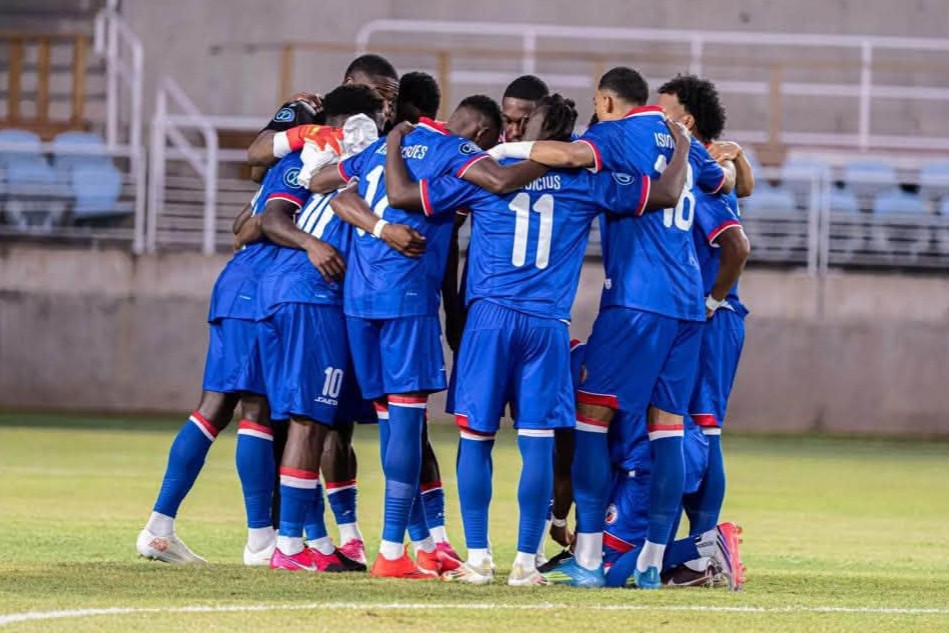
The recent victory of Haiti over the Dominican Republic by four goals to one, on Dominican soil, should have remained what it initially was: a remarkable moment of football, a demonstration of talent from our Grenadiers, and a legitimate source of pride for a people who receive very few good news today.<\/p>
But once again, something much deeper has intruded into the sport.<\/p>
Incidents reportedly occurred at the entrance of the stadium, where a crowd movement, largely made up of Haitian supporters, allegedly forced and damaged a barrier to access the stands. If violations were committed, they must be condemned and treated as such. However, it is essential to maintain a sense of proportion. Since when does a crowd management incident in a stadium justify a sanction affecting, indiscriminately and permanently, players or an entire national community?<\/p>
A second incident quickly took on a political dimension. According to reported information, the Haitian-born player Wilson Isidor allegedly made a statement referencing the island and Haiti. This remark provoked a strong reaction from the Dominican side. Following this, Dominican Sports Minister Kelvin Cruz reportedly announced a measure prohibiting Haitian players from performing on Dominican territory, a position later supported by President Luis Abinader.<\/p>
If this decision and its scope have been reported accurately, they would be not only disproportionate but extremely revealing. One does not respond to a damaged barrier or a phrase uttered in the euphoria of a sports victory with a collective measure targeting athletes based on their nationality. Such a response transcends football. It inevitably brings us back to the weight of history and the identity tensions that have plagued the island for nearly two centuries.<\/p>
A HISTORY THAT CANNOT BE ERASED<\/p>
Between 1822 and 1844, under Jean-Pierre Boyer, the entire island was governed from Port-au-Prince. The Dominican Republic traces its national independence to its separation from Haiti in 1844, and this period still occupies a central place in its national narrative.<\/p>
It is essential, however, to be precise about the subsequent history. In 1861, Dominican President Pedro Santana placed his country again under Spanish sovereignty. When Dominicans launched their War of Restoration, from 1863 to 1865, to oust Spain, Haiti provided significant support to Dominican restorationists. In other words, the history of our two peoples is much more complex than the simplistic narrative of an eternal hostility.<\/p>
Yet, in certain Dominican ultranationalist currents, the episode of 1822–1844 continues to be mobilized as a matrix for a more contemporary anti-Haitian discourse. Historian Ernesto Sagás, in Race and Politics in the Dominican Republic, has extensively studied the construction of anti-Haitianism as a political ideology. The works of Richard Lee Turits, notably on the 1937 massacre, also show how race, nationalism, border, and authoritarianism intertwined in 20th-century Dominican politics.<\/p>
It is precisely this past that makes certain current reactions particularly alarming.<\/p>
1937: MEMORY CANNOT BE SELECTIVE<\/p>
Under the dictatorship of Rafael Leónidas Trujillo, thousands of Haitians and Dominicans of Haitian descent were massacred in October 1937 in the border regions. Estimates vary significantly depending on the sources, generally ranging from several thousand to about twenty thousand dead, with some assessments exceeding that figure.<\/p>
This episode, often referred to as the Parsley Massacre, is neither a Haitian invention nor a militant exaggeration. It is abundantly documented by historians.<\/p>
Trujillo transformed anti-Haitianism, colorism, and a racialized conception of Dominican identity into instruments of power. This policy did not, by itself, create all the prejudices existing in Dominican society, but it institutionalized and politically exploited them.<\/p>
This is why contemporary policies toward Haitian migrants cannot be viewed as if they suddenly emerged in a historical void.<\/p>
IMMIGRATION AS A POLITICAL WEAPON<\/p>
Luis Abinader has made Haitian immigration one of the major themes of his policy. His government has multiplied deportation operations, strengthened the border, and adopted extremely harsh measures against Haitian migrants. International organizations and human rights advocates have repeatedly reported allegations of mistreatment, racial profiling, family separations, and expedited procedures during certain expulsions.<\/p>
The Dominican Republic, like any sovereign state, obviously has the right to control its borders and enforce its immigration laws. But sovereignty does not mean permission to humiliate, racialize, or dehumanize.<\/p>
This is the fundamental difference.<\/p>
When every diplomatic crisis, every bilateral tension, or now every sporting incident seems to lead to a measure targeting Haitians, it becomes legitimate to ask whether immigration has not become a particularly convenient political weapon.<\/p>
And that is precisely what concerns me in this matter.<\/p>
DOUBLE STANDARDS?<\/p>
The Dominican government has shown itself to be deeply offended by the phrase attributed to Wilson Isidor. Very well. A state can condemn words it considers offensive or provocative.<\/p>
But where is that same indignation when an openly contemptuous discourse targets Haitians?<\/p>
A Dominican influencer, Santiago Matías, reportedly published a statement whose meaning, as it circulated, amounted to asserting that Dominicans had "invaded Haiti," built their hotels on our beaches, controlled our trade, and turned Haitians into slaves.<\/p>
In my opinion, these remarks are infinitely more severe than a cry uttered by a football player in the excitement of a victory.<\/p>
Why would a phrase attributed to a Haitian player provoke a spectacular official reaction, while a discourse invoking the domination and enslavement of a neighboring people does not elicit the same condemnation?<\/p>
It is even permissible to wonder if some influencers do not publicly express what some ultranationalist fringes think more discreetly.<\/p>
That is the real problem.<\/p>
AND PORT-AU-PRINCE, STILL SILENT<\/p>
But it would be too easy to look only at the other side of the border.<\/p>
Where is the Haitian government?<\/p>
As this controversy erupted, no reaction commensurate with the stakes seemed to come from the highest authorities. Aside from limited communication from the Haitian consular representation, neither Prime Minister Alix Didier Fils-Aimé nor the directly concerned officials from Foreign Affairs or Sports seemed to have publicly defended the dignity of Haitian athletes and citizens with force.<\/p>
Once again, the Haitian people seem to be left to fend for themselves.<\/p>
This attitude is unfortunately not new. Too often, in the face of the Dominican Republic, some Haitian officials seem to adopt a posture resembling diplomatic submission.<\/p>
A responsible state does not need to insult its neighbor. It also does not need to provoke unnecessarily. But it must know how to say no when the dignity of its citizens is attacked.<\/p>
Diplomacy is not servility. Moderation is not silence. And peace between two peoples cannot be built on the permanent humiliation of one of them.<\/p>
FOOTBALL SHOULD HAVE REMAINED FOOTBALL<\/p>
What makes this matter particularly regrettable is that we should have been talking today about our Grenadiers.<\/p>
We should have been talking about their discipline, their talent, this brilliant 4–1 victory, achieved away from home in front of a passionate crowd. Instead, we are talking about bans, immigration, nationalism, and hostility. And perhaps it is precisely here that the true political success of this disproportionate response lies: it has shifted the focus.<\/p>
Instead of celebrating the greatness of our team, we are now debating sanctions and borders. Instead of talking about the field, we are discussing migration policy.<\/p>
The sporting spectacle has been hijacked.<\/p>
TWO PEOPLES ARE NOT CONDEMNED TO HATE EACH OTHER<\/p>
Nonetheless, I refuse to conflate the Dominican people with the ultranationalist sectors that claim to speak on their behalf.<\/p>
I lived for several months in the Dominican Republic. I met respectful, generous Dominicans who are deeply supportive of Haitians. Dominicans have publicly denounced the mistreatment of their neighbors. Citizens, religious leaders, intellectuals, and human rights organizations have taken a stand against xenophobia.<\/p>
The problem is therefore not simply "Dominicans versus Haitians." The problem lies in the ability of certain political leaders and ultranationalist movements to transform prejudice into political capital.<\/p>
That is what must be denounced. We must not bow our heads.<\/p>
THE TIME OF DIGNITY<\/p>
When the residents of Ouanaminthe decided to continue the construction of the canal on the Massacre River despite pressures, they reminded us of something essential: a people abandoned by its leaders can still choose to defend its interests and dignity.<\/p>
Even today, Haitians will need to exhibit that same determination. Not in hatred. Not in violence. But in organization, historical consciousness, solidarity, and firm assertion of our sovereignty.<\/p>
Our two peoples are condemned by geography to share the same island. They can choose to do so in permanent confrontation or in mutual respect. But respect can never be one-sided.<\/p>
Haiti does not ask for privilege. Haitians do not ask to be allowed to violate the laws of a neighboring country. We simply demand what every dignified people demands: that our citizens be treated as human beings, that our athletes not be collectively punished for individual incidents, and that our country never be regarded as a nation that can be humiliated without consequence.<\/p>
Our Grenadiers spoke on the field.<\/p>
Four goals to one.<\/p>
It is now up to our leaders to find their voice outside a football field. And for the Haitian people to never forget their own. We can live as neighbors. We can even become true partners. But the dignity of Haiti is non-negotiable.<\/p>
— Georges Bossous, Jr. is a psychotherapist by profession. He is a founding member and president of the Vertières Foundation. He is also the founder of Word and Action, Inc. and the Haitian American Leadership Initiative, Inc. An engaged host, he is the director of the weekly OPINION show broadcast on Radio Mega. A social justice activist, respected political analyst, and influential voice in the Haitian media landscape and the diaspora, Bossous uses his expertise to serve the truth, social change, and the collective memory of Haiti.<\/p>
