

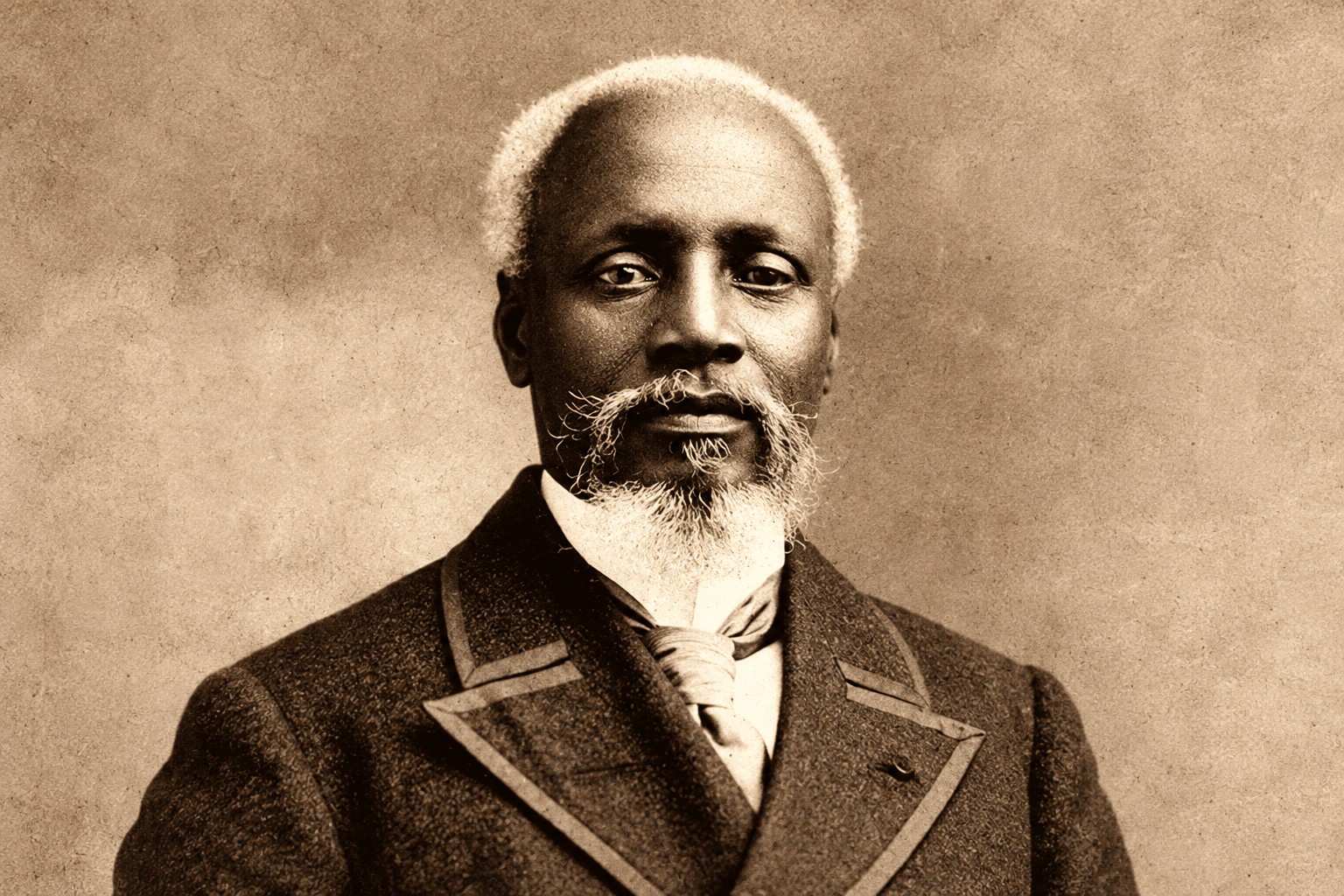
Intellectual, statesman, and 19th-century Haitian anthropologist, Anténor Firmin holds a unique place in the history of political and decolonial thought in Haiti. Born in a fragile post-independence context constantly threatened by Western imperial ambitions, the politician devoted his writings and political action to the defense of his homeland. For him, the "homeland" is not just a simple geographical concept or a passive legal entity. It symbolizes a moral ideal inasmuch as it serves as a bulwark for national sovereignty, while asserting itself as the exceptional laboratory for the rehabilitation of the black race in the eyes of the world. Thus, by standing firm in 1891 against American military pressures for control of Môle Saint-Nicolas, Firmin proved that his love of the homeland did not exist without dignity and absolute independence. Therefore, one might ask how the anthropologist's conception of the homeland manages to articulate the safeguarding of local sovereignty with a universal struggle for human equality? This analysis will first highlight Firmin's defensive and diplomatic patriotism in the face of imperialism. It will then examine his vision of an internal regeneration of the nation through education, good governance, and civic duty. Finally, it will demonstrate how, in the mind of the statesman, the value and success of Haitian homeland carry a major historical responsibility for the emancipation of the entire black diaspora. (Firmin, Anténor. (1891). Haiti from a Political, Administrative and Economic Perspective. Paris: F. Pichon).
A. Anténor Firmin's Defensive and Diplomatic Patriotism embodies a rigorous doctrine of preserving Haitian national sovereignty. Active at the end of the 19th century and the beginning of the 20th century, this prominent ethnologist devised a unique strategy to immunize Haiti against the rising imperialism of great powers, particularly the expansionism of the United States. Thus, his approach is structured around three main points:
1. Diplomatic Firmness: The Môle Saint-Nicolas Affair (1891)
The pinnacle of Firmin's defensive patriotism on the ground occurs when he serves as Minister of Foreign Affairs under the presidency of Florvil Hyppolite. At that time, supported by their naval fleet, the United States demanded control of Môle Saint-Nicolas, either through cession or lease, to establish a strategic military base there. On the Haitian side, Firmin categorically and skillfully refused the American negotiators. Thanks to his legal mastery and composure, he defused the crisis without provoking armed conflict, embodying pure resistance diplomacy. Consequently, he strictly relied on international law and the Haitian Constitution which, at the time, prohibited the alienation of territory. (Firmin, Anténor. Letter of refusal regarding the request for leasing Môle Saint-Nicolas (Official diplomatic correspondence of April 22, 1891).
2. Preventive and Doctrinal Patriotism
For Firmin, diplomacy must be guided by intellectual clarity. In his magnum opus On the Equality of Human Races (1885), he asserts that the small republic of Haiti bears a tremendous responsibility: to prove to the entire world the regenerative capabilities and civilization of the black race in the face of Western racism. In his political writings, he declared: “Shame on all those who, forgetting their duty to the homeland, call upon foreigners.” In clear terms, patriotism becomes an absolute moral imperative and a bulwark against imperialism. The ability to organize as a homeland and to feel a patriotic sentiment is not the exclusive domain of a "superior race," but a universal attribute of the human condition.
Moreover, in his testamentary essay The Effort in Evil (1911), Firmin theorizes that national sovereignty cannot hold if institutions collapse from within. This is why, in 1905, he wrote: “If we continue to devour each other, to ruin our finances, to insult our laws, to debase our flag, it is not the strength of our independence that will triumph, but the silent appeal to a foreign hand.”
In other words, Firmin's patriotism is not blind. He warns that chronic political instability, corruption, and civil wars in Haiti are the "red carpet" that will invite foreign imperialism under the pretext of restoring order. Protecting the nation, according to him, thus required profound moral and administrative reform.
3. Antilleanism as a Geopolitical Shield
Aware of the power asymmetry between small Caribbean nations and Western empires, the statesman promotes a patriotism extended to the regional scale. This is why, in dialogue with figures like Cuban patriot José Martí, Firmin advocates for the creation of an Antillean Confederation uniting the Greater Antilles, namely Haiti, Cuba, the Dominican Republic, and Puerto Rico. (Diana Cantón Otaño, Joseph Auguste Anténor Firmin: His Historical Links with Cuba, CIDIHCA Editions. This work by a Cuban diplomat specifically analyzes the ideological convergence, patriotism, and shared anti-imperialist struggles between Anténor Firmin and José Martí).
The fundamental goal of this approach was to constitute a solidary bloc capable, on the one hand, of countering European colonial ambitions as well as American hegemony. On the other hand, this union aimed to unify their diplomatic voices to fully allow them to exist on the international stage.
B. For the Haitian intellectual and politician Anténor Firmin, the renowned author of On the Equality of Human Races (1885), the rehabilitation of black peoples in the face of Western pseudo-scientific racism could not be disconnected from an internal regeneration of the Haitian nation. Convinced that Haiti had to be the showcase of the black man's ability to govern himself, he theorized a national recovery based on three indivisible pillars: education, good governance, and civic duty.
1. Education: The Engine of Popular Emancipation
For Anténor Firmin, education is not just an intellectual luxury, but rather a weapon of sovereignty and the main tool for leveling opportunities. Indeed, he asserts that a people cannot progress under an authoritarian regime, stating that: “Despotism is nothing other than moral slavery: it leaves freedom of movement to the feet and hands; but it chains and throttles the human soul.” This is why democratic ethics entails the categorical refusal of political arbitrariness and tyranny, as the latter destroy the natural elasticity and dynamism of society.
Having himself been an inspector of schools, Firmin lamented the gap between the urban elite and the peasant masses regarding universal access and education for the masses. According to him, a nation cannot rise if the majority of its population is kept in ignorance. Therefore, he denounced the systematic exclusion of the popular masses by the intellectual elites. Thus, for moral and democratic principles to come alive, public education must imperatively serve as an emancipation tool. It is precisely by developing the intellectual and civic abilities of each citizen that civil society becomes capable of fully participating in public life and subsequently holding its leaders accountable. This democratic urgency is illustrated by his historical warning: “It will take one of two things: either Haiti falls under foreign domination, or it resolutely adopts the principles for which I have always fought and struggled.” (The Effort in Evil, 1911).
Moreover, to build a strong society, the intellectual considered that educating the youth was the only means to shield the country from internal political manipulation as well as from imperialist interference. As he wrote in On the Equality of Human Races: “It is only by educating the youth that we can build a strong society capable of resisting external pressures and internal divisions.”
2. Good Governance: Institutional Reform and Refusal of Corruption
Anténor Firmin fiercely fought against the political practices of his time, which were marked by militarism, anarchy, instability, and financial corruption. This is why, in his major work M. Roosevelt, President of the United States and the Republic of Haiti (1905), he lays the foundations of a doctrinal anti-imperialism.
Furthermore, as Minister of Finance and Foreign Affairs, he proved through facts that a rigorous management of public funds was possible, thanks to modernization and administrative integrity. His vision of governance, therefore, hinged on transparency, respect for the law, and the cleansing of the economy to effectively combat the waste of national resources.
Moreover, as Minister of Finance and Foreign Affairs, he proved, through modernization and administrative integrity, that a rigorous management of public funds was possible. His vision of governance, therefore, hinged on transparency, respect for the law, and the cleansing of the economy against the waste of national resources.
He also advocated, through inclusion and development, for a democratic transition where political institutions would no longer serve the interests of an oligarchy or a military clan but would resolutely turn toward the development of the popular masses. (Anténor Firmin, between the sword and the pen or On the Equality of Human Races,” film directed by Arnold Antonin, 2024).
3. Civic Duty: The Cult of the Common Good Against Prejudice and Selfishness
The regeneration of Haiti required, according to Firmin, a profound moral reform and the emergence of genuine civic consciousness. In the first place, he attacked the internal divisions of Haitian society, notably the “color prejudice,” the tensions between mulatto and black elites inherited from colonization. Indeed, this social poison, in his patriotic conception, shattered national cohesion and thereby hampered any collective action. (Desormeaux, Daniel. (2016). The Literary Factor in Anténor Firmin's On the Equality of Human Races, L'Esprit Créateur, Vol. 56, No. 1.).
Secondly, this moral reform had to be through constructive patriotism. This is why Firminist civic duty is expressed through dedication to the homeland, a sense of responsibility, and respect for public affairs. Ultimately, he called for substituting the politics of arms and personal ambitions with a politics of ideas, so that each citizen becomes aware of their role in the elevation of the nation.
C. According to Haitian intellectual Anténor Firmin, the political, moral, and social success of Haiti is an indispensable condition to prove the regenerating capacity of the black race and guide the emancipation of its entire diaspora. In his magnum opus On the Equality of Human Races (1885), Firmin assigns to the Haitian homeland a lighthouse role and a major historical duty through this brief analysis of his philosophical vision emphasized on these three strategic lines.
1. Haiti as Living Proof of Human Equality
The Haitian politician, Anténor Firmin, presents Haiti as the living and irrefutable proof of human equality. By directly opposing European “scientific racism” of the time, particularly embodied by Arthur de Gobineau's essay on the inequality of races, he makes the history and accomplishments of the Republic of Haiti the factual pillar of his anthropological demonstration.
2. A Moral Responsibility Towards the Black World
From the outset, the Minister of Foreign Affairs argues that the Haitian people do not wholly belong to themselves, as they are the custodians of the dignity of all the oppressed of their race. Consequently, if Haiti fails to modernize or falls into instability, its detractors will immediately use this pretext to justify colonization in Africa as well as the segregation of the diaspora in America. This is why Haiti's success is not only a national issue, but a moral obligation to validate the global emancipation of black humanity.
3. The Cradle of Modern Pan-Africanism
Although Africa is historically and culturally recognized as the original cradle of humanity, the birth of the transnational political solidarity movement, first termed “pan-negroism” before becoming modern pan-Africanism, emerged at the end of the 19th century through what historians call the “Atlantic triangle” (Caribbean, Americas, Europe).
It is in this context that Haitian intellectual Anténor Firmin imposes himself as a leading figure of this intellectual dynamic. Indeed, by placing the history of the Haitian Revolution, carried by figures like Toussaint Louverture and Jean-Jacques Dessalines, at the center of the rehabilitation of the black man, Firmin becomes one of the very first thinkers of pan-Africanism.
In conclusion, for Anténor Firmin, the value of the homeland transcends mere emotional attachment or chauvinism to rise to the level of a moral, scientific, and universal mission. Through his major works, particularly On the Equality of Human Races (1885), the defense of his homeland, Haiti, is inseparable from the rehabilitation of the entire black race in the face of 19th-century Western scientific racism. For the journalist and statesman, loving one's homeland implies a double duty: to fiercely struggle internally against ignorance, corruption, and the excesses of elites to build a modern state and to resist externally against imperialism to preserve national sovereignty. Although the foreign influence contradicts Firminist philosophy on the value of the homeland, the fact that Haitian actors await it to dialogue, negotiate, and share power is even more concerning. Since they have systematically asked outsiders to arbitrate their conflicts and oversee their elections, they have ended up normalizing this intrusion. This is why foreign intervention is no longer simply endured or invited, but has transformed into an unavoidable necessity. In clear terms, Firmin's legacy reminds us that the true value of a nation is measured by its ability to educate its people, to triumph over social justice, and to serve as a beacon for universal freedom.
Bibliographic References
They are rather inserted into the text, more specifically, in the appropriate paragraphs.
